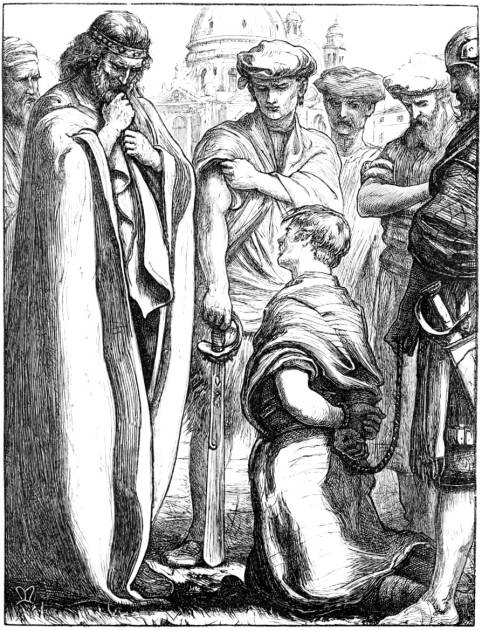
The parable this week is “The Unforgiving Servant” and is taken from Matthew 18:21-35. Chapter 18 primarily deals with the issues of repentance and forgiveness. The preceding text for this parable (Matthew 18:15-20) sets the context necessary to decode the parable. The text reads…
“If your brother sins against you, go and tell him his fault, between you and him alone. If he listens to you, you have gained your brother. But if he does not listen, take one or two others along with you, that every charge may be established by the evidence of two or three witnesses. If he refuses to listen to them, tell it to the church. And if he refuses to listen even to the church, let him be to you as a Gentile and a tax collector. Truly, I say to you, whatever you bind on earth shall be bound in heaven, and whatever you loose on earth shall be loosed in heaven. Again I say to you, if two of you agree on earth about anything they ask, it will be done for them by my Father in heaven. For where two or three are gathered in my name, there am I among them.”
Thus Peter responds in verse 21.
Then Peter came up and said to him, “Lord, how often will my brother sin against me, and I forgive him? As many as seven times?”
Peter’s response is more astute than many modern teachers give him credit for. The typical commentary puts forth the the idea that Peter is attempting to tie Jesus down to a particular number of times forgiveness can be given. Peter’s question concerning forgiving someone 7 times speaks volumes to this when understood in Jewish context. Jewish tradition taught that forgiveness for an offense could only be extended 3 times. After that, the requirement to absolve another had expired. This idea was taken from Amos 1:3, 2:6 & Job 33:29-30. Therefore Peter is more than doubling the grace previously offered. This is solid evidence that Peter does have an initial grasp on what Jesus is teaching.
Jesus’ response further proves this idea in verse 22…
Jesus said to him, “I do not say to you seven times, but seventy-seven times.
If Peter was on the wrong track or his heart was in the wrong place, Jesus would have most certainly rebuked him, instead Jesus’ response is one of magnified agreeance. Jesus, in effect, is saying that Peter is right and urging him to not stop at 7 times, but proceed to a number so large that one loses count. Peter is picking up the grace talk that Jesus is laying down. He just failed to realize how unfathomable God’s grace truly is.
To help Peter and the other disciples understand this, Jesus tells a parable.
“Therefore the kingdom of heaven may be compared to a king who wished to settle accounts with his servants. When he began to settle, one was brought to him who owed him ten thousand talents. And since he could not pay, his master ordered him to be sold, with his wife and children and all that he had, and payment to be made. So the servant fell on his knees, imploring him, ‘Have patience with me, and I will pay you everything.’ And out of pity for him, the master of that servant released him and forgave him the debt. But when that same servant went out, he found one of his fellow servants who owed him a hundred denarii, and seizing him, he began to choke him, saying, ‘Pay what you owe.’ So his fellow servant fell down and pleaded with him, ‘Have patience with me, and I will pay you.’ He refused and went and put him in prison until he should pay the debt. When his fellow servants saw what had taken place, they were greatly distressed, and they went and reported to their master all that had taken place. Then his master summoned him and said to him, ‘You wicked servant! I forgave you all that debt because you pleaded with me. And should not you have had mercy on your fellow servant, as I had mercy on you?’ And in anger his master delivered him to the jailers, until he should pay all his debt. So also my heavenly Father will do to every one of you, if you do not forgive your brother from your heart.”
In the parable, Jesus begins his picture by likening an earthly king and his kingdom to the Kingdom of Heaven. It is revealed that this King has servants who are indebted to him. The King at this time wishes to settle these debts. The king is not shown to be unreasonable but instead is both just (in that he wishes to settle what is owed him) and gracious (in that he had previously extended time to pay). A servant was brought to him that owed 10,000 talents. This would be equivalent about $165,017,300 today. $165 million dollars. The servant, of course, cannot pay. Therefore the King demands all that the servant has as payment, not because it will equal the debt, but because it’s all that he has. This means that the man and his family would be sold into slavery along with all of his possessions. This was a culturally common means of debt restitution in first century AD (precedence can be found in Leviticus 25:39 & 47, Exodus 22:3, 2 Kings 4:1, Nehemiah 5:5, Isaiah 50:1, Amos 2:6 & 8:6).
In response to this the servant falls to his knees at the feet of the king and begs the King to be patient with him. He says that he will do what ever he can to pay the king back. Luther writes…
“Before the king drew him to account, he had no conscience does not feel the debt and cared nothing about it. But now that the king reckons with him, he begins to feel the debt. So it is with us. The greater part does not concern itself about sin, goes on securely, fears not the wrath of God. Such people cannot come to the forgiveness of sin, for they do not realize that they have sins. they say indeed, with the mouth, that they have sin; but if they were serious about it they would speak far otherwise. This servant, too, says, before the king reckons with him, so much I owe to my lord, namely ten thousand talents; but he goes ahead and laughs. But now that the reckoning is held, and his lord orders him, his wife, his children and everything to be sold, now he feels it. So, too, we feel in earnest when our sins are revealed in the heart., when the record of our debts is held before us, then the laughter stops. Then we exclaim: I am the most miserable man, there is none as unfortunate as I on the earth. Such knowledge makes me a real humble man, works contrition, so that one can come to the forgiveness of sins.”
Luther, as usual, is correct. Even though the servant knew he had accrued a sizable debt, he didn’t care. It was not until the king summoned him to collect the debt that servant because cognizant of staggering gravity of his situation. It was at this point that the servant begged and pleaded for patience. The response of the servant to fall down and petition the king was initiated by the King’s verdict, not by the servant. The servant didn’t enter into the kings presence petitioning on his knees, nor did he initiate the petition,but the petition flowed from the dire realization of his situation. It hit him like a ton of bricks. Notice that the man doesn’t argue with the king. He doesn’t place the blame on the king. He accepts his sentence as just, but asks for short-term clemency in the form of patience. The king, knowing full well that no amount of time could be granted that would allow this man to make arrangements to pay off his enormous debt, has pity on the servant. This picture is the perfect example of us when we come to a realization of our sin. R.C.H. Lenski writes…
It is correct psychology when Jesus lets this debtor beg for time and promise to pay the vast debt. This is the first though that comes to the sinner. He does not at once realize the enormity of his guilt and, as Luther says, cannot actually think that God will actually forgive it all but imagines he must pay it off and in his fright promises to do it. The law at once does not produce its full effect…God is just and must confront us with our sin; but he is equally compassionate and full of grace and ready to remit our sins. Now the moment the sinner realizes his sin, confesses it and turns to God, God pardons the guilt.
Therefore, our response is the same. When confronted with the vastness of our sin, our natural reaction is to try to pay it off ourselves. We make lists and seek help from those touting books on “5 steps to this” or “10 steps to do that.” The simple answer is that there is nothing that we could ever do to begin to pay of our debt. It is simply insurmountable. However, the king, in his great mercy, forgives the debt. Take a few minutes and consider the weight of that verdict. Could you imagine owing 165 million dollars to a king and since you could not pay, all of your family and possessions are sold. Everything you know will be gone, including your freedom. Then, mercifully, the king, completely forgives the debt. What unspeakable joy. What a burden lifted.
An important point here is that although the debt is forgiven from the man, the king still took the hit. He was justly owed that money. Pardoning the servant doesn’t end with the king getting 10,000 talents. This is where Jesus shows up in the story. This is the picture of the cross. The servant was only pardoned because the merciful king took the debt upon himself. The guilt of the debt was removed from the servant and placed upon Christ. This was just one servant. Imagine every human to ever be conceived. Imagine that each owes 165 billion dollars. Try to fathom the weight that Christ took upon himself on the cross. Do you begin to see how triumphant, impenetrable and perfectly merciful our God is? He bore the sins of the world in our place. For us. We were indebted to him because of our sin. He forgave the debt and paid for it himself upon the cross. The resurrection is the assurance that our collective debt was paid in full.
So this servant, now debt free, goes off singing and thanking the king right?!?
Absolutely not. As soon as he is pardoned, he goes down to a brother that owes him 100 denarii (1 denarii is equivalent to a days pay at US minimum wage ($60) so we are talking about $6000) and grabs him by the neck demanding his money in full! When the man pleaded with him in similar fashion, he had him thrown in jail until he could pay! What an outrage! This man who was just forgiven a debt he could never pay, goes directly out and violently demands immediate payment on the relatively small sum owed to him and has him thrown into prison until he can pay in full. This is not mercy. This is not grace. This is not love. However, sadly this is the picture of us and our brothers more times than not. God has forgiven each of us an insurmountable debt in which we could never pay. We are free from the burden and guilt of sin. However, when our brothers sin against us we are quick to act similarly by demanding they pay for their actions as we continue to hold grudges against them. We want justice! We want recompense! We want exonerated! How quickly we forget the debt in which we were forgiven. This is gravely serious to our God. When Jesus teaches us how to pray in Matthew 6, verse 12 specifically points to this.
“and forgive us our debts, as we also have forgiven our debtors.”
You see, if we are unwilling to forgive those who have sinned against us, then the Father in heaven will be unwilling to forgive us of our sins. And that is precisely how this parable ends. The king is told of the wretched behavior of the servant who was forgiven much and he is once again brought before the king. This time the king hands him over to the jailors until he can pay in full. Jesus closes by saying that our heavenly Father will do likewise to those who do not forgive their brother from their heart. My friends, this is a serious offense. We have each been forgiven much and therefore we should forgive much. However you have been hurt by a brother, the amount you are owed is infinitely less than the amount in which God the Father has forgiven you through his Son Jesus Christ. In Luke 7:47, a woman of ill repute anoints the feet of Jesus with nard. The Pharisees are amazed at this seemingly wasteful act. Jesus’ reply echoes the theme of this parable when he says “Therefore I tell you, her sins, which are many, are forgiven—for she loved much. But he who is forgiven little, loves little.” It is my encouragement for you to forgive as you have been forgiven.