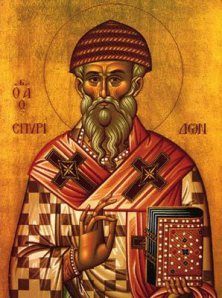
 Cyril was an early fifth century Patriarch of Alexandria, serving from 412 to 444. Cyril was most known for his Christological disputes with Nestorius which lead to his involvement at the first council of Ephesus (431) and resulted the in deposition of Nestorius as Patriarch of Constantinople. The dispute dealt with the hypostatic union and centered on whether the virgin Mary could be called Theotokos (God-bearer) or Christotokos (Christ-bearer). Nestorius coined Christotokos (Christ-bearer) seeking to find middle ground between those who deny the full deity of Jesus and those who affirm it. This view lead to both Nestorius and his phrase Christotokos being ruled as heretical in Canon’s 1-5 at the first Council of Ephesus. Cyril was known to be a prolific writer and thankfully, many of his works have survived antiquity. He wrote much on the trinity and the hypostaic union as well as several commentaries on the Old Testament, the Gospel of Luke and the Gospel of John. The first volume of a modern English translation of his commentary on the Gospel of John (translated by David R. Maxwell and edited by Joel C. Elowsky) was recently released (and can be found here). Today’s selection is taken from this very work as found in “Book 1” on pages 4 through 6.
God has instructed the thought of the holy Evangelists, and it is truly precise. From a hill or a lookout post, as it were, they scan with an eagle eye in every direction for something to benefit their hearers. With intense zeal, they track down what they think would profit those who thirst for the true exposition of divine teachings and who search with good intentions for the meaning hidden in the Holy Scriptures. The Spirit does not reveal the truth to those who spend too much effort preparing for battle and who exult in tangled and deceptive arguments rather than rejoice in the truth. That is because the Spirit does not “enter a deceitful soul,” nor does he otherwise allow his precious pearls to be rolled under the feet of swine. Instead, he would rather spend his time with simple minds because they move without guile and avoid superfluous sophistry. Such sophistry leads to senselessness and a departure from the straight royal road because one leans too far to the right. “For the one who walks simply, walks surely,” as Solomon says.
The holy Evangelists have a precision in their writing that is quite amazing because they are not the ones who are speaking, as Savior says, but the Spirit of the Father who is in them. One might with good reason say that the composition of the book of John far surpasses even wonder itself when one looks at the excellence of his thoughts, the sharpness of his his reasoning and the unceasing introduction of one idea after another. The Evangelists are like a team of horses in the interpretation of divine teaching that has left the starting gate and is racing towards one goal. The character of the discourse, however, is put together differently for each of them. It seems to me that they are like people who are ordered to assemble in one city but by no means are to travel by one and the same route. One can see that the other Evangelists provide a precise account of our Savior’s genealogy according to the flesh. They trace the descendants in order from Abraham down to Joseph, or they go from Joseph back up to Adam. But the blessed John is not overly concerned about these matters. he harnesses the lightening-hot motion of hid thoughts to reach for subjects that are beyond human comprehension. He dares to narrate the ineffable and unutterable birth of God the Word, knowing that the “glory of God hides speech” and that the dignity that benefits God is greater than all out thought and speech. The properties of the divine nature are difficult to utter and even more difficult to explain clearly.
Yet it was necessary in some way to measure heaven with a span and, using the small measurements of human nature, to turn and approach things that are hard for everyone to understand and explain. That way, the road may not be left wide open for false teachers to assail those who are simpler. Since none of the sayings of the saints who have become “eyewitnesses and servants of the word fetter the evil ideas of such teachers, John gets right to the point, to the chief of all divine doctrines. “In the beginning was the Word,” he cries, “and the Word was with God, and the Word was God. He was in the beginning with God.”
I think that those who are engaged with the Holy Scriptures need to approach all writings that might be good, noble and free from harm. In this way, by gathering what many people have observed from various points of view about the same thing, and by bringing them all to bear on one point, they will climb to a good measure of knowledge. The will imitate the bee, a wise worker, and build the sweet honeycomb of the Spirit.
Some of those who study these matters most intensely say that after our Savior’s crucifixion and ascension into heaven, certain false shepherds and false teachers fell on the savior’s flock like wild beasts and threw them into great turmoil. They spoke “from their own hearts,” as it is written, “and not from the mouth of the Lord,” or rather, not only from their own heart but also from the teaching of their father, who is clearly the devil. (For no one can say, “Jesus is cursed,” except by Beelzeboul, how could our claim about their father not be true?) What teachings then did these people belch up in opposition to their own head? They ignorantly and impiously insisted that the only begotten Word of God, the eternal light, in whom we all move and have our being, was first called into being when he was born as man of the holy virgin. After taking this ordinary form, he “was seen on earth,” as it is written “and dwelt with humanity.” As for those who were disposed this way and who dared to slander the ineffable and eternal generation of the Son, the word of the prophets commands them, “Come here, you lawless sons, you seed of adulterers and a prostitute. Whom did you ridicule? At whom did you open your mouth and stick out your tongue?” Clearly, your tongue is not bringing out good things from a good heart but is spewing the venom of the bloodstained serpent whom the psalmist references when he says to the one God who is over all, “You have crushed the heads of the serpent on the water.”
There was no small disturbance about these matters among the believers, and the consequences of the scandal, were consuming the souls of the simple like a plague. Some were dragged away from the true teachings by the nonsense of these teachers and believed that the Word was first called into existence when he became human. Therefore, those of the faithful who were wiser gathered together and met together about this. They went to the Savior’s disciple (I mean of course John himself) and told him about the disease that was afflicting him the brothers, and they disclosed the nonsense of the heterodox teachers. They then urged hi to come to their aid with all his might by the illumination of the Spirit and to stretch out a saving hand to those already caught in the nets of the devil. The disciple grieved over the lost, whose minds had been corrupted, and he thought it would be equally catastrophic not to give some forethought to future generations. So he risked writing a book. He left to the other Evangelists the task of explaining the humans legal and natural birth according to the flesh, while he himself pronounced with fire and vigor on the nonsense of those false teachers, saying…
“In the beginning was the Word.”
Cyril of Alexandria – Commentary on John