forgiveness of sins

The Bride of Christ Needs Counseling…

I’m thankful that I’m married.

Watching my single friends run through the gambit of 21st century dating etiquette allows me to feel all the more blessed.

The onslaught of what is considered culturally acceptable on social media platforms boggles the mind as many freely expose the dark taboo-ish corners of their lives in an effort to gain attention through individualism and avant garde living.  I’m amazed at what is considered “commonplace” in the arena of social media.  Passive aggressive girlfriends who, with their forked tongues, speak slander and praise as an attempt to manipulate their way through relationships.  Misogynist man-boys who’s goal is to mark their territory and expand their imaginary empires by the means of lies, deception and emotional thievery.  This formerly sealed off corner now has the spotlight through the likes of  reality TV and no-holds-barred social media.  The landscape is hostile, lawless and ultimately narcissistic.

This paradigm shift makes me all the more satisfied that I not only have a wife, but that I love her and find security and assurance in our relationship.  Sure neither of us are close to being perfect and our relationship has its ups and downs, but as I watch while others openly live their lives in the public forum, I began to entertain a thought.  What would the bride of Christ, which is the church, look like within the confines of  modern day social media?  Do we look passive aggressive?  Do we jump into the relationship just to strip-mine the benefits for ourselves and then bail?  Are we emotionally unbalanced?  What is our current mental state?  I recently read an article on “Ask Men” titled “10 signs she’s crazy.”  In the article the author lays out 10 signs that you might be dating someone who is crazy and when I compared the list to the current state of the Church, the results were scary.

10. Controls Narrative

We like to be the one that controls the narrative.  So often, God’s word is conformed to our worldview instead of our worldview being conformed to God’s word.  We control this narrative through many ways such as the purpose and direction of the church service, how worship is viewed and a strange view of what prayer actually is.  I could spend much time delving into how the modern church is embracing culture instead of maintaining its position as counter-cultural, but for the sake of time I’m going to focus on prayer.  Prayer is often viewed as a literal conversation between us and God.  In the personal setting many are instructed to find a quiet room, talk to God and wait in silence until he answers.  This is the perceived “conversation” that many Christians expect.  However, this is not the biblical definition of prayer.  Prayer is simply talking to God, through Jesus.  The perfect picture of this is found in the Old Testament where the high priest would offer prayers for the people and would burn incense to represent the prayers ascending to God. Interestingly enough, the smoke never descended back to the people. Nor did it change back to incense and audibly reply. This is because prayer is not like our earthly conversations.  We should not expect an answer directly from God, but instead should seek answers in his word.  That is how God speaks to us.  Prayer is not a conversation.  Look at the Psalms.  David was a prophet and how many of his prayers were conversational?  Jesus is God and taught us how to pray in Matthew 6 and Mark 11.  Jesus’ prayer doesn’t end “…and deliver us from evil and answer me back to let me know if I should date Cindy.” The Lord’s Prayer was given because it shows God’s precise will for each of our lives.  It’s not that Cindy doesn’t matter, but that if you are honestly praying the contents of the Lord’s prayer, then you will trust that his will be done.  I am not saying that God could not talk directly to us, only that direct revelation is not normative. The modern church correctly takes its every need and desire to God, as directed through scripture, but controls dialogue when answers are sought outside the appropriate method of response, given by God, which is through his word.   The answers to our prayers will ultimately be answered as God perfectly reveals his will in his perfect time.

9. Self Aggrandizing

There is so much self importance placed upon the individual that Christ is left as a supporting cast member instead the lead actor.  This happens often as many sermons are set up to make us feel important.  These days, it’s more important to make people feel like they have purpose than to show them they are a sinner in desperate need of salvation.  I mean, who wants to feel bad about themselves? Many pastors subtly engage in this behavior by reading themselves into the biblical texts.  When the narrative of David and Goliath is the Sunday text, the pastor compares the congregations life to that of David and accordingly asks them to identify the “Goliath” in their lives.  This belittling of the biblical narrative not only takes our eyes off of Christ and his scarlet thread through the old testament, but feeds our inner narcissist as we suddenly have the power to slay our giants of guilt, debt or anger.  The problem is that Goliath was a real Philistine giant not a projection of our problems.  The bible is not about us.  The bible is about Jesus and what he has done FOR us.  All things point to him and we can rest in what he has accomplished in our place.  The bible isn’t a self help book that leads us on a path to self actualization, but instead is a book enables us to die to self as we place our faith in Christ Jesus, Emmanuel, that came, bled, died and rose again for our justification.  The church should be aggrandizing it’s groom, Jesus, not itself.

8. Hates other women

How often do Christians look down on unbelievers living in exposed sin?  How often are our lives lived as if we are sinning less and less while the world around us are way worse sinners than we are?  Have you ever caught yourself feeling pretty good on the inside when a person that annoys you gets caught in sin?  Have you ever had a person tailgate you for 10 miles until you move over and let them pass only to think “I hope there’s a cop up there waiting to give them a ticket” as if you never speed?  How about realizing that you are sinning by not speeding because your motive for driving under the limit is fueled by greed instead of a desire to serve Christ through obedience? How often do we look like Pharisees on both the inside and out. This attitude against unbelievers is true hatred.  Love would come along side them.  Love is not haughty.  Love would not discount the damage and and ugliness of their sin, but would point to Christ as the one who died and rose again for those sins.  Love would point to repentance, not as a process to perfection, but as a realization of complete inability to please God apart from the work of Jesus Christ.  True love doesn’t hate others through haughty eyes that see the spec in their neighbor’s eye while missing the plank in their own.  We often harbor hatred for others because of our own insecurities.  We may have been deeply, personally hurt by a particular sin of others and now paint those with even a hint of that sin with the broad brush of reprobation. We often hate because we see what we don’t like about ourselves or our experiences in others.  That sin is just as damning as the sin committed against us because both sins are in opposition to God.  This is precisely what 1 John 4:20 is talking about.

7. Isolates herself

How many times do we like to hang out in our comfortable groups, speaking Christianese as a way to protect ourselves against the trials and tribulations of this world.  This is not only unhealthy for us, it is also hypocritical.  Hanging out with “only” Christians as we isolate ourselves not only implies superiority, but also projects an unloving attitude.  This attitude will reveal itself in the places in which we are in contact with the largest population of unbelievers…which is usually our work environments.  Our unbelieving co-workers are curious as to why we claim to be Christians, but fail to show them any love or always turn them down when they extend an invitation.  The mission field is wherever our vocation is.  Every time we head into the office, job site or the onto the production floor we carry the torch of Christianity through our thought, word and deed.  The same goes for when we visit others work places as we dine in restaurants, pick up our children at daycare and interact with others at the grocery store. The world doesn’t need to see us in our collective groups of dissociation.  The world needs to hear the comfort of the full proclamation of the gospel message.  The world needs to know that we struggle just as they struggle, but that our faith and hope lay in the one who came and died for the sins of the world instead of faith in our works.  Isolation is not an adjective that defines the Christian life.

6. Weird about Exes

We are pretty weird about our exes.  Our exes in this case are the idols that we used to (and continue) to exalt in place of God.  These idols could be food, comfort, luxury, pietism, other people…really anything.  As Calvin famously said, our hearts are idol factories.  This being the case, we are weird about them.  We struggle to call them what they are. We often run back to them in an attempt to satisfy the longings of our sinful flesh.  It’s a weird coping mechanism. On one hand we hate and renounce them while on the other, we secretly love and cling to them.  Our God is a jealous God who doesn’t desire to interact with our former crushes.  He wishes to exterminate them and call them out for what they really are…false securities of our sinful flesh.

5. False Accusations

Many times in an effort to comfort ourselves, we project our shortcomings onto our loved ones.  When we see the things that we hate so much about ourselves in other people we tend to harp on it.  This is an interesting paradigm when compared to our relationship with Christ.  How many times, in our sin, have we said “Well you made me this way.”  How often to we project our shortcomings onto Christ as if he is responsible for our condition. The interesting twist is that even though he is not responsible for our condition, he did willingly and actively take our place on the cross.  He bore each and everyone of our sins that we falsely blame him for to earn our pardon.  He defeated death and the false accusations which to him were very real, true and painful as he suffered and died only to rise again for our justification.

4. Shaves her head

We are attention seekers.  We really love attention even if it’s negative.  We do weird things in order to steal the spotlight.  Many times these weird things are a blemish to the name of Christ. We do many of these attention seeking acts in the name of relevance with the tag line “If it could only save one person…” as our qualifier.  We shave our heads by attempting to make the worship service “entertaining.”  This could be as ridiculous as an arena rock service with smoke machines and laser lights or as head scratching as a Mixed Martial Arts Fight Church (I am not lying.  This is a real thing).  This is akin to the girlfriend that always acts outrageous as a means to gain acceptance, while her boyfriend stands at the side shaking his head in disgust.  Once again the church is and always will be counter-cultural.  It’s not counter-cultural to draw attention to itself because it’s an attention seeker, but because we have been given a true picture of what the church should look like in scripture and it’s never been bright lights and parties to draw in unbelievers.  For 120 years Noah preached the word to all who would hear.  Scripture doesn’t tell us that Noah offered free drinks, a rock concert and a MMA fight to get people into the Ark.  He simply preached the word.  Sure the Ark was a spectacle. A spectacle of ridicule instead of relevance.  The same Ark that he was ridiculed for building, is the same Ark that God used to save him and the only 7 others in the world that believed God’s word, which were Noah’s family.  We shouldn’t figuratively shave our heads to focus the attention on us, but instead should stay with the outline that Scripture gives us and focus the spotlight on Jesus Christ.  Anything we do to steal the spotlight, will take our eyes off of him.

3. Hits below the belt

This can either be a literal kick or an verbal spar.  Either are equally painful.  Angry and hateful comments about our family or lack of success should be off limits to our spouses, but sometimes find themselves fair game in the heat of battle. The church utilizes these cheap shots against our Lord and Savior when we deny the efficacy of the sacraments.  Jesus, through his word, promises to be present and offer gifts through baptism, the Lord’s Supper, and absolution of sin.  When the church, through many denominations, deny what Jesus proclaims using arguments of fallen reason, it is a hit below the belt.  Jesus offers to meet us and give himself to us through these particular means and many reject them because it doesn’t fit within their comfort zone or desired understanding.  I am sure that some will take exception with this, but think about it for a moment.  If the sacraments are truly efficacious, as I believe the word clearly proclaims, then rejecting them on any basis would be a supreme low blow to the one offering his presence and gifts.

2. Contradicts herself

This deals with the sad fact that many Christians that I run into, couldn’t explain their faith if their life depended on it.  Jay Leno used to have a segment called “man on the street” where random tourists outside his studio would be asked insanely simple questions and fail to give the correct answer.  If we did a similar experiment in many of our churches, I hypothesize that the results would be similar.  This is a major issue because those participating in Jay Leno’s segment aren’t making a knowledge or affiliated claim before being subjected to the simple questions whereas those in the church are claiming fellowship and thus should know something substantive about what they believe.  This does not mean that each and every Christian should be able to succinctly wax eloquent on the hypostatic union, but should at minimal, be able to defend the faith they claim to lay hold of.  When we don’t know what we believe, we become walking and talking contradictions.  These contradictions are easy to spot and make us easy picking for false teachings and teachers who will gladly guide us to apostasy.  Could you imagine a marriage where the wife has only superficial knowledge of her husband?  Could you imagine the confusion and utter amazement of the husband for how clueless his wife really is?  It doesn’t take Sherlock Holmes to figure out that the relationship is based off of what the bride can “get” instead of actual genuine, sacrificial love.

1. Other crazy people think she’s crazy

Atheists and agnostics are quick to point out all the craziness that was pointed out in the previous 9 signs.  While I am fine with a self-proclaimed atheist or agnostic calling me crazy if I am proclaiming the truth of the gospel, (1 Corinthians 1:18 tells us that the message of the cross is foolishness to those who are perishing) it’s a whole other story to behave in the fashion of the “signs” listed above and be justly labeled crazy.  There is a difference.  Accept the label of foolishness for the message of the cross, not because you exhibit behavior found in the above “signs” of craziness.

Is this what the true bride of Christ looks like or is this some doppelganger infiltrating the ranks of Christendom?  As much as I would like to lay the blame on an evil twin, scripture gives us picture of what we look like and it’s messy.  Throughout scripture the church is compared to a prostitute.  Our story is more  desperate than we’d like to admit.  This doesn’t mean that we are supposed to give up and give into our sin nature as scripture also gives us a picture of what we should strive to look like.  We will continually fall short of the goal, but his grace gifted to us is what gives life to the striving.  We have been redeemed.  Purchased for a price.  Bought and freed from the bounds of sin, death, and the devil.  Our groom is the text-book example of loving and puts up with our garbage as he continues to strengthen and encourage our faith in him through word and sacrament.  So yes we have many problems and need counseling. Yet, even though we are trapped in these earthen vessels, we can look forward with faith, hope and love to our wedding day when we are finally united with our groom who gave it all for us so that we can have freedom in him.  We are the treasure in the field.
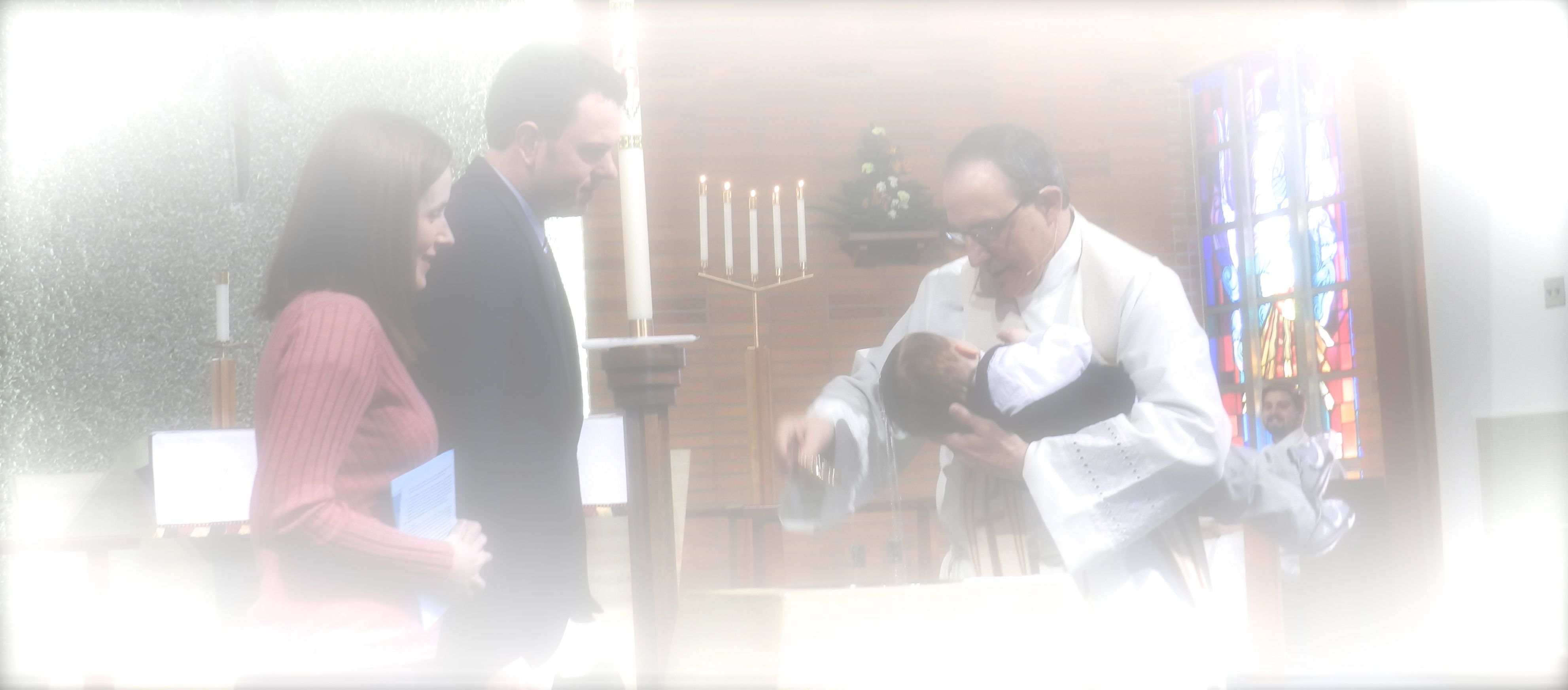
Christian Baptism Series – Part 6 – Should Infants Be Baptized?

Dylan Baptism

Should Infants Be Baptized?

It has been established by the previous posts in this series that baptism actually does something.  It gifts forgiveness of sins and the Holy Spirit.  If the scriptural promise attached to baptism is true, then the question of  nessecity arises concerning whether infants need the gifts offered.  Do infants need forgiveness of sins?  Are they born perfect or are they born sinful?

Romans 5:12
“Therefore, just as sin came into the world through one man, and death through sin, and so death spread to all men because all sinned”

Job 15:14
What is man, that he can be pure? Or he who is born of a woman, that he can be righteous?

Psalm 51:5
Behold, I was brought forth in iniquity, and in sin did my mother conceive me

John 3:6
That which is born of the flesh is flesh and that which is born of the Spirit is spirit.

Ephesians 2:3
among whom we all once lived in the passions of our flesh, carrying out the desires of the body and the mind, and were by nature children of wrath, like the rest of mankind.

These verses paint a rather dire situation for anyone born of flesh (with Christ Jesus being the lone exception).  Infants may not be able to rob a bank, tell a lie or covet their neighbors Ferrari, but the seed of Adam is ever present within us all from the point of conception forward.  The fall has infected us to the core.  Sin has no prejudice. Like a pit viper, it inflicts it’s poisoness effect without regard for gender, race, status or age in hopes of certain death for it’s victim.  The anti-venom is only found in the blood of Jesus Christ.  So yes, it is quite evident that infants need what baptism offers.  They need forgiveness of sin.  This may be shocking or a hard teaching for many, but within historical Christianity, there wasn’t even a debate about this. The earliest teaching resembling the doctrine of believers’ baptism didn’t arise until the 1520’s when the Zwickau Prophets organized to protest Martin Luther. These “prophets” came out of the early stages of the radical reformation.  They taught that the Holy Spirit reveals all that is needed, directly, to the individual apart from the word.  Therefore they taught that the bible was not authoritative. This claim was in opposition to Luther’s teaching of sola scriptura.  Their defense of denying sola scriptura stated that if the Bible was indeed authoritative, then God would have dropped it directly out of the sky. Since the bible was written by mere men, it couldn’t attain the status of divine authorship or authority.  On the other hand, they taught that God dropped the Holy Spirit out of the sky and implanted him into all believers and therefore, authoritative truth proceeds solely from believers.  Because of this view, they divorced what the scriptures said concerning many things, including baptism, and created their own views based on their supposed direct revelations. They severely opposed infant baptism and affirmed believers’ baptism based on these direct revelations.  Following in the baptismal steps of the Zwickau Prophets the radical reformation moved forward through the likes of Anabaptist groups like the Hutterites and Mennonites.  Unlike the Zwickau Prophets, these groups affirmed Sola Scriptura, however since the Bible didn’t explicitly say “baptize infants” they rejected infant baptism through the claim of Sola Scriptura. Many controversies and separations continued as this new teaching of symbolic adult baptism continued to spread.  Other groups were also influenced by the radical reformation which resulted in the English separatist movement in the 17th century which birthed denominations like the Baptists.  The position of the Radical Reformation came out of a stark desire to distance themselves as far away from Rome as possible as they believed Luther’s error was that he did not go far enough.

Therefore the baptismal continuum looks something like this. From 30AD to 1525AD, baptism was taught to be regenerative and for all regardless of age, then a split started with the birth of the radical reformation around 1525 that produced 3 alternative views resulting in 4 major branches; Regenerative baptism for all ages, non-regenerative baptism for all ages, regenerative believers baptism and believers baptism as a symbol. There is a major problem with this as it would mean that for approximately 1500 years Jesus would leave His church completely misinformed and lost in the woods concerning one of only two things that He instituted in Matthew 28:19-20. For there to be a misuse, there has to be an initial correct use. If I am misusing a wrench, there had to first be a correct use for which the wrench was intended before misuse can be entertained. Concerning baptism, history reveals unity in appropriate use and function for 1500 years, followed by 500 years of proper use alongside misuse. The church fathers are rather clear in their position as they repeatedly affirm regenerative baptism for all ages. If the church fathers that carried the torch of Christianity through the first 5 centuries alone are studied, it is clear that infant baptism is the standard, accepted, unquestioned, professed and proclaimed view amongst the church. There was no discussion concerning age requirements for baptism apart from whether baptism should occur on or before the eighth day. That debate was quickly extinguished by Cyprian of Carthage in 253AD when he suggested that the day doesn’t matter, just do it as soon as possible. Here is a list of solid, sound church fathers who affirm regenerative baptism as a means of grace for people of all ages…

1st Century – Barnabus and Hermas
2nd Century – Irenaeus, Theophilus of Antioch, Clement of Alexandria & Justin Martyr
3rd Century – Tertullian, Cyprian of Carthage and Hippoytus
4th Century – Gregory of Nazianz, John Chrysostom, Basil the Great, Ambrose of Milan, Aphraahat the Persian, Cyril of Jerusalem, Athanasius, Eusibius of Caesarea and Jerome
5th Century – Augustine, Theodore of Mopsuestia and Severian of Gabala,

Now that the historical ground work has been laid for regenerative baptism for all ages, what does scripture say?

Matthew 28:19-20
Go therefore and make disciples of all nations, baptizing them in the name of the Father and of the Son and of the Holy Spirit, teaching them to observe all that I have commanded you. And behold, I am with you always, to the end of the age

This verse issues a directive to make disciples of all nations. This is to be done by baptizing and teaching the word.  The qualifier in the statement hinges on what is meant by “nations.” Webster defines it as “a territorial division containing a body of people of one or more nationalities and usually characterized by relatively large size and independent status.” This is a pretty standard definition. The primary subject that defines a nation is “people.” “People” is nondescript. The word “people”, in its generic use (which is how it is used in this context), has no age description. People, I contend, are people from conception to death. The verse does not say make disciples of all men, or women or all people except infants and small children. It says make disciples of all nations. Infants are included when the census is taken. Citizenship is granted as a birthright. This is as inclusive as it gets.

Galatians 3:28-29
There is neither Jew nor Greek, there is neither slave nor free, there is no male and female, for you are all one in Christ Jesus. And if you are Christ’s, then you are Abraham’s offspring, heirs according to promise.

This verse is also purposefully written to be inclusive. Paul is stating that salvation is for all as there is no hierarchy or limits to who can be saved. Once again, if the Holy Spirit though Paul wished to exclude small children and infants, said exclusion would have been part of the text. The fact that this verse goes to great lengths to be inclusive is proof positive. Each of the categories that Paul mentions could refer to an infant or the elderly, therefore the necessity for such language is unnecessary.  Once again the full inclusivity of Christ is presented.

Acts 2:38-39
And Peter said to them, “Repent and be baptized every one of you in the name of Jesus Christ for the forgiveness of your sins, and you will receive the gift of the Holy Spirit. For the promise is for you and for your children and for all who are far off, everyone whom the Lord our God calls to himself.”

This response by Peter is to those at the Day of Pentecost sermon when they realize Jesus’ blood was on their hands.  The text says they were cut to the core and asked Peter what they needed to do to be saved. Once again, an enormously inclusive verse is given. One particular argument that I have heard is that Peter is really saying that “you and your children”  is descriptive of “the Jews” and that “all who are far off” describes the “gentiles” therefore the “you and your children” section should not be taken literally. This is shortsighted eisegesis. It is true that both Jews and gentiles are included in the statement as there is a great crowd at Pentecost full of both Jews and various gentile nations (thus the necessity for tongue speaking and translators). Peter is simply preaching what he was told in Matthew 28:19-20. Peter is making disciples through the method in which Jesus commanded him. This crowd was precisely “you and your children and for all who are far off…” All nations were present in the crowd. There were adults, parents, children, infants, brothers, sisters, aunts, uncles, nephews, nieces, fathers, mothers and cousins. These were people of all ages. Peter once again does not exclude anyone from baptism. He says it is for you and for your children and for all who are far off, for as many as the Lord will call unto himself. The verse when taken literally includes everyone present.  If the verse is present only figuratively (as the argument claims) then this verse, by nature, becomes exclusive.  There are no liguistic, historical or theological reasons that necessitate reading this verse other than literally.  This verse clearly states that baptism is “for” the forgiveness of sins and the gift of the Holy Spirit, therefore the promise is made to all who need it which includes “you and your children” as were present at Pentecost and are still present today. This leads us to the next verses…

Matthew 19:13-15
Then children were brought to him that he might lay his hands on them and pray. The disciples rebuked the people, but Jesus said, “Let the little children come to me and do not hinder them, for to such belongs the kingdom of heaven.” And he laid his hands on them and went away.

Luke 18:15-17
Now they were bringing even infants to him that he might touch them. And when the disciples saw it, they rebuked them. But Jesus called them to him, saying, “Let the children come to me, and do not hinder them, for to such belongs the kingdom of God. Truly, I say to you, whoever does not receive the kingdom of God like a child shall not enter it.”

There are a couple things that need to be pointed out here. To properly understand what is going one must look to the koine Greek word for children used in these passages. Matthew uses παιδία (paidia) which means small child.  Paida is somewhat broad as it can be either an infant or a young toddler.  Luke uses the word βρέφη (brephē) which is more precise and means “suckling infant.’  This word is used 8 times in scripture and always identifies the child as being as young as possible.  For instance Luke uses this same word to describe John the Baptist in utero when he lept with joy inside of Elizabeth when Mary shared the news of her immaculate conception.  It is crystal clear that this verse is speaking about infants and very small children.  When these parents were bringing their small children to Jesus, the disciples rebuked them.  Jesus, however, overturned their rebuke and let the children come to Him without hindrance.  These children cannot come to Jesus apart from their parents carrying them because they are so small.  Jesus desires these small children to be brought to him, therefore the question today becomes how do our small infant children come to Jesus? They can’t be brought to a physical Jesus as in the gospel narratives because Jesus has ascended and we are waiting on His return. The answer is found in where Jesus promises to be for his church (word and sacrament), therefore, they are brought to Jesus in the waters of baptism. One of the claims of those who affirm believers’ baptism is that infants cannot repent or have faith because they cannot comprehend such things. The issue is that apart from Christ neither can we. Age is not something that lessens sins stranglehold and according to these verses, age actually does the opposite by increasing sins grip. I didn’t come to Christ because of anything I did and more specifically not because I turned a particular age or ascended to a certain mental capacity.  It was 100% Christ finding me and carrying me home. Because of Jesus, I was gifted with repentance, salvation and the Holy Spirit. I did zero to earn it. Apart from Christ I could not even desire repentance, let alone salvation, I could only despise it. Once again  Romans 10:17 states that faith comes by hearing the Word. Infants can hear from within the womb. There is Psalm 22:9 where David confesses faith while nursing.  Also in Luke 1:15, John the Baptist was filled with the Holy Spirit from the womb. To be filled with the Holy Spirit is to have faith. Lastly, baptism gifts the Holy Spirit (Acts 2:28-39).  If the Holy Spirit is within someone, faith must also be present in order to receive the gift.  Therefore if faith isn’t present before baptism, the word and water will create the faith necessary to receive the gift promised by the word through the waters of holy baptism. Considering all of this, I am most perplexed that many who fight the abortion culture war in this country, that ascribe so much to life at conception (and rightly so) by exalting so high the temporal gift of life, yet completely wash away the spiritual blessings and promises that God has made to and for our infant children by the word through the waters of baptism.

So now the question is raised concerning what this means. Is it certain salvation? The answer to this is actually rather simple.  The answer is to believe God and His promises. To clarify that statement, baptism is a means of grace just like the audible teaching of the Word is a means of grace. Just as there are those who reject the teaching of of the word, there too will be those who will reject the promises gifted in baptism.  The word is always efficacious (capable of producing an effect), but not always effective (producing an effect). Baptism is the same. The mysteries of God must be acknowledged in that that God sometimes allows his will to be thwarted (e.g. the anguished words of Jesus regarding Jerusalem: “How often would I have gathered your children together as a hen gathers her brood under her wings, and you would not!”). What gets us turned around so easily is that we constantly confuse God’s certainty of promise keeping with our proclivity for promise breaking. God is offering a promise in baptism just like he is offering a promise in teaching the Word, we can accept (passively) or reject (actively) the gift of that promise, but keep in mind that our rejection doesn’t nullify the fact that the promise has been made. Age doesn’t figure anywhere into this equation. Our infant children have been tainted by the sin of Adam. Even though our little ones cannot lie or cheat or murder at so young an age, they still have inherited the curse (Romans 5:12). Baptism cleanses not only the sin of Adam, but also the sins of their future because baptism is what God does, not something that we do.  However, this doesn’t negate the necessity of proper nourishment.  Infants must be reared in the shadow of word and sacrament.  After baptism, the second part of process for making disciples must take place as they are taught and instructed all the things the Jesus taught through the disciples found in the written word.   In baptism, God works by gifting forgiveness of sins and the Holy Spirit to the recipient.  The promise of this gift should eagerly send parents running their children to the baptismal font. This is the attitude present when the early church fathers answered questions concerning age of baptism. Good parenting entails proper nourishment, love and care.  If infants are bathed to cleanse the temporal dirt from their body, then scripture gives all the more reason too cleanse them in the waters of baptism as a means of proper spiritual nourishment, love and care.  Failing to do this is the essence of hindering the young ones from coming to Christ.  Therefore infant baptism doesn’t abdicate parental responsibility, it increases it.

(Click here for a link to quotes on regenerative baptism for all ages  by early church fathers as compiled by Chris Rosebrough)

Stay tuned for the final post of the “Christian Baptism Series – Part 7 – Summary and FAQ”

Click here to link to “Christian Baptism Series – Part 5 – What does Baptism do?”

Christian Baptism & The Fountain of Youth

ImageEver since my move from American Evangelicalism to the Confessional Lutheran Church, baptism has been a topic of much discussion and debate. I’ve played the spectator in many social media feuds between Lutherans and most other denominations on this topic over the last year or so. I sincerely believe that both sides are well intentioned, but are talking past each other in an effort to play their supposed trump cards to “win” the debate once and for all. Coming from American Evangelicalism, I can certainly understand where they (American Evangelicals) are coming from. I no longer agree with them, but I can understand them. The American Evangelicals (here on referred to as AE’s) believe that baptism is a decision rooted in spiritual acumen. It’s the first step of new obedience to begin ones sanctified journey. Lutherans, on the contrary, believe that baptism is much, much more. Lutherans believe that baptism actually saves and gifts faith. The argument here is typically based in how we define “work” as it applies to our salvation. The AE’s say that Lutherans are adding baptism to the gospel message in a similar way the Judaizers in Galatia did with circumcision. This is a complete misunderstanding of what Lutheran’s believe about baptism. Lutheran’s do not believe that baptism works “ex opere operato” (that the act in and of itself grants salvation), but that the God is working in, with and under baptism as a means to fulfill His promise of forgiveness of sins. The Judiazers in Galatia stated that in order to become a Christian, one must first become a Jew (through circumcision) and only then could salvation be obtained. This is the essence of “ex opere operato.”

So the question often bandied about centers on how is the NT work of circumcision (as found in Galatia) different from Lutheran view of baptismal regeneration?

The answer lies in who is doing the work. There is no NT promise attached to circumcision as circumcision was the sign of the Abrahamic covenant. The Abrahamic covenant was fulfilled in Christ (as Christ is the Seed of Abraham as found in Genesis 22:17 & Galatians 3). So now circumcision is just that; circumcision. There is, however, a NT promise attached to baptism. The promise is “the forgiveness of sins” and the “gifting of the Holy Spirit.” We see this promise in many places in the NT (Acts 2:37-39, Titus 3:4-7, John 3:5-6, Colossians 2:11-15, 1 Peter 3:18-21, Acts 22:12-16, Romans 6:1-5, Matthew 28:19-20).  When a promise is made (by God), it is He (God) who fulfills the promise. This is where the rubber meets the road. In the Lutheran view, the act of baptism is not a human work, because the recipient is not doing any of the work. The promises are being fulfilled by God through the means of baptism (water and the triune name of God). In addition, the recipient is just that…a recipient. In speaking with a dear friend concerning this, a rather helpful analogy came to mind.

(Please keep in mind that all analogies break down when taken too far…)

As I was considering the debate on Christian baptism, the idea of the fountain of youth crossed my mind and I realized that it could be used as a tool to help explain the Lutheran view of baptism. For those unfamiliar with the fountain of youth, I’ll give you a brief overview. The fountain of youth is a mystical tale that crosses cultural, national and historic boundaries. It claims there exists a hidden fountain that has the magical property to stop aging and overcome death; eternal life. All that one must do is find the fountain and dip in it and the promises of the fountain will attach themselves to the person dipping. Similarly, in the NT, (Acts 2:37-39, Titus 3:4-7, John 3:5-6, Colossians 2:11-15, 1 Peter 3:18-21, Acts 22:12-16, Romans 6:1-5, Matthew 28:19-20) we are told that Baptism “…is for the remission of sins”, “baptism now saves”, and “…is the washing of regeneration” (as well as gifting The Holy Spirit). In these verses we see that baptism actually does something. Here is also where I surrender that baptism is a work; the question is who’s doing the work? If the result of the work is forgiveness of sins, and Mark 2:7 tells us that only God can forgive sins, then it stands to reason that God is doing the work. This is where the “fountain of youth” comes in handy. When someone finds the fountain of youth and dips in it, is youthful complexion and eternal life a gift or a wage? Where did the eternal life come from? The answer is the fountain. The only thing the person dipping in the fountain did was receive the promise of never aging and eternal life. This also helps in explaining how faith is created in infant baptism. If the fountain of youth grants eternal life by merely dipping in it, then what does age matter? If I dipped my infant in the fountain of youth, would the promise of youth be rejected because of failure to comprehend the promise? No, that’s not how it works. Baptism is the delivery method for the gifts of God’s promise to forgive our sins in Christ. Baptism is an extension of what was wrought and accomplished on the cross. Infants can and should be baptized because they are sinners through the seed of Adam (Romans 5:12) and thus need what baptism has to offer. Just as an infant will eventually age and die, the fountain of youth will counteract this result through dipping in the fountain. Similarly, since we all are sinners and face the wage of death, we all need forgiveness of sins obtained through a dip in the waters of baptism in the name of the Father, Son and Holy Spirit.