Jesus

A Treatise on Western Christmas in the 21st Century

It’s been eleven years since I wrote about the tension I feel every December—the mixture of genuine joy in Christ’s coming and deep frustration with what we’ve turned the season into. Back then, I said that Christmas exists because of our sin, not our sentimentality.

I still believe that, maybe even more now.

(more…)

Mining the Parables – The Lost Coin (Chapter 1b)

Lost Coin

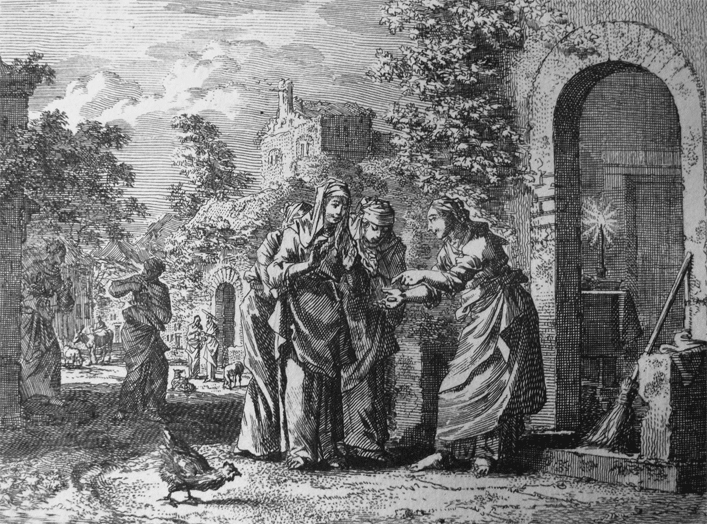
The Parable of the Lost Coin and the Lost Sheep are two parts of the same parable. The Lost Sheep is considered Part “a” while the Lost Coin is considered Part “b.” The audience, plot and ending are quite similar. I considered grouping these together in one chapter, but thought it wise to keep them separate as there are subtle and unique differences between the two. The text is found in Luke 15:8-10 and is as follows…

“Or what woman, having ten silver coins, if she loses one coin, does not light a lamp and sweep the house and seek diligently until she finds it? And when she has found it, she calls together her friends and neighbors, saying, ‘Rejoice with me, for I have found the coin that I had lost.’ Just so, I tell you, there is joy before the angels of God over one sinner who repents.”

Jesus begins this section in like manner by asking a similar rhetorical question. This is done not only to acknowledge the women in the audience by directing a question to them (as opposed to the men in Luke 15:4), but also to parallel the man from the Lost Sheep with the woman from the Lost Coin. Jesus is the true picture of the man in the Lost Sheep parable and the church, his bride, is the true picture of the woman in this, the Lost Coin, parable. The Lost Sheep parable speaks to Jesus’ loving concern and care for the sheep which was lost, while the Lost Coin parable speaks to the church’s diligence in reaching the lost as she turns the light on and sweeps the house diligently to find the coin. Both the sheep and the coin are representative of the unrepentant sinner. One particularly important difference is the value assigned to the coin when compared to the sheep. The sheep was 1 out of 100 while the coin was 1 out of 10. We will see next week, in the Parable of the Prodigal Son, that the value is further increased to 1 out of 2. This is important because as humans, we are likely to think losing 1% is small and insignificant in size, so it could be easily withstood. Now considering the woman and her coins, 10% is a much larger hit and thus a more difficult loss. Now thinking ahead to next week, 50% is a huge hit and thus splits a family. As Jesus continues, the value he places on the unrepentant sinner increases.

Much has been discussed concerning the true meaning behind the light and the broom and while it may lend to reading too far into the parable, I think it is safe and helpful to say that they are the tools in which we, the church, are given to help find the lost. The heavenly tools the church is given to work repentance are found through the proclamation of the law and the gospel. The law both condemns and exhorts to good works while the gospel gifts freedom from the weight of the law and motivates one to strive toward good works. Both proper preaching of the law and the gospel are necessary proclamations to bring the unrepentant sinner to true repentance. Therefore the true church searches diligently for the lost through the preaching of the law and the gospel.

The resulting celebration upon finding her lost coin elicits a similar response to that of the man finding his lost sheep. Overwhelming joy.  Sadly, the result that caused great rejoicing in heaven only garners murmuring and malcontent from the Pharisees (Luke 16:14) in the presence of Jesus as he spoke these very parables. By telling this parable to a crowd full of sinners, Jesus uses the very same tools as the woman used to find the coin; the law and the gospel. This is the job of the church; to utilize these tools as the means to call lost sinners to repentance.

The message of the Parable of the Lost Sheep and Lost Coin deal with repentance. Each of the following parables build on what follows after repentance. Please tune in next week for “Chapter 2 – The Prodigal Son.”


Introducing the Church Fathers – Isidore of Seville (Part 2)

Isadore of Seville

Last week I had the pleasure of presenting Isidore of Seville and a selection from his massive work called Etymologies on the many names of God the Father. I decided to carry Isidore of Seville forward two more weeks to allow him the space to cover the names of both God the Son and God the Holy Spirit.  Therefore, this week will function as Part 2 and deal with the many names of God the Son. Next week will function as Part 3 and will cover the many names of the God the Holy Spirit.  His work is so fantastically in depth that it would be a tragedy not to release them as a series.  And now with no further adieu, Part 2, the many names of God the Son…

ii. The Son of God (De Filio Dei)

In the divine writings Christ is also found to be named in many ways, for he, the only-begotten Son of God the Father, although he was the equal of the Father, took the form of a slave (Philippians 2:7) for our salvation. Whence some names are given to him with regard to the substance of his divinity, and some with regard to the dispensation of his assumed humanity.

He is named ‘Christ’ (Christus) from ‘chrism’ (chrisma), that is, ‘anointed one,’ for it was a precept among the Jews that they would confect a sacred ointment by which those who were called to the priesthood or the kingship might be anointed. Just as nowadays for kings to be clothed in the purple is the mark of royal dignity, so for them anointing with sacred ointment would confer the royal title and power. Hence they are called ‘anointed ones’ (christus) from chrism, which is unction, for the Greek chrisma is ‘unction’ (unctio) in Latin. When this anointing was done spiritually, it accommodated the name ‘Christ’ to the Lord, because he was anointed by the Spirit from God the Father, as in Acts (4:27): “For there assembled together in this city against thy holy child . . . whom thou hast anointed” – by no means with visible oil, but by the gift of grace, for which visible ointment is a sign. ‘Christ’ is not, however, a proper name of the Savior, but a common-noun designation of his power. When he is called ‘Christ,’ it is a common designation of his importance, but when he is called ‘Jesus Christ’ it is the proper name of the Savior. Further, the name of Christ never occurred at all elsewhere in any nation except in that kingdom alone where Christ was prophesied, and whence he was to come. Again, in Hebrew he is called ‘Messiah’ (Messias), in Greek ‘Christ,’ in Latin ‘the anointed’ (unctus).

The Hebrew ‘Jesus’ is translated σωτήρ in Greek, and “healer” (salutaris) or “savior” (salvator) in Latin, because he has comefor all nations as the ‘bearer of salvation’ (salutifer). The Evangelist renders the etymology of his name, saying (Matthew 1:21), “And thou shalt call his name Savior (salvator ; cf. Vulgate Iesus), for he shall save his people.” Just as ‘Christ’ signifies a king, so ‘Jesus’ signifies a savior. Not every kind of king saves us, but a savior king. The Latin language did not have this word salvator before, but it could have had it, seeing that it was able to when it wanted. The Hebrew Emmanuel in Latin means “God is with us,” undoubtedly because, born of a Virgin, God has appeared to humans in mortal flesh, that he might open the way of salvation to heaven for the inhabitants of earth.

Christ’s names that pertain to the substance of his divinity are as follows: God (Deus), Lord (Dominus). He is called God because of his unity of substance with the Father, and Lord because of the creation subservient to him. And he is God and man, for he is Word and flesh.Whence he is called the Doubly-Begotten (bis genitus), because the Father begot (gignere, ppl. genitus) him without amotherin eternity,andbecause amotherbegot him without a father in the temporal world. But he is called the Only-Begotten (unigenitus) according to the peerless quality of his divinity, for he is without brothers; he is called the First-Begotten (primogenitus) with regard to his assuming of human nature, in which he deigned through the grace of adoption to have brothers, among whom he was the first begotten.

He is called ‘of one substance’ (homousion, i.e. ὁμοούσιος ) with the Father because of their unity of substance, because in Greek substance or essence is called ὄνομα and ὁμο – means “one.” The two joined together therefore denote ‘one substance.’ For this reason he is called Homousion, that is (John 10:30), “I and the Father are one” – that is, of the same substance with the Father. Although this name is not written in Sacred Scripture, nevertheless it is supported in the formal naming of the whole Trinity because an account is offered according to which it is shown to be spoken correctly, just as in those books we never read that the Father is the Unbegotten (Ingenitus), yetwe have no doubt that he should be spoken of and believed to be that.2 Homoeusion (i.e. ὁμοιούσιος ), that is “similar in substance,” because as God is, so also is God’s image. Invisible is God, and invisible his image (i.e. the divinity latent in Jesus).

The Beginning (Principium), because all things are from him, and before him nothing was. The End (Finis), either because he deigned at the end (finis) of time to be born and to die humbly in the flesh and to undertake the Last Judgment, or because whatever we do we refer to him, and when we have come to him we have nothing further to seek. He is the ‘Mouth of God’ (Os Dei) because he is hisWord, for just as we often say ‘this tongue’ and ‘that tongue’ for ‘words,’ which are made by the tongue, so ‘Mouth’ is substituted for the ‘Word of God,’ because words are normally formed by the mouth. Further, he is called the Word (Verbum) because through him the Father established or commanded all things. Truth (Veritas), because he does not deceive, but gave what he promised. Life (Vita) because he created. He is called the Image (Imago) because of his equivalent likeness to the Father. He is the Figure (Figura) because although he took on the formof a slave, he portrayed in himself the Father’s image and immeasurable greatness by his likeness to the Father in his works and powers.

He is the ‘Hand of God’ (Manus Dei) because all things were made through him. Hence also the ‘Right Hand’ (Dextera) because of his accomplishment of the work of all creation, which was formed by him. The Arm (Brachium), because all things are embraced by him. The Power (Virtus), because he contains in himself all the authority of the Father, and governs, holds, and rules thewhole creation of heaven and earth. Wisdom (Sapientia), because he himself reveals the mysteries of knowledge and the secrets of wisdom. But although the Father and the Holy Spirit may be ‘Wisdom’ and ‘Power’ and ‘Lamp’ and ‘Light,’ nevertheless strictly speaking it is the Son who is designated by these names. Again, he is called Clarity (Splendor) because of what he plainly reveals. Lamp (Lumen), because he illuminates (illuminare). Light (Lux), because he unlocks the eyes of the heart for gazing at the truth. Sun (Sol), because he is the illuminator. The Orient (Oriens, i.e. “East,” “Sunrising”) because he is the source of light and the brightener of things, and because he makes us rise (oriri) to eternal life. The Fount (Fons), because he is the origin of things, or because he satisfies those who thirst.

He is also the Α and Ω. He is Alpha because no letter precedes it, for it is the first of the letters, just as the Son of God is first, for he answered the Jews interrogating him that he was the beginning (John 8:25). Whence John in the Apocalypse, properly putting down the letter itself, says (22:13), “I am Α and Ω, first and last.” First, because before him nothing is. Last, because he has undertaken the Last Judgment. Mediator (Mediator), because he has been constituted a mean (medius) between God and humanity, so that he might lead humanity through to God – whence the Greeks also call him μεσίτης (“mediator”). Paraclete, that is, advocate, because he intercedes for us with the Father, as John says of him (I John 2:1), “We have an advocate with the Father, Jesus Christ the just.” For Paraclete (Paracletus) is a Greek word that means “advocate” in Latin. This name is ascribed to both the Son and the Holy Spirit, as the Lord says in the Gospel (John 14:16), “I will ask the Father, and he shall give you another Paraclete.”

Also the Son is called Intercessor (Intercessor), because he devotes care to remove our sins, and he exerts effort to wash away our crimes. Bridegroom (Sponsus), because descending from heaven he cleaves to the Church, so that by the grace of the New Covenant they might be two in one flesh. He is called an Angel (Angelus, i.e. ‘messenger’) because of his announcing of his Father’s and his own will. Whence it is read in the Prophet (cf. Isaiah 9:6), “Angel of great counsel,” although he is God and Lord of the angels. He is called the ‘One Sent’ (Missus) because he appeared to this world as the Word made flesh, whence also he says (John 16:28), “I came forth from the Father, and am come into the world.” He is also called the ‘Human Being’ (Homo)because hewas born. Prophet (Propheta), because he revealed future things. Priest (Sacerdos), because he offered himself as a sacrifice for us. Shepherd (Pastor), because he is a guardian. Teacher (Magister), because he shows the way. Nazarene (Nazarenus) from his region, but Nazarite (Nazareus) is an earned title meaning “holy” or “clean,” because he did no sin.

Further, Christ attracts to himself types of names from other lesser things so that he might more easily be understood. For he is called Bread (Panis) because he is flesh. Vine (Vitis), because we are redeemed by his blood. Flower (Flos), because he was picked. The Way (Via), because by means of him we come to God. The Portal (Ostium), because through him we make our approach to God. Mount (Mons), because he is mighty. Rock (Petra), because he is the strength of believers. Cornerstone (Lapis angularis), because he joins two walls coming from different directions, that is from the circumcised and the uncircumcised, into the one fabric of the Church, or because he makes peace in himself for angels (angelus) and humans. The Stumbling-stone (Lapis offensionis), because when he came in humility unbelievers stumbled (offendere) against him and he became a ‘rock of scandal’ (Romans 9:33), as the Apostle says (I Corinthians 1:23), “Unto the Jews indeed a stumbling block (scandalum).”

Further he is called the Foundation (Fundamentum) because faith on him is most firm, or because the Catholic Church was built upon him. Now Christ is the Lamb (Agnus) for his innocence, and the Sheep (Ovis) for his submissiveness, and the Ram (Aries) for his leadership, and Goat (Haedus) for his likeness to sinful flesh, and the Calf (Vitulus) because he was made a sacrificial victim for us, and Lion (Leo) for his kingdom and strength, and Serpent (Serpens) for his death and his sapience (sapientia), and again Worm (Vermis) because he rose again, Eagle (Aquila) because after his resurrection he returned to the stars.

Nor is it a wonder that he should be figured forth by means of lowly signs, he who is known to have descended even to the indignities of our passions or of the flesh. For although he is coeternal with God the Father before worldly time, when the fullness of time arrived, the Son for our salvation took the form of a slave (Philippians 2:7), and the Son of God became a son of humankind. For this reason some things are said of him in Scripture according to the form of God, some according to the form of a slave. Two of these should be kept in mind for an example, so that particular instances may severally be connected with these particular forms. So, he spoke of himself according to the formof God (John 10:30), “I and the Father are one”; according to the formof a slave (John 14:28), “For the Father is greater than I.”

But people who little understand how one thing may be said for another wish to transfer to the Son’s character as God what has been said with regard to his character as a slave. Again, they want what has been said relating the Persons to one another to be names for God’s nature and substance, and they make an error in their faith. For human nature was so conjoined to the Son of God that one Person was made from two substances. Only the man endured the cross, but because of the unity of Person, the God also is said to have endured it. Hence we find it written (I Corinthians 2:8), “For if they had known it, they never would have crucified the Lord of glory.” Therefore we speak of the Son of God as crucified, not in the power of his divinity but in the weakness of his humanity, not in his persistence in his own nature but in his acceptance of ours.
The Bride of Christ Needs Counseling…

I’m thankful that I’m married.

Watching my single friends run through the gambit of 21st century dating etiquette allows me to feel all the more blessed.

The onslaught of what is considered culturally acceptable on social media platforms boggles the mind as many freely expose the dark taboo-ish corners of their lives in an effort to gain attention through individualism and avant garde living.  I’m amazed at what is considered “commonplace” in the arena of social media.  Passive aggressive girlfriends who, with their forked tongues, speak slander and praise as an attempt to manipulate their way through relationships.  Misogynist man-boys who’s goal is to mark their territory and expand their imaginary empires by the means of lies, deception and emotional thievery.  This formerly sealed off corner now has the spotlight through the likes of  reality TV and no-holds-barred social media.  The landscape is hostile, lawless and ultimately narcissistic.

This paradigm shift makes me all the more satisfied that I not only have a wife, but that I love her and find security and assurance in our relationship.  Sure neither of us are close to being perfect and our relationship has its ups and downs, but as I watch while others openly live their lives in the public forum, I began to entertain a thought.  What would the bride of Christ, which is the church, look like within the confines of  modern day social media?  Do we look passive aggressive?  Do we jump into the relationship just to strip-mine the benefits for ourselves and then bail?  Are we emotionally unbalanced?  What is our current mental state?  I recently read an article on “Ask Men” titled “10 signs she’s crazy.”  In the article the author lays out 10 signs that you might be dating someone who is crazy and when I compared the list to the current state of the Church, the results were scary.

10. Controls Narrative

We like to be the one that controls the narrative.  So often, God’s word is conformed to our worldview instead of our worldview being conformed to God’s word.  We control this narrative through many ways such as the purpose and direction of the church service, how worship is viewed and a strange view of what prayer actually is.  I could spend much time delving into how the modern church is embracing culture instead of maintaining its position as counter-cultural, but for the sake of time I’m going to focus on prayer.  Prayer is often viewed as a literal conversation between us and God.  In the personal setting many are instructed to find a quiet room, talk to God and wait in silence until he answers.  This is the perceived “conversation” that many Christians expect.  However, this is not the biblical definition of prayer.  Prayer is simply talking to God, through Jesus.  The perfect picture of this is found in the Old Testament where the high priest would offer prayers for the people and would burn incense to represent the prayers ascending to God. Interestingly enough, the smoke never descended back to the people. Nor did it change back to incense and audibly reply. This is because prayer is not like our earthly conversations.  We should not expect an answer directly from God, but instead should seek answers in his word.  That is how God speaks to us.  Prayer is not a conversation.  Look at the Psalms.  David was a prophet and how many of his prayers were conversational?  Jesus is God and taught us how to pray in Matthew 6 and Mark 11.  Jesus’ prayer doesn’t end “…and deliver us from evil and answer me back to let me know if I should date Cindy.” The Lord’s Prayer was given because it shows God’s precise will for each of our lives.  It’s not that Cindy doesn’t matter, but that if you are honestly praying the contents of the Lord’s prayer, then you will trust that his will be done.  I am not saying that God could not talk directly to us, only that direct revelation is not normative. The modern church correctly takes its every need and desire to God, as directed through scripture, but controls dialogue when answers are sought outside the appropriate method of response, given by God, which is through his word.   The answers to our prayers will ultimately be answered as God perfectly reveals his will in his perfect time.

9. Self Aggrandizing

There is so much self importance placed upon the individual that Christ is left as a supporting cast member instead the lead actor.  This happens often as many sermons are set up to make us feel important.  These days, it’s more important to make people feel like they have purpose than to show them they are a sinner in desperate need of salvation.  I mean, who wants to feel bad about themselves? Many pastors subtly engage in this behavior by reading themselves into the biblical texts.  When the narrative of David and Goliath is the Sunday text, the pastor compares the congregations life to that of David and accordingly asks them to identify the “Goliath” in their lives.  This belittling of the biblical narrative not only takes our eyes off of Christ and his scarlet thread through the old testament, but feeds our inner narcissist as we suddenly have the power to slay our giants of guilt, debt or anger.  The problem is that Goliath was a real Philistine giant not a projection of our problems.  The bible is not about us.  The bible is about Jesus and what he has done FOR us.  All things point to him and we can rest in what he has accomplished in our place.  The bible isn’t a self help book that leads us on a path to self actualization, but instead is a book enables us to die to self as we place our faith in Christ Jesus, Emmanuel, that came, bled, died and rose again for our justification.  The church should be aggrandizing it’s groom, Jesus, not itself.

8. Hates other women

How often do Christians look down on unbelievers living in exposed sin?  How often are our lives lived as if we are sinning less and less while the world around us are way worse sinners than we are?  Have you ever caught yourself feeling pretty good on the inside when a person that annoys you gets caught in sin?  Have you ever had a person tailgate you for 10 miles until you move over and let them pass only to think “I hope there’s a cop up there waiting to give them a ticket” as if you never speed?  How about realizing that you are sinning by not speeding because your motive for driving under the limit is fueled by greed instead of a desire to serve Christ through obedience? How often do we look like Pharisees on both the inside and out. This attitude against unbelievers is true hatred.  Love would come along side them.  Love is not haughty.  Love would not discount the damage and and ugliness of their sin, but would point to Christ as the one who died and rose again for those sins.  Love would point to repentance, not as a process to perfection, but as a realization of complete inability to please God apart from the work of Jesus Christ.  True love doesn’t hate others through haughty eyes that see the spec in their neighbor’s eye while missing the plank in their own.  We often harbor hatred for others because of our own insecurities.  We may have been deeply, personally hurt by a particular sin of others and now paint those with even a hint of that sin with the broad brush of reprobation. We often hate because we see what we don’t like about ourselves or our experiences in others.  That sin is just as damning as the sin committed against us because both sins are in opposition to God.  This is precisely what 1 John 4:20 is talking about.

7. Isolates herself

How many times do we like to hang out in our comfortable groups, speaking Christianese as a way to protect ourselves against the trials and tribulations of this world.  This is not only unhealthy for us, it is also hypocritical.  Hanging out with “only” Christians as we isolate ourselves not only implies superiority, but also projects an unloving attitude.  This attitude will reveal itself in the places in which we are in contact with the largest population of unbelievers…which is usually our work environments.  Our unbelieving co-workers are curious as to why we claim to be Christians, but fail to show them any love or always turn them down when they extend an invitation.  The mission field is wherever our vocation is.  Every time we head into the office, job site or the onto the production floor we carry the torch of Christianity through our thought, word and deed.  The same goes for when we visit others work places as we dine in restaurants, pick up our children at daycare and interact with others at the grocery store. The world doesn’t need to see us in our collective groups of dissociation.  The world needs to hear the comfort of the full proclamation of the gospel message.  The world needs to know that we struggle just as they struggle, but that our faith and hope lay in the one who came and died for the sins of the world instead of faith in our works.  Isolation is not an adjective that defines the Christian life.

6. Weird about Exes

We are pretty weird about our exes.  Our exes in this case are the idols that we used to (and continue) to exalt in place of God.  These idols could be food, comfort, luxury, pietism, other people…really anything.  As Calvin famously said, our hearts are idol factories.  This being the case, we are weird about them.  We struggle to call them what they are. We often run back to them in an attempt to satisfy the longings of our sinful flesh.  It’s a weird coping mechanism. On one hand we hate and renounce them while on the other, we secretly love and cling to them.  Our God is a jealous God who doesn’t desire to interact with our former crushes.  He wishes to exterminate them and call them out for what they really are…false securities of our sinful flesh.

5. False Accusations

Many times in an effort to comfort ourselves, we project our shortcomings onto our loved ones.  When we see the things that we hate so much about ourselves in other people we tend to harp on it.  This is an interesting paradigm when compared to our relationship with Christ.  How many times, in our sin, have we said “Well you made me this way.”  How often to we project our shortcomings onto Christ as if he is responsible for our condition. The interesting twist is that even though he is not responsible for our condition, he did willingly and actively take our place on the cross.  He bore each and everyone of our sins that we falsely blame him for to earn our pardon.  He defeated death and the false accusations which to him were very real, true and painful as he suffered and died only to rise again for our justification.

4. Shaves her head

We are attention seekers.  We really love attention even if it’s negative.  We do weird things in order to steal the spotlight.  Many times these weird things are a blemish to the name of Christ. We do many of these attention seeking acts in the name of relevance with the tag line “If it could only save one person…” as our qualifier.  We shave our heads by attempting to make the worship service “entertaining.”  This could be as ridiculous as an arena rock service with smoke machines and laser lights or as head scratching as a Mixed Martial Arts Fight Church (I am not lying.  This is a real thing).  This is akin to the girlfriend that always acts outrageous as a means to gain acceptance, while her boyfriend stands at the side shaking his head in disgust.  Once again the church is and always will be counter-cultural.  It’s not counter-cultural to draw attention to itself because it’s an attention seeker, but because we have been given a true picture of what the church should look like in scripture and it’s never been bright lights and parties to draw in unbelievers.  For 120 years Noah preached the word to all who would hear.  Scripture doesn’t tell us that Noah offered free drinks, a rock concert and a MMA fight to get people into the Ark.  He simply preached the word.  Sure the Ark was a spectacle. A spectacle of ridicule instead of relevance.  The same Ark that he was ridiculed for building, is the same Ark that God used to save him and the only 7 others in the world that believed God’s word, which were Noah’s family.  We shouldn’t figuratively shave our heads to focus the attention on us, but instead should stay with the outline that Scripture gives us and focus the spotlight on Jesus Christ.  Anything we do to steal the spotlight, will take our eyes off of him.

3. Hits below the belt

This can either be a literal kick or an verbal spar.  Either are equally painful.  Angry and hateful comments about our family or lack of success should be off limits to our spouses, but sometimes find themselves fair game in the heat of battle. The church utilizes these cheap shots against our Lord and Savior when we deny the efficacy of the sacraments.  Jesus, through his word, promises to be present and offer gifts through baptism, the Lord’s Supper, and absolution of sin.  When the church, through many denominations, deny what Jesus proclaims using arguments of fallen reason, it is a hit below the belt.  Jesus offers to meet us and give himself to us through these particular means and many reject them because it doesn’t fit within their comfort zone or desired understanding.  I am sure that some will take exception with this, but think about it for a moment.  If the sacraments are truly efficacious, as I believe the word clearly proclaims, then rejecting them on any basis would be a supreme low blow to the one offering his presence and gifts.

2. Contradicts herself

This deals with the sad fact that many Christians that I run into, couldn’t explain their faith if their life depended on it.  Jay Leno used to have a segment called “man on the street” where random tourists outside his studio would be asked insanely simple questions and fail to give the correct answer.  If we did a similar experiment in many of our churches, I hypothesize that the results would be similar.  This is a major issue because those participating in Jay Leno’s segment aren’t making a knowledge or affiliated claim before being subjected to the simple questions whereas those in the church are claiming fellowship and thus should know something substantive about what they believe.  This does not mean that each and every Christian should be able to succinctly wax eloquent on the hypostatic union, but should at minimal, be able to defend the faith they claim to lay hold of.  When we don’t know what we believe, we become walking and talking contradictions.  These contradictions are easy to spot and make us easy picking for false teachings and teachers who will gladly guide us to apostasy.  Could you imagine a marriage where the wife has only superficial knowledge of her husband?  Could you imagine the confusion and utter amazement of the husband for how clueless his wife really is?  It doesn’t take Sherlock Holmes to figure out that the relationship is based off of what the bride can “get” instead of actual genuine, sacrificial love.

1. Other crazy people think she’s crazy

Atheists and agnostics are quick to point out all the craziness that was pointed out in the previous 9 signs.  While I am fine with a self-proclaimed atheist or agnostic calling me crazy if I am proclaiming the truth of the gospel, (1 Corinthians 1:18 tells us that the message of the cross is foolishness to those who are perishing) it’s a whole other story to behave in the fashion of the “signs” listed above and be justly labeled crazy.  There is a difference.  Accept the label of foolishness for the message of the cross, not because you exhibit behavior found in the above “signs” of craziness.

Is this what the true bride of Christ looks like or is this some doppelganger infiltrating the ranks of Christendom?  As much as I would like to lay the blame on an evil twin, scripture gives us picture of what we look like and it’s messy.  Throughout scripture the church is compared to a prostitute.  Our story is more  desperate than we’d like to admit.  This doesn’t mean that we are supposed to give up and give into our sin nature as scripture also gives us a picture of what we should strive to look like.  We will continually fall short of the goal, but his grace gifted to us is what gives life to the striving.  We have been redeemed.  Purchased for a price.  Bought and freed from the bounds of sin, death, and the devil.  Our groom is the text-book example of loving and puts up with our garbage as he continues to strengthen and encourage our faith in him through word and sacrament.  So yes we have many problems and need counseling. Yet, even though we are trapped in these earthen vessels, we can look forward with faith, hope and love to our wedding day when we are finally united with our groom who gave it all for us so that we can have freedom in him.  We are the treasure in the field.

Christian Baptism Series – Part 6 – Should Infants Be Baptized?

Dylan Baptism

Should Infants Be Baptized?

It has been established by the previous posts in this series that baptism actually does something.  It gifts forgiveness of sins and the Holy Spirit.  If the scriptural promise attached to baptism is true, then the question of  nessecity arises concerning whether infants need the gifts offered.  Do infants need forgiveness of sins?  Are they born perfect or are they born sinful?

Romans 5:12
“Therefore, just as sin came into the world through one man, and death through sin, and so death spread to all men because all sinned”

Job 15:14
What is man, that he can be pure? Or he who is born of a woman, that he can be righteous?

Psalm 51:5
Behold, I was brought forth in iniquity, and in sin did my mother conceive me

John 3:6
That which is born of the flesh is flesh and that which is born of the Spirit is spirit.

Ephesians 2:3
among whom we all once lived in the passions of our flesh, carrying out the desires of the body and the mind, and were by nature children of wrath, like the rest of mankind.

These verses paint a rather dire situation for anyone born of flesh (with Christ Jesus being the lone exception).  Infants may not be able to rob a bank, tell a lie or covet their neighbors Ferrari, but the seed of Adam is ever present within us all from the point of conception forward.  The fall has infected us to the core.  Sin has no prejudice. Like a pit viper, it inflicts it’s poisoness effect without regard for gender, race, status or age in hopes of certain death for it’s victim.  The anti-venom is only found in the blood of Jesus Christ.  So yes, it is quite evident that infants need what baptism offers.  They need forgiveness of sin.  This may be shocking or a hard teaching for many, but within historical Christianity, there wasn’t even a debate about this. The earliest teaching resembling the doctrine of believers’ baptism didn’t arise until the 1520’s when the Zwickau Prophets organized to protest Martin Luther. These “prophets” came out of the early stages of the radical reformation.  They taught that the Holy Spirit reveals all that is needed, directly, to the individual apart from the word.  Therefore they taught that the bible was not authoritative. This claim was in opposition to Luther’s teaching of sola scriptura.  Their defense of denying sola scriptura stated that if the Bible was indeed authoritative, then God would have dropped it directly out of the sky. Since the bible was written by mere men, it couldn’t attain the status of divine authorship or authority.  On the other hand, they taught that God dropped the Holy Spirit out of the sky and implanted him into all believers and therefore, authoritative truth proceeds solely from believers.  Because of this view, they divorced what the scriptures said concerning many things, including baptism, and created their own views based on their supposed direct revelations. They severely opposed infant baptism and affirmed believers’ baptism based on these direct revelations.  Following in the baptismal steps of the Zwickau Prophets the radical reformation moved forward through the likes of Anabaptist groups like the Hutterites and Mennonites.  Unlike the Zwickau Prophets, these groups affirmed Sola Scriptura, however since the Bible didn’t explicitly say “baptize infants” they rejected infant baptism through the claim of Sola Scriptura. Many controversies and separations continued as this new teaching of symbolic adult baptism continued to spread.  Other groups were also influenced by the radical reformation which resulted in the English separatist movement in the 17th century which birthed denominations like the Baptists.  The position of the Radical Reformation came out of a stark desire to distance themselves as far away from Rome as possible as they believed Luther’s error was that he did not go far enough.

Therefore the baptismal continuum looks something like this. From 30AD to 1525AD, baptism was taught to be regenerative and for all regardless of age, then a split started with the birth of the radical reformation around 1525 that produced 3 alternative views resulting in 4 major branches; Regenerative baptism for all ages, non-regenerative baptism for all ages, regenerative believers baptism and believers baptism as a symbol. There is a major problem with this as it would mean that for approximately 1500 years Jesus would leave His church completely misinformed and lost in the woods concerning one of only two things that He instituted in Matthew 28:19-20. For there to be a misuse, there has to be an initial correct use. If I am misusing a wrench, there had to first be a correct use for which the wrench was intended before misuse can be entertained. Concerning baptism, history reveals unity in appropriate use and function for 1500 years, followed by 500 years of proper use alongside misuse. The church fathers are rather clear in their position as they repeatedly affirm regenerative baptism for all ages. If the church fathers that carried the torch of Christianity through the first 5 centuries alone are studied, it is clear that infant baptism is the standard, accepted, unquestioned, professed and proclaimed view amongst the church. There was no discussion concerning age requirements for baptism apart from whether baptism should occur on or before the eighth day. That debate was quickly extinguished by Cyprian of Carthage in 253AD when he suggested that the day doesn’t matter, just do it as soon as possible. Here is a list of solid, sound church fathers who affirm regenerative baptism as a means of grace for people of all ages…

1st Century – Barnabus and Hermas
2nd Century – Irenaeus, Theophilus of Antioch, Clement of Alexandria & Justin Martyr
3rd Century – Tertullian, Cyprian of Carthage and Hippoytus
4th Century – Gregory of Nazianz, John Chrysostom, Basil the Great, Ambrose of Milan, Aphraahat the Persian, Cyril of Jerusalem, Athanasius, Eusibius of Caesarea and Jerome
5th Century – Augustine, Theodore of Mopsuestia and Severian of Gabala,

Now that the historical ground work has been laid for regenerative baptism for all ages, what does scripture say?

Matthew 28:19-20
Go therefore and make disciples of all nations, baptizing them in the name of the Father and of the Son and of the Holy Spirit, teaching them to observe all that I have commanded you. And behold, I am with you always, to the end of the age

This verse issues a directive to make disciples of all nations. This is to be done by baptizing and teaching the word.  The qualifier in the statement hinges on what is meant by “nations.” Webster defines it as “a territorial division containing a body of people of one or more nationalities and usually characterized by relatively large size and independent status.” This is a pretty standard definition. The primary subject that defines a nation is “people.” “People” is nondescript. The word “people”, in its generic use (which is how it is used in this context), has no age description. People, I contend, are people from conception to death. The verse does not say make disciples of all men, or women or all people except infants and small children. It says make disciples of all nations. Infants are included when the census is taken. Citizenship is granted as a birthright. This is as inclusive as it gets.

Galatians 3:28-29
There is neither Jew nor Greek, there is neither slave nor free, there is no male and female, for you are all one in Christ Jesus. And if you are Christ’s, then you are Abraham’s offspring, heirs according to promise.

This verse is also purposefully written to be inclusive. Paul is stating that salvation is for all as there is no hierarchy or limits to who can be saved. Once again, if the Holy Spirit though Paul wished to exclude small children and infants, said exclusion would have been part of the text. The fact that this verse goes to great lengths to be inclusive is proof positive. Each of the categories that Paul mentions could refer to an infant or the elderly, therefore the necessity for such language is unnecessary.  Once again the full inclusivity of Christ is presented.

Acts 2:38-39
And Peter said to them, “Repent and be baptized every one of you in the name of Jesus Christ for the forgiveness of your sins, and you will receive the gift of the Holy Spirit. For the promise is for you and for your children and for all who are far off, everyone whom the Lord our God calls to himself.”

This response by Peter is to those at the Day of Pentecost sermon when they realize Jesus’ blood was on their hands.  The text says they were cut to the core and asked Peter what they needed to do to be saved. Once again, an enormously inclusive verse is given. One particular argument that I have heard is that Peter is really saying that “you and your children”  is descriptive of “the Jews” and that “all who are far off” describes the “gentiles” therefore the “you and your children” section should not be taken literally. This is shortsighted eisegesis. It is true that both Jews and gentiles are included in the statement as there is a great crowd at Pentecost full of both Jews and various gentile nations (thus the necessity for tongue speaking and translators). Peter is simply preaching what he was told in Matthew 28:19-20. Peter is making disciples through the method in which Jesus commanded him. This crowd was precisely “you and your children and for all who are far off…” All nations were present in the crowd. There were adults, parents, children, infants, brothers, sisters, aunts, uncles, nephews, nieces, fathers, mothers and cousins. These were people of all ages. Peter once again does not exclude anyone from baptism. He says it is for you and for your children and for all who are far off, for as many as the Lord will call unto himself. The verse when taken literally includes everyone present.  If the verse is present only figuratively (as the argument claims) then this verse, by nature, becomes exclusive.  There are no liguistic, historical or theological reasons that necessitate reading this verse other than literally.  This verse clearly states that baptism is “for” the forgiveness of sins and the gift of the Holy Spirit, therefore the promise is made to all who need it which includes “you and your children” as were present at Pentecost and are still present today. This leads us to the next verses…

Matthew 19:13-15
Then children were brought to him that he might lay his hands on them and pray. The disciples rebuked the people, but Jesus said, “Let the little children come to me and do not hinder them, for to such belongs the kingdom of heaven.” And he laid his hands on them and went away.

Luke 18:15-17
Now they were bringing even infants to him that he might touch them. And when the disciples saw it, they rebuked them. But Jesus called them to him, saying, “Let the children come to me, and do not hinder them, for to such belongs the kingdom of God. Truly, I say to you, whoever does not receive the kingdom of God like a child shall not enter it.”

There are a couple things that need to be pointed out here. To properly understand what is going one must look to the koine Greek word for children used in these passages. Matthew uses παιδία (paidia) which means small child.  Paida is somewhat broad as it can be either an infant or a young toddler.  Luke uses the word βρέφη (brephē) which is more precise and means “suckling infant.’  This word is used 8 times in scripture and always identifies the child as being as young as possible.  For instance Luke uses this same word to describe John the Baptist in utero when he lept with joy inside of Elizabeth when Mary shared the news of her immaculate conception.  It is crystal clear that this verse is speaking about infants and very small children.  When these parents were bringing their small children to Jesus, the disciples rebuked them.  Jesus, however, overturned their rebuke and let the children come to Him without hindrance.  These children cannot come to Jesus apart from their parents carrying them because they are so small.  Jesus desires these small children to be brought to him, therefore the question today becomes how do our small infant children come to Jesus? They can’t be brought to a physical Jesus as in the gospel narratives because Jesus has ascended and we are waiting on His return. The answer is found in where Jesus promises to be for his church (word and sacrament), therefore, they are brought to Jesus in the waters of baptism. One of the claims of those who affirm believers’ baptism is that infants cannot repent or have faith because they cannot comprehend such things. The issue is that apart from Christ neither can we. Age is not something that lessens sins stranglehold and according to these verses, age actually does the opposite by increasing sins grip. I didn’t come to Christ because of anything I did and more specifically not because I turned a particular age or ascended to a certain mental capacity.  It was 100% Christ finding me and carrying me home. Because of Jesus, I was gifted with repentance, salvation and the Holy Spirit. I did zero to earn it. Apart from Christ I could not even desire repentance, let alone salvation, I could only despise it. Once again  Romans 10:17 states that faith comes by hearing the Word. Infants can hear from within the womb. There is Psalm 22:9 where David confesses faith while nursing.  Also in Luke 1:15, John the Baptist was filled with the Holy Spirit from the womb. To be filled with the Holy Spirit is to have faith. Lastly, baptism gifts the Holy Spirit (Acts 2:28-39).  If the Holy Spirit is within someone, faith must also be present in order to receive the gift.  Therefore if faith isn’t present before baptism, the word and water will create the faith necessary to receive the gift promised by the word through the waters of holy baptism. Considering all of this, I am most perplexed that many who fight the abortion culture war in this country, that ascribe so much to life at conception (and rightly so) by exalting so high the temporal gift of life, yet completely wash away the spiritual blessings and promises that God has made to and for our infant children by the word through the waters of baptism.

So now the question is raised concerning what this means. Is it certain salvation? The answer to this is actually rather simple.  The answer is to believe God and His promises. To clarify that statement, baptism is a means of grace just like the audible teaching of the Word is a means of grace. Just as there are those who reject the teaching of of the word, there too will be those who will reject the promises gifted in baptism.  The word is always efficacious (capable of producing an effect), but not always effective (producing an effect). Baptism is the same. The mysteries of God must be acknowledged in that that God sometimes allows his will to be thwarted (e.g. the anguished words of Jesus regarding Jerusalem: “How often would I have gathered your children together as a hen gathers her brood under her wings, and you would not!”). What gets us turned around so easily is that we constantly confuse God’s certainty of promise keeping with our proclivity for promise breaking. God is offering a promise in baptism just like he is offering a promise in teaching the Word, we can accept (passively) or reject (actively) the gift of that promise, but keep in mind that our rejection doesn’t nullify the fact that the promise has been made. Age doesn’t figure anywhere into this equation. Our infant children have been tainted by the sin of Adam. Even though our little ones cannot lie or cheat or murder at so young an age, they still have inherited the curse (Romans 5:12). Baptism cleanses not only the sin of Adam, but also the sins of their future because baptism is what God does, not something that we do.  However, this doesn’t negate the necessity of proper nourishment.  Infants must be reared in the shadow of word and sacrament.  After baptism, the second part of process for making disciples must take place as they are taught and instructed all the things the Jesus taught through the disciples found in the written word.   In baptism, God works by gifting forgiveness of sins and the Holy Spirit to the recipient.  The promise of this gift should eagerly send parents running their children to the baptismal font. This is the attitude present when the early church fathers answered questions concerning age of baptism. Good parenting entails proper nourishment, love and care.  If infants are bathed to cleanse the temporal dirt from their body, then scripture gives all the more reason too cleanse them in the waters of baptism as a means of proper spiritual nourishment, love and care.  Failing to do this is the essence of hindering the young ones from coming to Christ.  Therefore infant baptism doesn’t abdicate parental responsibility, it increases it.

(Click here for a link to quotes on regenerative baptism for all ages  by early church fathers as compiled by Chris Rosebrough)

Stay tuned for the final post of the “Christian Baptism Series – Part 7 – Summary and FAQ”

Click here to link to “Christian Baptism Series – Part 5 – What does Baptism do?”

Introducing the Church Fathers – Maximus of Turin

ImageThere is not much surviving information concerning the life of Maximus of Turin.  He was born sometime in the mid to late 4th century (estimated about 380 AD) and died in the mid 5th century (estimated about 465 AD).  We was an Italian bishop and theologian.  According to Patrick Comerford…”He (Maximus of Turin) is the author of numerous discourses, including 118 homilies, 116 sermons, and six treatises or tracts.” The selection chosen below is from “Sermon 85.3” and discusses the the armor of God (Ephesians 6:10-18), the battle narrative of David and Goliath (1 Samuel 17) and weaves them together through the person and work of Jesus Christ (Psalms 118:22, 1 Peter 2:7-8). The ability to find Jesus in the midst of Old Testament narrative was commonplace with our church fathers but sadly, has become a lost art amongst 21st century pastors and theologians.  The hope of this series is not only to bring attention to the writings of these torch bearers of the faith, but to also to help restore the lost art of revealing Jesus in the Old Testament.

“Therefore, brothers, let us arm ourselves with heavenly weapons for the coming judgement of the world: let us gird on the breastplate of faith, protect ourselves with the helmet of salvation, and defend ourselves with the word of God as with a spiritual sword.  For the one who is arrayed with these weapons does not fear present disturbance and is not afraid of future judgement, since holy David, protected with his devotion, killed the very strong and armed Goliath without weapons and struck down the warlike man, girt about with defenses on all sides, by the strength of his faith alone.  For although David did not put on a helmet, strap on a shield, or use a lance, he killed Goliath.  He killed him, however, not with an iron spear but with a spiritual sword, for although he appeared weaponless in the eyes of human beings, yet he was adequately armed with divine grace. But the spiritual sword itself was not a sword, since it was not by the sword but by a stone that Goliath died when he was struck down. We read in the Scriptures that Christ is figuratively designated by the word stone, as the prophet says: “The stone that the builders rejected has become the head of the corner.” Therefore when Goliath was struck by a stone, he is struck down by the power of Christ.  And in what part of the body is he struck?  On the forehead, for when the sacrilegious man is struck, there Christ was absent, and where his end comes upon him, there the sign of salvation is not to be found. For although Goliath was protected by weapons on all sides, still his forehead was exposed to death because it did not carry the Savior’s seal, and therefore he is slain in the spot where he is found to be bare of God’s grace.  But there is no one who does not realize that this took place figuratively.  For David had also put on armor beforehand but, since he was so heavy and awkward in it that he could hardly walk, he removed it at once, signifying that the weapons of the world are vain and superfluous things and that the person who chooses to involve themselves in them will have no unimpeded road to heaven, since he will be too heavy and encumbered to walk.  At the same time this teaches us that victory is not to be hoped for from arms alone but is to be prayed for in the name of the Savior.”  Sermon 85.3

Introducing the Church Fathers – John Chrysostom

Image

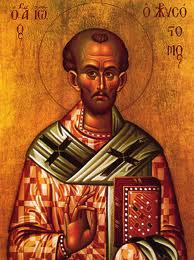
John Chrysostom was a late 4th century/early 5 century (died AD 407) church father who held office as a deacon and presbyter in Antioch before his appointment to Archbishop of Constantinople in AD 397.  He was born to seemingly affluent parents in AD 347  as his father was a military officer. His father died shortly after John was born, thus John was primarily raised by his mother.  John began his education under the pagan Libanius focusing on language, literature and the use of rhetoric.  As he grew, so did his interest in Christianity.  John eventually left Libanius to focus solely on Christianity.  He was known as an eloquent speaker who defended the literal interpretation over the allegorical (Chrysostomos means golden mouthed in Greek). Thankfully a significant amount of his works have survived antiquity.  The selection chosen for today is from a work entitled “Homilies on Hebrews.”

“The name of Jesus [Joshua] was a type. For this reason then, and because of the very name, the creation reverenced him. What then! Was no other person called Jesus [Joshua]? But this man was on this account so called as a type; for he used to be called Hoshea. Therefore the name was changed: for it was a prediction and a prophecy. He brought in the people into the promised land, as Jesus into heaven; not the law; since neither did Moses (enter the promised land) but remained outside. The law has not the power to bring in, but grace.”

Homilies on Hebrews 27.6

Christian Baptism Series – Part 2 – Jewish Rites of Purification & Pharisaical Law

Jewish Rites of Purification
As discussed in Part 1 of the Christian Baptism Series, there are many Old Testament verses concerning purification rituals for various purposes. However, the Jews, through the Pharisees, innovated and expanded these laws extraordinarily thus creating two distinct categories for specific cleansings; Netilat Yadayim and tevilah. Pharisaical law determines which purification right is to be performed for which cleansing.

Netilat Yadayim is the washing of the hands with a cup and is to be performed at meals, before worship, before priestly blessing, after sleeping, after visiting the bathroom, after cutting hair, after cutting nails, after participating in a funeral procession, being at a funeral, coming in contact with a corpse, after touching body parts that are typically covered (arm pits, private parts, etc), touching inside of nose or ear, after touching scalp, or prior to scribal work.

Tevilah is the full body immersion in a mikveh.  A mikveh is a collection of water as found  in a natural spring, river or drawn bath. This purification is also performed for a variety of reasons.
– Those who came in contact with a corpse
– Those with skin conditions
– Those emitting bodily fluids
– Women experience their monthly flow
– Men experiencing seminal discharge
– The one who led the scapegoat on Yom Kippur
– Those suffering from any issue resulting from blood discharging from the body
– Conversion to Judaism (2nd century)

When the list is studied, a blending of Biblical cleansing mixed with manufactured cleansing rituals are revealed. The “tevilah” appears to have a Biblical root in the Old Testament purification rituals that were listed in Part 1 of this study, while the “netilat yadayim” appears to be an innovation or hybrid (man’s law and God’s law) at best. There are two particular New Testament passages that reference these innovations; John 2:6 and Mark 7. In John 2:6, there is only a mention of 6 ceremonial washing jars (netilat yadayim) at the wedding in Cana. Mark 7 tells us not only what these jars are for, but gives a clear scope of the meaning behind them. In the passage, the Pharisees become agitated that Jesus and the disciples didn’t ceremonially wash their hands (netilat yadayim) before eating. This appears to be a small debate to our 21st century minds, however, when one understands what is actually at stake, the fight that Jesus and his disciples are initiating by not washing their hands is cataclysmic. To fully understand what is going on, two things must be explained;

(1) How Pharisaical laws came to be
(2) What not washing their hands really meant.

How Pharisaical Law came to be
The common perception of Pharisaical law tends to visualize itself as well intentioned law guarding. Their extra, innovative laws are thought of as caution tape (Pharisaical Law) around an open manhole (God’s Law).  The seemingly well intentioned Pharisees are just helping by devising extra precaution to keep from danger.  While it may appear that way on the surface, there is much more going on than meets the eye. The Pharisees actually believe(d) in 2 Torahs; the written and the verbal. They also believe(d) that Rabbi’s had absolute authority to interpret scripture and this absolute authority was governable by the majority. Therefore, the “second” verbal Torah was the Pharisaical rabbi’s living interpretation of scripture. It was verbal because they wanted to keep it to themselves in order to exclude the gentiles. The written Torah was for everyone, while the verbal Torah was exclusive. This conveniently resulted in the Pharisees having absolute power to determine law without having to explain themselves to anyone, let alone God. They used an irrational interpretation of Deuteronomy 30:12 and Exodus 30:12 to support their position.

Deuteronomy 30:12 says ” It is not in heaven, that you should say, ‘Who will ascend to heaven for us and bring it to us, that we may hear it and do it?”

Exodus 30:12 says “When you take the census of the people of Israel, then each shall give a ransom for his life to the LORD when you number them, that there be no plague among them when you number them.”

By taking these two verse completely out of context and combining them together they establish that since the Torah is no longer in Heaven, but on earth, interpretation is now solely their responsibility according to the consensus of the Pharisaical council. With this understanding, the Rabbinical Pharisees are the only ones who can now interpret God’s law; even excluding God (since the Torah is no longer in Heaven). Therefore they take these interpretations, create traditions of the elders or (takanote) and bestow upon them the authority of God’s commands (written Torah). This is how God’s commands such as “keep the Sabbath holy” can devolve into equating spitting on the ground with gardening. This understanding goes a long way in explaining Jesus’ incessant anger at the Pharisees. It is also important to note that the verbal Torah was eventually written down and is now the Talmud (Jerusalem and Babylonian).  This position is evident in reading the Talmud.  There is an account of Rabbi Eliezer in the Babylonian Talmud found in Baba Mezi’a 59 a & b.  Here is the selected account…

We learnt elsewhere: If he cut it into separate tiles, placing sand between each tile: R. Eliezer declared it clean, and the Sages declared it unclean; and this was the oven of ‘Aknai. Why [the oven of] ‘Aknai? — Said Rab Judah in Samuel’s name: [It means] that they encompassed it with arguments as a snake, and proved it unclean. It has been taught: On that day R. Eliezer brought forward every imaginable argument, but they did not accept them. Said he to them: ‘If the halachah agrees with me, let this carob-tree prove it!’ Thereupon the carob-tree was torn a hundred cubits out of its place — others affirm, four hundred cubits. ‘No proof can be brought from a carob-tree,’ they retorted. Again he said to them: ‘If the halachah agrees with me, let the stream of water prove it!’ Whereupon the stream of water flowed backwards — ‘No proof can be brought from a stream of water,’ they rejoined. Again he urged: ‘If the halachah agrees with me, let the walls of the schoolhouse prove it,’ whereupon the walls inclined to fall. But R. Joshua rebuked them, saying: ‘When scholars are engaged in a halachic dispute, what have ye to interfere?’ Hence they did not fall, in honour of R. Joshua, nor did they resume the upright, in honour of R. Eliezer; and they are still standing thus inclined. Again he said to them: ‘If the halachah agrees with me, let it be proved from Heaven!’ Whereupon a Heavenly Voice cried out: ‘Why do ye dispute with R. Eliezer, seeing that in all matters the halachah agrees with him!’ But R. Joshua arose and exclaimed: ‘It is not in heaven.’ What did he mean by this? — Said R. Jeremiah: That the Torah had already been given at Mount Sinai; we pay no attention to a Heavenly Voice, because Thou hast long since written in the Torah at Mount Sinai, After the majority must one incline. R. Nathan met Elijah and asked him: What did the Holy One, Blessed be He, do in that hour? — He laughed [with joy], he replied, saying, ‘My sons have defeated Me, My sons have defeated Me.’ It was said: On that day all objects which R. Eliezer had declared clean were brought and burnt in fire. Then they took a vote and excommunicated him. Said they, ‘Who shall go and inform him?’ ‘I will go,’ answered R. Akiba, ‘lest an unsuitable person go and inform him, and thus destroy the whole world.’ What did R. Akiba do? He donned black garments and wrapped himself in black, and sat at a distance of four cubits from him. ‘Akiba,’ said R. Eliezer to him, ‘what has particularly happened to-day?’ ‘Master,’ he replied, ‘it appears to me that thy companions hold aloof from thee.’ Thereupon he too rent his garments, put off his shoes, removed [his seat] and sat on the earth, whilst tears streamed from his eyes. The world was then smitten: a third of the olive crop, a third of the wheat, and a third of the barley crop. Some say, the dough in women’s hands swelled up.

This account begins with an argument between Rabbi Eleazer and the other Rabbis concerning whether the oven tile arrangements  were clean or unclean.  Rabbi Eleazer says the arrangement is clean while all other Rabbi’s issue dissent.  Rabbi Eleazar continues to argue his point against the other Rabbis to no avail.  Once he sees that his words and reason cannot sway the other Rabbis, he calls on God for supernatural proof that he is correct.   There are a series of supernatural events including a tree uprooting, a river reversing flow and a library collapsing.  The other Rabbis scoffed and refused to accept these events as proof that Eleazar was right in his assessment of the oven tiles.  As a final sign to prove his assertion, he says ‘If the halachah agrees with me, let it be proved from Heaven!’ Whereupon a Heavenly Voice cried out: ‘Why do ye dispute with R. Eliezer, seeing that in all matters the halachah agrees with him!’ The other Rabbi’s were unimpressed saying that it doesn’t matter what a voice from heaven says because the Torah was given at Mt. Sinai and thus is no longer in heaven.  They believed that God himself didn’t have the power to overthrow the Pharisaical Consensus. Thus Rabbi Eleazer was excommunicated.  This is the perfect picture of how Deuteronomy 30:12 and Exodus 30:12 was twisted and ripped from context to grant the Pharisaical counsil absolute executive power.

What not washing their hands really meant
Now it should be much clearer why the refusal of Jesus and His disciples to wash their hands would spark outrage. The argument is not about whether it is good to wash hands before dinner (it is); the argument was about whether God commanded it or not. The Pharisees believe that He did because they believe that Deuteronomy 30:12  and Exodus 30:12 gives them interpretive authority that supersedes even God. Jesus, rightly so, says that it is not one of God’s commands, but instead, a “tradition of the elders.” His mere saying this completely strips their self-appointed authority away and exposes it for what it is; twisting of God’s word in the form of man’s law. By refusing to wash their hands, Jesus and the disciples are rebuking these Rabbis and exposing their false teachings and deception. This was no minor dispute as it calls the very office of Pharisaical Rabbi into question. This completely attacks and strips their perceived self appointed authority.

What does this have to do with Baptism?
I bring this up primarily to discount any arguments for Jewish rites of purification stemming from Pharisaical law as a case for understanding Christian baptism. I am a staunch advocate for looking at history to get a full, clear picture; however, in this case, any Jewish purification rite that stems from Pharisaical law must be discounted as it was birthed from a tradition of the elders. However, purification laws that stem from Old Testament passages can and should be studied as a prefigurement of Christian baptism; especially when New Testament apostles reference them.

Summary from Part 1 & 2
When looking at Old Testament law, it is apparent that purification laws served many purposes. Old Testament purification laws were efficacious for all that participated. This is known because scripture tells us that Priests who followed the “tent of meeting” purification laws lived and those who didn’t died. There are also the allegorical verses that shed light on the Flood and the parting of the red sea. These are both equated with baptism. In addition, there is also the prophecy in Ezekiel that points toward efficacious baptism. So while baptism practiced salvivicly for all people isn’t part of the Old Testament, there is imagery present that is pushing toward John and his baptism of repentance; this imagery would lead to the Pharisees sending messengers to inquire who he is and what he is doing. The groundwork has been laid in the OT rites of purification, allegories and specific prophesies concerning both baptism and the one who would prepare the way for the Messiah.  This was apparent enough to the Pharisees to cause them to believe that John and his baptismal work could be the fulfillment. Notice in Matthew 3 that they are not curious as to what John is doing; only who he is and why he is doing it.  Keep the Pharisaical beliefs studied above in the Eleazer account close at hand as it will shed light on John the Baptists response to the Pharisaical messengers discussed in Matthew 3.  Stay tuned for Part 3 – John and his baptism of Repentance.

Click here for “Christian Baptism Series – Part 3 – John & his Baptism of Repentance”