Salvation

Introducing the Church Fathers – Prosper of Aquitaine

Prosper of Acquitaine

Prosper of Aquitaine was a lay theologian born in 390AD.   Although the year of his death is uncertain, many scholars believe it was sometime between 455AD and 465AD.  Prosper was born in Aquitaine which is the southwestern metropolitan region of France.  Following in the footsteps of Hippo of Augustine’s debate with Pelagius and his followers, Prosper primarily wrote against the semi-pelagian heresy that was gaining popularity in the fifth century.  In addition to his contributions on soteriology, he was also a continuator of Jerome’s historical work called “The Universal Chronicle.”  His contributions are viewed as important due to a general lack of historical documentation from his time period.  The selection of today’s post is Chapter 8 from his book “The Call to All Nations.”  This is a fantastic book and one of his later writings. This book was recognized by Caesarius of Arles at the Council of Orange as a positive case in denouncing the semi-pelagian heresy.  Martin Luther found this work very helpful in formulating his reformation view of predestination, grace and the will.  If you haven’t read this work, I highly encourage you to get your hands on a copy and make your acquaintance.

Prosper of Aquitaine – The Call to All Nations – Chapter 8

Grace repairs God’s work in such a manner as not to take away free will but rather to heal it by itself.

In Adam our nature existed without blemish, but he by his wilful disobedience incurred many evils and transmitted them to his posterity in whom they were to multiply more and more.  The victory over these evils and their utter destruction only springs from the grace of the saviour who restores His own work with His own labour. For, as the Apostle John says For this purpose the Son of God appeared, that He might destroy the works of the devil. He it is who breaks the chains of the prisoner. He clothes the nakedness of the robbed man, He heals the injuries of the wounded, but all this in such a manner that what He works in him is also effected by man himself.  He indeed cannot risk to fight against his enemy without a protector. He has to wage war against one who once defeated him. He should, therefore, not trust in his own strength which, even when it was unimpaired, did not hold out; but let him seek victory through the One who alone is unconquerable and who brought victory to all. And if he does seek victory, he should not doubt that he has received this very desire of seeking it from Him whom he is seeking. And he should not think that, because he is led by the Spirit of God, he no longer has free will. This he did not lose even when he wilfully surrendered himself to the devil. The devil perverted his judgment that goes with the will, but did not take it from him. What was not taken away by the one who inflicted a wound is still less destroyed by the One who comes to heal. He heals the wound. He does not set aside nature. But what was lost in nature cannot be restored except by its Author; in whose sight what was lost in nature did not perish. He is eternal wisdom, eternal truth, eternal goodness, eternal justice, He is, in short, the eternal light of all virtues, and all that is virtue is God. Unless He works in us, we cannot be partakers of any virtue. For indeed without this Good nothing is good, without this Light nothing is bright, without this Wisdom nothing is wise, without this Justice nothing is right. For the Lord says through the mouth of Isaias, I am, I am the Lord, and there is no one besides me who saves; and Jeremias says, I know, O Lord, that the way of a man is not in him; neither is it in a man to direct his way. Mortal man, born according to the flesh from a source that was cursed in Adam, cannot come to the spiritual dignity of the new birth except through the guidance of the Holy Spirit. Indeed, he cannot even foster any desire for it as long as he has not received from God the ardour of this desire, about which the Lord says, I am come to cast fire on the earth, and what will I, but that it be burning? That fire is the love of God which a lover of the world cannot conceive in his enslaved heart. He is filled with the love of vain things, and even if he could escape these to some extent, and, rising above temporal and visible goods, attain through his own understanding the eternal and invisible ones; even if he could renounce the worship of idols and give up the adoration of heaven and earth and all the created things of this world; even so he would not conceive the faith and the love of Christ, because he would be upset by His lowliness. He would not with his own insight overcome the scandal of our Lord’s nativity and death. For, as the wisdom of the world resists the wisdom of God, thus blinding the pride of the self-conceited, so it pleased God by the foolishness of our preaching to save them that believe. Hence, those who are made arrogant by their worldly learning, think that the Cross of Christ is something to be laughed at rather than adored; and the higher a man rises in the attainments of the human sciences, the more he scorns the humility and feebleness of our preaching. No wonder either, that pagan philosophy opposes the Gospel of the Cross of Christ, when Jewish learning also resists it. We conclude that neither the learned nor the illiterate of whatever race or rank come to God led by human reason; but every man who is converted to God is first stirred by God’s grace. For man is no light unto himself, nor can he inflame his own heart with a ray of his own light. If Saint John than whom no son of men was greater, was not the light because he did not shine with his own brightness, but had received the power to enlighten others from the true Light which enlighteneth every man that cometh into this world: what man is there who would give up so many conflicting opinions, so many constraining habits, so many inveterate prejudices, relying only on his own judgment and helped solely by the spoken word of a teacher? Grace would then consist only in the exterior hearing of the doctrine and the whole of a man’s faith would spring from his own will If such were the case, there would be no difference between grace and the Law; and the spirit of forgiveness would enliven no one if the letter that kills remained. For indeed the Law commands things to be done or avoided, but it does not help one to do or to avoid them. Its rigour is complied with not out of free choice but out of fear. But the Lord with a view not to destroy but to fulfill the Law, through the help of His grace, made the command of the Law effective, and through the abundance of His clemency lifted its penal sanction so that He might not avenge sin with punishments, but destroy it through forgiveness. That is why the adulterous woman whom the Law prescribed to be stoned, was set free by Him with truth and grace, when the avengers of the Law frightened with the state of their own conscience had left the trembling guilty woman to the judgment of Him who had come to seek and save what was lost. And for that reason He, bowing down that is, stooping down to our human level and intent on the work of our reformation-wrote with His finger on the ground in order to repeal the Law of the commandments with the decrees of His grace and to reveal Himself as the One who had said, I will give my laws in their understanding and I will write them in their heart. This indeed He does every day when He infuses His will into the hearts of those who are called, and when with the pen of the Holy Spirit the Truth mercifully rewrites on the pages of their souls all that the devil enviously falsified. Whenever, then, the word of God enters into the ears of the body through the ministry of the preachers, the action of the divine power fuses with the sound of a human voice, and He who is the inspirer of the preacher’s office is also the strength of the hearer’s heart. Then the food of the word becomes sweet to the soul; the darkness of old is expelled by the new light; the interior eye is freed from the cataracts of the ancient error; the soul passes from one will to another, and although the will that is driven out lingers on for a while, yet the newborn one claims for itself all that is better in man, so that the law of sin and the law of God do not dwell in the same way and together in the same man. And then, whilst the flesh lusteth against the spirit and the spirit also resists the desires of the flesh, the tempter ventures to ambush man through exterior objects; but the mind strong with God’s help prevails. For, obviously, there are occasions for struggle and these serve the great profit of the faithful: their weakness is buffeted that their holiness may not yield to pride. Hence, too, the Apostle says: Lest in the greatness of the revelations I should be exalted, there was given me . . . an angel of Satan to buffet me. For which thing thrice I besought the Lord that it might depart from me, but He said to me: My grace is sufficient for thee, for power is made perfect in infirmity. Let, then, the Lord seek His image; let the Good Shepherd find His erring sheep and not disdain to bear it, sick and tired for long of the trackless wilds, on His shoulders, and save it not only by calling it back, but also by carrying it along. Let the Lord seek His image, wash away from it all accumulated uncleanness that has stained it and so brighten up the mirror of the human heart. For it is written: Who can make clean that is conceived of unclean seed? Is it not Thou who only art? Let the Lord seek His image that in its renovation and justification the grace of its Reformer may appear, as the Apostle Paul testifies to have happened to himself when he says: And I was unknown by face to the churches of Judea, which were in Christ. . . . They had heard only that he who persecuted us in times past doth now preach the faith which . . .he impugned. And they glorified God in me. Such was the conviction of the Christian people at that time, such the belief of the first members of the Church who had but one heart and one soul: when they saw a man converted from his error to the acceptance of the truth, they gave glory to God and confessed that the convert’s faith came from a divine gift. The Lord Himself when instructing His disciples, the teachers of all nations, said: So let your light shine before men, that, seeing your good works, they may magnify your Father who is in heaven.

Introducing the Church Fathers – Maximus of Turin

ImageThere is not much surviving information concerning the life of Maximus of Turin.  He was born sometime in the mid to late 4th century (estimated about 380 AD) and died in the mid 5th century (estimated about 465 AD).  We was an Italian bishop and theologian.  According to Patrick Comerford…”He (Maximus of Turin) is the author of numerous discourses, including 118 homilies, 116 sermons, and six treatises or tracts.” The selection chosen below is from “Sermon 85.3” and discusses the the armor of God (Ephesians 6:10-18), the battle narrative of David and Goliath (1 Samuel 17) and weaves them together through the person and work of Jesus Christ (Psalms 118:22, 1 Peter 2:7-8). The ability to find Jesus in the midst of Old Testament narrative was commonplace with our church fathers but sadly, has become a lost art amongst 21st century pastors and theologians.  The hope of this series is not only to bring attention to the writings of these torch bearers of the faith, but to also to help restore the lost art of revealing Jesus in the Old Testament.

“Therefore, brothers, let us arm ourselves with heavenly weapons for the coming judgement of the world: let us gird on the breastplate of faith, protect ourselves with the helmet of salvation, and defend ourselves with the word of God as with a spiritual sword.  For the one who is arrayed with these weapons does not fear present disturbance and is not afraid of future judgement, since holy David, protected with his devotion, killed the very strong and armed Goliath without weapons and struck down the warlike man, girt about with defenses on all sides, by the strength of his faith alone.  For although David did not put on a helmet, strap on a shield, or use a lance, he killed Goliath.  He killed him, however, not with an iron spear but with a spiritual sword, for although he appeared weaponless in the eyes of human beings, yet he was adequately armed with divine grace. But the spiritual sword itself was not a sword, since it was not by the sword but by a stone that Goliath died when he was struck down. We read in the Scriptures that Christ is figuratively designated by the word stone, as the prophet says: “The stone that the builders rejected has become the head of the corner.” Therefore when Goliath was struck by a stone, he is struck down by the power of Christ.  And in what part of the body is he struck?  On the forehead, for when the sacrilegious man is struck, there Christ was absent, and where his end comes upon him, there the sign of salvation is not to be found. For although Goliath was protected by weapons on all sides, still his forehead was exposed to death because it did not carry the Savior’s seal, and therefore he is slain in the spot where he is found to be bare of God’s grace.  But there is no one who does not realize that this took place figuratively.  For David had also put on armor beforehand but, since he was so heavy and awkward in it that he could hardly walk, he removed it at once, signifying that the weapons of the world are vain and superfluous things and that the person who chooses to involve themselves in them will have no unimpeded road to heaven, since he will be too heavy and encumbered to walk.  At the same time this teaches us that victory is not to be hoped for from arms alone but is to be prayed for in the name of the Savior.”  Sermon 85.3

When did you get saved?

This is a common question these days.

Interestingly enough, it usually comes with presuppositions.

Much can be said about ones theology by not only how the question is answered, but more importantly, how the question is phrased.  This question/answer paradigm, in general, is a personal pet peeve and the primary reason I’m penning this post.

The common American Evangelical answer spans a variety of possibilities, but most involve a personal experience had by an individual that enlightened them to the reality of their sinfulness and newly realized need for a savior.  These experiences materialize through a variety of ways including altar calls, youth retreats, and conferences.  These are only a few examples as the list goes on.  The problem with this answer is that it responds to the wrong question.  The response above actually answers the question “When did you come to faith in Christ for the forgiveness of your sins?”  The English language is eroding due to a toxic mixture of laziness and post-modern language deconstruction. This devaluation of language carries forth into our speech, thoughts and theology.  Therefore, the primary issue with the question “When did you get saved” is that it asks the wrong question for the desired answer. This misunderstanding of the proper “question/answer” paradigm as it pertains to salvation has allowed theological language to erode to the point of accepted inconsistencies.  The second issue comes by way of allowing the initial “When did you get saved” question to stand, instead of correcting the inquirer.  As a result truth is subjected to experience.  When the question of salvation hinges upon our experience with God instead of absolute truth as revealed by God, errors will abound.  While I agree that God can work through experience, I am concerned about where the assurance of salvation for those asking and answering the question “as posed” rests. In reality, no one is, was or ever will be  “saved” at any of these events in particular.  The word spoken at these events may allow one to realize their sin and subsequent need for salvation by grace through faith in Christ, but nonetheless, their salvation was bought, purchased and paid for at Calvary’s cross nearly 2,000 years ago and rightly proven on the 3rd day when Christ rose again for our justification (Romans 4:25).  This is when and where salvation happened for all people.

The problem with looking to my conversion story as the defining point for salvation rests in who did the work.  When pressed, many will readily confess that Christ actually did the work, however, that is not what the question or the answer implies. The implication is that the experience is the foundation for their personal salvation even if the individual fails to realize it.  The essence of what is being said is that “I got saved at this particular event and therefore I know I am saved because of that experience.”  Thus Christ’s atoning work on the cross plays second fiddle in assurance .  Assurance is first identified with experience and secondly identified with Christ.

This may seem nit-picky to some, but I find it a grave misunderstanding that can lead to an incorrect understanding of God for both the believer and unbeliever alike. All hope and assurance that we have rests in the person and work of Jesus Christ.  He is our salvation.  Rest in him instead of experiences. It may seem like I am opposed to “experience”, but in all truthfulness I’m not in the least.  Experiences are great.  I still get the “tinglies” when my wife smiles at me. I cherish hugs and playtime with my 3 year old son. I enjoy the way music makes me feel and  there’s nothing quite like the sun coming up on the horizon as winter gives way to spring.  These experiences are all fantastic; but they aren’t truth. Truth may be found in bits and pieces of these experiences, but these experiences in an of themselves are not truth.  Simply put, don’t let  experience trump truth, but instead let truth define experience.

Therefore, going forth…

…if someone asks, “Hey, when did you get saved?” 

Either correct the question or truthfully answer “Nearly 2000 years ago when Christ died for the sins of the world.”

…if someone asks “Where were you when you got saved?” 

Either correct the question or truthfully answer “Hidden in the wounds of Christ.”


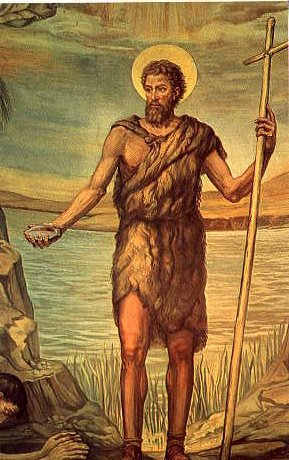
Christian Baptism Series – Part 3 – John & His Baptism of Repentance

Image

Who is John the Baptist and what was the purpose of his baptism?
When introduced to John the Baptist in the beginning of the gospels, the role he plays is essential to defining both what baptism is and who Jesus is. In the beginning of the Matthew (Chapter 3) and John’s (Chapter 2) gospel accounts it is revealed that the Pharisees send messengers to inquire about John the Baptist to discern who he claims to be and why he is baptizing. They are curious as to whether he is the Christ, Elijah or the (faithful) Prophet (John 1:19-22). He denies each of these titles and answers by simply quoting Isaiah 40:3 saying that he is a “voice crying out in the wilderness…” and points them to the one that will come after him whose “sandals he is unworthy to untie.” The Jews were used to their many forms of purification as we studied earlier, so while the act of purification was not foreign to them, the language used along with the massive number of recipients was. This was the basis for the Pharisees questioning. So what’s the difference between the baptism of John the Baptist and the baptism commissioned by Jesus in Matthew 28:19? Several times in scripture, John’s baptism is called a “baptism of repentance” (Luke 3:3, Mark 1:4, Acts 19:4) and this title is specific to John.

What does this mean?

Is it different than Jesus’ baptismal commission in Matthew 28:19?

To understand this, the person of John the Baptist, his purpose and work, must be understood. Scripture lays this out in detail.  Isaiah 40:3 is where this study begins.

“A voice cries: Prepare ye the way of the LORD; make straight in the desert a highway for our God.”

Traditionally, before the New Testament period, Isaiah 40:3 was viewed as fulfilled when the remnant of Judah returned from Babylonian captivity. The desert highway was the route of grace for those who remained faithful.  Barry G. Webb, in his commentary on Isaiah, has a more astute observation when he says…

“Although there was a partial return from exile in the years following 539 B.C., spiritually the exile continued until the Messiah came. Only he could solve the deep, underlying problem.”

This is actually at the heart of the often misquoted Jeremiah chapter 29.  Jeremiah has prophesied that Babylon will conquer Jerusalem but God will save for himself a remnant that will be exiled to Babylon. Chapter 29 is a letter of comfort to these exiles outlining the promises, hope and blessings they have and will be given for staying faithful.  The promises include both spiritual and temporal blessings. The temporal blessings were fulfilled when the remnant returned from exile, but the spiritual blessings of hope and a future were still yet to be fulfilled.  These blessings would be met in the person and work of the coming Messiah.

Malachi 3:1 says…

“Behold, I send my messenger, and he will prepare the way before me. And the Lord whom you seek will suddenly come to his temple; and the messenger of the covenant in whom you delight, behold, he is coming, says the Lord of hosts.

This is the same verse that is quoted in Matthew 11:10, Mark 1:2 and Luke 7:27. Notice there is a distinction between the “messenger” who prepares the way (John) and the “messenger of the covenant” (Jesus). Therefore, looking through these lenses, John’s ministry is fully preparatory for the entrance of Christ. This means that in all things John is preparing, which includes baptism. John’s baptism of repentance, in light of Isaiah 40:3, is a call for Israel to return from their spiritual exile. Thus John’s baptism of repentance is for Israel alone and fully efficacious for the remission of their sins. Therefore, the Pharisees were looking for Elijah to return in the flesh as a fulfillment of the prophecy in Malachi 4:5 and thus sent messengers to ask if this was who John claimed to be.  Malachi 4:5 says…

“Behold, I will send you Elijah the Prophet before the great and awesome day of the Lord.”

John denies this claim which was true.  He was not Elijah in the flesh but John who was naturally born of Zechariah and Elizabeth.  That being said, how does this work in light of Matthew 17:10-13 where Jesus refers to John the Baptist as Elijah?  Jesus was simply stating that John was a type of Elijah as he was the last prophet before Jesus Christ.  All previous prophets pointed forward to Christ and the same is true for John, only in addition to pointing to his coming, he was also Jesus’ contemporary and thus prepares the way for him. The idea of preparing the way for Jesus’ ministry begins with Johns baptism of repentance.  John’s preparatory baptism merges into Jesus’ ministry in John 3:26 and 4:1-2 when Jesus’ disciples begin to baptize alongside John. John’s view of this accompaniment is that he must decrease and Jesus must increase. R.C.H. Lenski puts it this way in his commentary on Matthew…

“In essence and efficacy both were the same. The Baptist’s was on the level of the revelation given at that time; that of Jesus on the level of his completed work. That of the Baptist made followers of the Christ about to come; That of Jesus followers of the Christ who had come. Both bestowed forgiveness; the one the forgiveness about to be wrought; the other the forgiveness that had been wrought. Thus the baptism of John was preparatory for Israel alone, Christ’s permanent for all nations. And only in this way that one made ready for and then gave way to the other.”

Therefore the only real difference between John’s preparatory baptism and Jesus’ is whom it is directed toward. John’s is for Israel and Jesus’ is for everyone. I would also like to address some confusion concerning John’s baptism as seen in Acts 19. When Paul arrives in Ephesus, he discovers some disciples who knew nothing of the Holy Spirit. Paul subsequently asks in whom they were baptized? They reply into John’s baptism. This appears to contradictory. The apostles and Apollos were also baptized into John’s baptism and it was fully efficacious not warranting a “re-baptism.” Paul makes sure to point out why their baptism wasn’t real; lack of knowledge of the work of Jesus or the Holy Spirit. These disciples were not familiar with Jesus nor had they heard of, let alone received the Holy Spirit in their baptism. This means that no baptism really took place. Paul lays hands on them and baptizes them in the triune name of God (in the name of the Father, Son and Holy Spirit); which is how the Lord Jesus commanded in Matthew 28:19. The New Bible Commentary has a solid explanation…

“These people had received a baptism of repentance, which was in itself a good thing, but unlike Apollos (Acts 18:25), they did not seem to know anything about Jesus. We are not told that Apollos needed to be rebaptized (Priscilla and Aquila certainly would have been able to baptize them, if Ananias could baptize Paul, Acts 9:17-19). The probable difference was that Apollos knew about and trusted in the Messiah (having accurate, if incomplete knowledge about him, Acts 18:25-26) and saw his baptism in connection with that faith, whereas for these disciples, the baptism was merely a pledge of good behavior. They still needed to be baptized into the name of the Lord Jesus.”

What is Repentance?

Now that the similarities and differences between John’s and Jesus’ disciples baptism have been established, it is important to look at and understand repentance as defined by scripture. These days, it seems common thought amongst Christians that repentance is something that the individual does in and of themselves. In this modern definition, I do the initial work and God takes care of the rest (by forgiving my sin). This is 180 degrees backwards from what scripture presents. Repentance is a gift that we cannot come to apart from God’s work. In Luke 15:3-7, Jesus tells the parable of the lost sheep.

So he told them this parable: “What man of you, having a hundred sheep, if he has lost one of them, does not leave the ninety-nine in the open country, and go after the one that is lost, until he finds it? And when he has found it, he lays it on his shoulders, rejoicing. And when he comes home, he calls together his friends and his neighbors, saying to them, ‘Rejoice with me, for I have found my sheep that was lost.’ Just so, I tell you, there will be more joy in heaven over one sinner who repents than over ninety-nine righteous persons who need no repentance.

This is where we go to truly understand repentance. The shepherd in the parable is Jesus and we are the sheep. A sheep is lost, representing us, and the shepherd does all the work to find the sheep, then puts the sheep on his shoulders, rejoices and carries him back home. Notice that Jesus doesn’t make the sheep walk back on his own. This is purposeful. This shows that we do absolutely none of the work as we are only receptive of the life saving gift. In verse 7, Jesus concludes by saying that this parable is a picture of repentance. Repentance is Jesus finding us and carrying us home, therefore, it is not something we do. The only role we play in the story is that of getting ourselves lost, and when found, agreeing with Christ that we are indeed lost thus we cooperate by returning with him.  Repentance is gifted agreeance with Christ.  Repentance acknowledges that our sin is indeed sin and is in opposition to the will of God and thus receives forgiveness of sins as a gift given from Christ’s atoning work on the cross.

Summary thus far

In effect, John’s baptism is one of repentance, specifically for Israel and Christ’s baptism is one of repentance for all nations. John’s baptism calls the Jews from their spiritual exile while Jesus’ baptism expands the call to all nations. Both baptisms are fully efficacious and do precisely what scripture says they do; forgive sin.  Neither baptism requires any work of our own because they both are 100% Christ’s work. In Mark 2, when the paralytic is lowered through the roof, Jesus first forgives the mans sin.  The Pharisees respond in verse 7 by saying…

“Why does this man speak like that? He is blaspheming! Who can forgive sins but God alone?”

The Pharisees were right in saying that only God can forgive sin.  By doing this Jesus claims His divinity and then proves it by healing the man’s temporal ailment allowing him to walk.  Baptism, as described in scripture is no different.  There are many passages that connect baptism to the forgiveness of sins.  These verses will be investigated in the upcoming installments of this study on baptism.  Before moving on, let’s look back to what was learned in week 1 of this study to begin to connect the Old Testament with the New Testament.  In week 1 of this study, several examples of “means and promise” were studied.  For the priest, washing feet and hands in the bronze basin before entering the tent of meeting was efficacious as it saved him from certain death.  For the person in contact with the deceased, washing on the 3rd and 7th day was efficacious in allowing him to return to the community.  This same “means and promise” purifies the leper as well as the scapegoat handler.  In like manner, the New/Old Testament allegories (The flood narrative and the crossing of the Red Sea) point to baptism as accomplishing salvation.  The Ezekiel prophecy in Chapter 36:24-27  says…

“I will take you from the nations and gather you from all the countries and bring you into your own land. I will sprinkle clean water on you, and you shall be clean from all your uncleanliness, and from all your idols I will cleanse you. And I will give you a new heart, and a new spirit I will put within you. And I will remove the heart of stone from your flesh and give you a heart of flesh. And I will put my Spirit within you, and cause you to walk in my statutes and be careful to obey my rules.”

This prophecy also speaks of “means and promise.”  The means is sprinkling with water and the promise is cleanliness, a new heart of flesh and gifting of the Holy Spirit.  This prophecy points forward to both John’s baptism of repentance and Jesus’ baptism for the forgiveness of sins (and gifting of the Holy Spirit) as Jesus’ baptism engulfs John’s and expands it to all.  There is no racial restriction. There is no cultural restriction. There is no gender restriction. There is no positional restriction.

There is no age restriction.

This statement of inclusion has been a topic of much debate in “modern” times.  I am well aware of there being no verse that clearly states “baptism is for infants.” However, using this same poor hermeneutical principle, a case could be made that communion isn’t for women as there is no place in the Bible that records a woman taking communion, or where it says that women can take communion. We know this to be hogwash, but it goes a long way in making the point as I am equally aware of zero verses that restrict baptism from infants. Simply, the arguments used to validate women taking the Lord’s Supper are the same arguments historically used for affirming infant baptism. We cannot say this argument can be used for women and communion but not for baptism and infants. Matthew 28:19 says that we are to baptize all nations; children and infants are included in all nations. They are part of the census. They are counted. Galatians 3:28-29 states…

There is neither Jew nor Greek, there is neither slave nor free, there is no male and female, for you are all one in Christ Jesus. And if you are Christ’s, then you are Abraham’s offspring, heirs according to promise.

These verses are solely salvivic. They clearly state there is no division or distinction in Christ’s salvation plan. I understand that it does not specifically say “elderly or infant”, nor does it have to. Any of the distinctions made in the verse could be infant or elderly. The purpose of the list is the complete inclusiveness of Christ. If Paul had added a disclaimer excluding “infants” it would not be inclusive, but exclusive. Remember in Ephesians 1:4, Paul says that…

“even as he chose us in him before the foundation of the world, that we should be holy and blameless before him.”

This statement is as inclusive as Galatians 3:28-29. If God chooses us, what does age have to do with anything? It is as irrelevant as our color, gender or social status. In addition, infants are in need of what baptism offers.  Job 15:14, Psalm 51:5, John 3:6, Ephesians 2:3 and Romans 5:12 show that all are born under the curse of sin.  No one is born good or innocent.  In addition to believing what scripture says about this, there is also temporal proof.  The proof is that infants die.  Romans 6:23 says that the wages of sin is death.  Therefore, with ample proof that all are born under the verdict of guilty, including infants, the reality of the necessity for baptism of all ages is presented.  This will be revisited and expanded upon in Parts 5 and 6 of this study. In the meantime, stay tuned for next weeks installment “Part 4 – Why was Jesus baptized?”

Click here for “Christian Baptism Series – Part 4 – Why was Jesus Baptized”

Click here for “Christian Baptism Series – Part 2 – Jewish Rites of Purification & Pharisaical Law”

Can I Lose My Salvation?

Navel Gazer Question Mark

I hate hearing it.

Not because it’s altogether wrong, but because it’s damaging.  It insinuates a contradiction.  A true life oxymoron.

I hate hearing the question “Can I lose my salvation?”

It’s like nails on a chalkboard.  It’s a contradiction because it insinuates that it can be done apart from our will.  When I lose something, I’m always upset about it because I never wanted to lose it in the first place.

I currently find myself in the midst of several home improvement projects.  My house is a disaster area.  In the mix of attempting to work from home, advise contractors and field questions from my wife; I lost my car keys.  Did I want to lose them? Not at all.  Did I reject that the car keys were effective in starting my car or unlocking my front door?  No.  I simply lost them.  The next reasonable question is why did I lose them? On the most simplistic level, I lost them because I am a sinful fallen creature that is encapsulated in this body of flesh until death or Christ’s return. I lost them because I’m forgetful. I lost them because my mind wanders.

I lost them because they were mine to lose.

This begs a rather large question.  Do we own Christ or does Christ own us?  Let’s go to scripture for answers.

1 Corinthians 6:19-20 – Or do you not know that your body is a temple of the Holy Spirit within you, whom you have from God? You are not your own, for you were bought with a price. So glorify God in your body.

1 Peter 2:9 – But you are a chosen race, a royal priesthood, a holy nation, a people for his own possession, that you may proclaim the excellencies of him who called you out of darkness into his marvelous light.

1 Corinthians 12:27 – Now you are the body of Christ and individually members of it

John 15:5 – I am the vine; you are the branches. Whoever abides in me and I in him, he it is that bears much fruit, for apart from me you can do nothing. If anyone does not abide in me he is thrown away like a branch and withers; and the branches are gathered, thrown into the fire, and burned.

These passages makes it very clear that we are the possession of Jesus Christ; not the other way around.  In addition to these verses, there are many more that speak of our new position in Christ as children of God.  Simply put, that is more evidence that we are His possession.  Therefore, in my case, I lost my keys not because I wanted to, but because I am a sinful fallen creature AND because they were mine to lose.  Christ Jesus on the other hand is not sinful nor is he a creature.  He is the one and only God-Man who is the Second Person of the Trinity and is of the same substance as the God the Father.  Therefore Jesus can never lose me.  His perfection won’t allow it.  We are secure in Christ.

This opens a whole new can of worms.

I can hear the premature victory chants from the Calvinists alongside feigning shouts from the synergists.

My encouragement is to bear with me because we’ve only just begun.

If you look back to the beginning of this post, you will see that my issue was with wording.  This is why proper phrasing is key. The phrase “lose your salvation” completely irks me primarily because it is not possible for anyone to lose their salvation.  However, I do think it is possible to forfeit your salvation.   There is an important difference between lose and forfeit.

Webster defines lose as “to be unable to find, to fail to win or to fail to keep or hold (something wanted or valued).”

Webster defines forfeit as “something that is lost or given up as punishment or because of a rule or law.”

In order to lose something, one must be in possession of it.  I have already established evidence that Jesus Christ is the one in possession of our salvation and thus cannot lose it because of His perfection.  On the contrary, one who receives a possession from the possessor has the right to forfeit the rights and privileges that are being given from the possessor. You don’t have to be in possession to forfeit or give up your rights to the possession.  Therefore, speaking directly of salvation, Christ is the possessor of salvation and whether you initially forfeit those rights in unbelief or you lay hold of salvivic rights through faith in Jesus and then forfeit them at some point later (Ephesians 2:8 states that faith is also a gift, and thus can be forfeited) the right to forfeit is freely given to all as is defined by the term forfeit. The second part of the definition states that forfeit occurs by punishment of a rule of law.  This also works perfectly within the constraints of biblical reason.  If the gift of salvation is passively received through faith in Jesus, then active rejection of the gift through unbelief obtains the wage we earned which is punishable by separation from God in hell since the law demands perfection (James 2:10).  So when salvation in Jesus is forfeited through unbelief, punishment in eternal hell is earned.  This presents two distinct categories of people who actively forfeit the gift by grace through faith won by Jesus upon the cross; those who always will reject the gift of faith and those who passively receive the gift of grace through faith and eventually actively reject through unbelief. Both categories forfeit the free gift that is offered.  The first category containing those who always reject faith and live in unbelief thus forfeiting their salvation is generally accepted as a normative doctrine amongst most denominations within the church catholic.  The second category is someone who comes to faith in Jesus and eventually forfeits said faith and becomes apostate. Whether this category is possible is often debated between brethren.  The bible is clear that though it is uncommon, the possibility does exist. The following verses provide clear evidence for this position.

Hebrews 10:19-39Therefore, brothers, since we have confidence to enter the holy places by the blood of Jesus, by the new and living way that he opened for us through the curtain, that is, through his flesh, and since we have a great priest over the house of God, let us draw near with a true heart in full assurance of faith, with our hearts sprinkled clean from an evil conscience and our bodies washed with pure water. Let us hold fast the confession of our hope without wavering, for he who promised is faithful. And let us consider how to stir up one another to love and good works, not neglecting to meet together, as is the habit of some, but encouraging one another, and all the more as you see the Day drawing near. For if we go on sinning deliberately after receiving the knowledge of the truth, there no longer remains a sacrifice for sins, but a fearful expectation of judgment, and a fury of fire that will consume the adversaries. Anyone who has set aside the law of Moses dies without mercy on the evidence of two or three witnesses. How much worse punishment, do you think, will be deserved by the one who has trampled underfoot the Son of God, and has profaned the blood of the covenant by which he was sanctified, and has outraged the Spirit of grace? For we know him who said, “Vengeance is mine; I will repay.” And again, “The Lord will judge his people.” It is a fearful thing to fall into the hands of the living God. But recall the former days when, after you were enlightened, you endured a hard struggle with sufferings, sometimes being publicly exposed to reproach and affliction, and sometimes being partners with those so treated. For you had compassion on those in prison, and you joyfully accepted the plundering of your property, since you knew that you yourselves had a better possession and an abiding one. Therefore do not throw away your confidence, which has a great reward. For you have need of endurance, so that when you have done the will of God you may receive what is promised. For, “Yet a little while, and the coming one will come and will not delay; but my righteous one shall live by faith, and if he shrinks back, my soul has no pleasure in him.” But we are not of those who shrink back and are destroyed, but of those who have faith and preserve their souls.”

This Hebrews passage is crystal clear in its warning to the church.  The person described in this passage has “received knowledge of the truth.”  The phrase itself forces the idea that the knowledge received was true to the person who received it.  If the person did not agree with the knowledge they received they would not label it as truth therefore the person receiving the knowledge must have agreed at one point that what is being received is true or the verse completely falls apart.  A few verses later in this passage the same person is labeled as being “sanctified” (meaning made holy) and then trampling Jesus underfoot.  It was already made abundantly clear in verse 26 that there no longer remains a sacrifice for sins for the this person.  Several verses later the writer of Hebrews warns the reader to not “throw away their confidence” in like fashion.  Why would the writer of Hebrews give an example of a sanctified believer that received knowledge of the truth and turned from that through rejection of Jesus by trampling Him underfoot through deliberate sin thus nullifying the forgiveness of sins that was gifted through the original reception of the knowledge of truth AND THEN warn of us not to do the same?  If falling away isn’t a possibility, this passage would simply be a lesson in futility. The Hebrews passage is abundantly clear and thus doesn’t need further explanation. The only reason one would attempt to twist these verses to mean anything other than what they clearly state would be to form them into a doctrine of human creation.

John 15:1-11 – “I am the true vine, and my Father is the vinedresser. Every branch in me that does not bear fruit he takes away, and every branch that does bear fruit he prunes, that it may bear more fruit. Already you are clean because of the word that I have spoken to you. Abide in me, and I in you. As the branch cannot bear fruit by itself, unless it abides in the vine, neither can you, unless you abide in me. I am the vine; you are the branches. Whoever abides in me and I in him, he it is that bears much fruit, for apart from me you can do nothing. If anyone does not abide in me he is thrown away like a branch and withers; and the branches are gathered, thrown into the fire, and burned. If you abide in me, and my words abide in you, ask whatever you wish, and it will be done for you. By this my Father is glorified, that you bear much fruit and so prove to be my disciples. As the Father has loved me, so have I loved you. Abide in my love. If you keep my commandments, you will abide in my love, just as I have kept my Father’s commandments and abide in his love. These things I have spoken to you, that my joy may be in you, and that your joy may be full.

John 15 provides further evidence concerning real possibility of forfeiting salvation.  This is the famous passage about Jesus being the vine and Christians playing the part of the branches.  Verse 5 tells us that if anyone doesn’t abide in Jesus, the true vine, they will be cut off and thrown into the fire.  To be in the vine is to be in Christ.  Jesus gives the answer on how to stay in the vine.  A person stays in the vine by abiding in Christ. A couple verses later, Jesus says that we abide by loving Him and we love him if we keep his commandments.  The Greek word for “keep” is “tereo” which does in fact mean keep, however, not in the sense that it is most often understood.  “Tereo” means keep-in-tact or guard. We keep Jesus’ commandments in tact when we believe that they are right and true.  We guard them against false teaching because they are right and true.  Therefore we keep His commandments by trusting in Him, i.e. faith.  Once again, faith in Jesus for the forgiveness of sins receives the promise of forgiveness of sins while unbelief forfeits the gift that is offered.  One cannot be cut from the vine if they were not or were never in the vine to begin with.  The argument that those who are apostate were never really saved doesn’t hold water because if they never had faith, they would have never been in the vine in the first place.

These two passages are clear texts that show that we must be on guard against apostasy (forfeiting our salvation).  Apostasy is always the result of unbelief expressed through continual, unrepentant sin.  One doesn’t accidentally fall into apostasy as it is a premeditated active exchange of forgiveness of sins in Jesus Christ for the pleasures of this world through temporal desire for instantaneous satisfaction. This doesn’t mean that when someone sins they are apostate or if someone fails to repent of each and every sin they have forfeited their salvation.  It simply means that if someone comes to a place where they find themselves consistently choosing /living in sin and when confronted with that sin, has no contrition, remorse or desire to repent, then forfeiture of salvation has occurred.  There is still hope for these people (as long as they have breath in them) that through the hearing of the word, God could bring them back to repentant faith in Him.

(Side Note:  I am aware that Hebrews 6:4-8 states that is impossible for anyone who has ” been enlightened, who have tasted the heavenly gift, and have shared in the Holy Spirit, and have tasted the goodness of the word of God and the powers of the age to come” to be restored again after falling away.  I wholeheartedly agree with this passage as it is scripture and I readily confess that all scripture is God breathed.  I’d like to take a moment to harmonize this passage with my thoughts pertaining to hope for those who have fallen away.  What is exposed in this passage is “blasphemy of the Spirit” also known as the unpardonable sin.  This sin is also discussed in Matthew 12:31-32, Mark 3:28-29 and Luke 12:10. The writer of Hebrews paints a vivid picture of one who truly believes and experiences the complete fullness of the Christian life with great understanding and then falls away, rejecting all that they factually know to be true (we are not dealing with standard unbelief, but true belief that results in them rejecting all they know be true).  Since we do not know the heart of those we minister too, we cannot go forward with the attitude that all who have fallen away fit this description of having blasphemed the Spirit, therefore we must treat all as if there is hope.  I have actually met some people who thought they had blasphemed the Holy Spirit and were wrecked thinking that they were hopeless.  Their contrition proves their heart has not completely hardened (Acts 28:27).  I initially considered removing the statement concerning hope for those who have fallen away out of the post as to avoid confusing people or starting a debate, but I decided to leave it as a way to give hope to those who may have thought they unintentionally committed blasphemy of the Spirit.  After thinking about it i decided it would be better to add this side note for clarification.)

The argument put forth in this post is why I get worked up when I hear of someone terrified of losing their salvation and equally upset when they believe they are eternally preserved by the Calvinist doctrine of Perseverance of the Saints.  You see, either end of this spectrum will bring you doubt instead of comfort. Either end of this spectrum forces you to look within yourself to determine if you have either lost your salvation or to answer internal doubts about whether you are indeed elect (or not).  Whenever we look to ourselves for proof of salvation, we take our eyes off of Jesus Christ, the possessor of our salvation who will never lose or forfeit our salvation because of his perfection.  In the gospels of Matthew and Mark when Peter walks upon the water to meet Jesus, he only begins to sink when he takes his eyes off of Jesus.  Likewise, looking to ourselves takes our eyes off of Jesus which causes us to sink into the miry depths of depression and soul searching while leaving us in constant limbo as we continually question our salvation.  Both the Calvinist position of perseverance of the saints and the synergist position of losing your salvation are two sides of the same coin and the effects are equally damning to any confidence that we have in Jesus Christ.  They both draw you away from Jesus by turning your eyes from His promises to introspective mind games of self doubt and insecurity. It’s my encouragement for you to stop looking in the mirror.  Stop focusing on yourself so much because ultimately it’s not about you; it’s about what Jesus Christ has done for you.  That should be the focus of your attention.  Rest in his perfection.