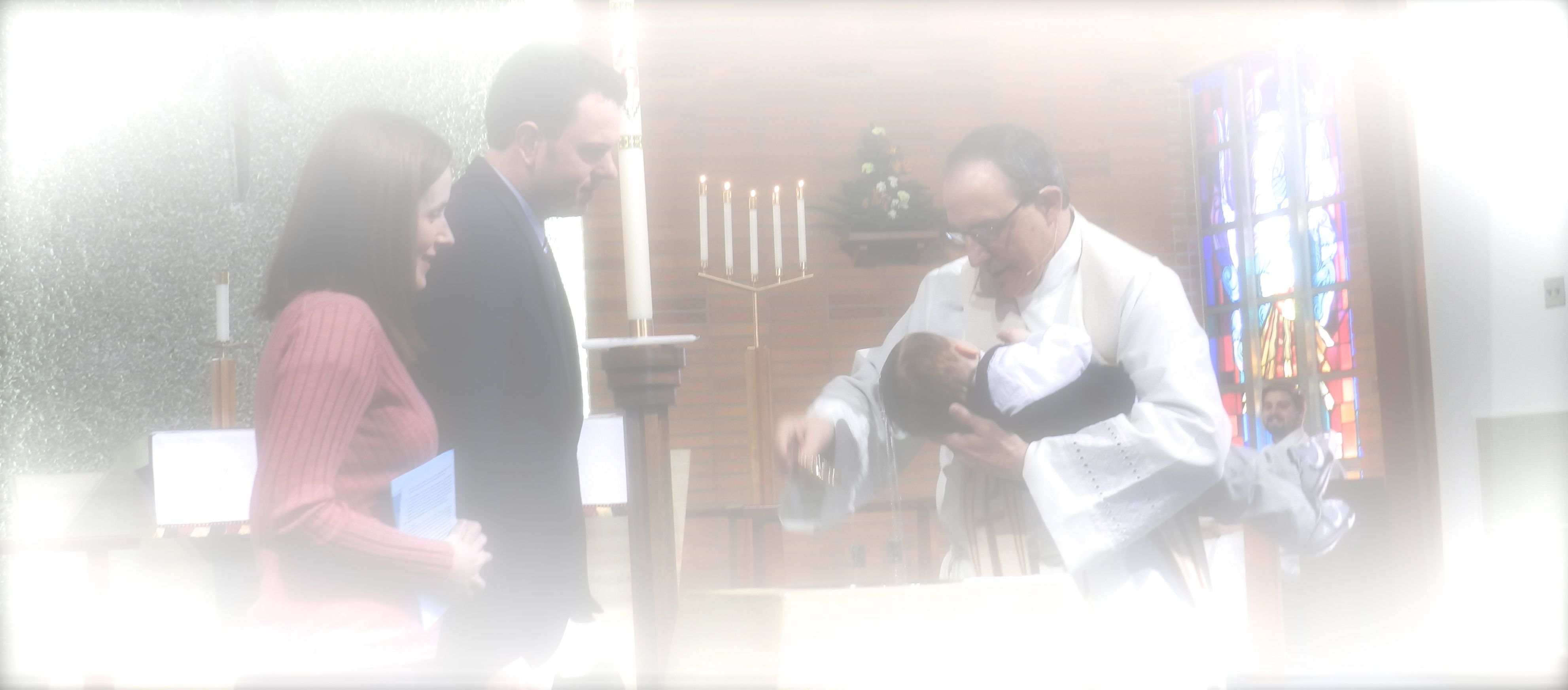
Should Infants Be Baptized?
It has been established by the previous posts in this series that baptism actually does something. It gifts forgiveness of sins and the Holy Spirit. If the scriptural promise attached to baptism is true, then the question of nessecity arises concerning whether infants need the gifts offered. Do infants need forgiveness of sins? Are they born perfect or are they born sinful?
Romans 5:12
“Therefore, just as sin came into the world through one man, and death through sin, and so death spread to all men because all sinned”Job 15:14
What is man, that he can be pure? Or he who is born of a woman, that he can be righteous?Psalm 51:5
Behold, I was brought forth in iniquity, and in sin did my mother conceive meJohn 3:6
That which is born of the flesh is flesh and that which is born of the Spirit is spirit.Ephesians 2:3
among whom we all once lived in the passions of our flesh, carrying out the desires of the body and the mind, and were by nature children of wrath, like the rest of mankind.
These verses paint a rather dire situation for anyone born of flesh (with Christ Jesus being the lone exception). Infants may not be able to rob a bank, tell a lie or covet their neighbors Ferrari, but the seed of Adam is ever present within us all from the point of conception forward. The fall has infected us to the core. Sin has no prejudice. Like a pit viper, it inflicts it’s poisoness effect without regard for gender, race, status or age in hopes of certain death for it’s victim. The anti-venom is only found in the blood of Jesus Christ. So yes, it is quite evident that infants need what baptism offers. They need forgiveness of sin. This may be shocking or a hard teaching for many, but within historical Christianity, there wasn’t even a debate about this. The earliest teaching resembling the doctrine of believers’ baptism didn’t arise until the 1520’s when the Zwickau Prophets organized to protest Martin Luther. These “prophets” came out of the early stages of the radical reformation. They taught that the Holy Spirit reveals all that is needed, directly, to the individual apart from the word. Therefore they taught that the bible was not authoritative. This claim was in opposition to Luther’s teaching of sola scriptura. Their defense of denying sola scriptura stated that if the Bible was indeed authoritative, then God would have dropped it directly out of the sky. Since the bible was written by mere men, it couldn’t attain the status of divine authorship or authority. On the other hand, they taught that God dropped the Holy Spirit out of the sky and implanted him into all believers and therefore, authoritative truth proceeds solely from believers. Because of this view, they divorced what the scriptures said concerning many things, including baptism, and created their own views based on their supposed direct revelations. They severely opposed infant baptism and affirmed believers’ baptism based on these direct revelations. Following in the baptismal steps of the Zwickau Prophets the radical reformation moved forward through the likes of Anabaptist groups like the Hutterites and Mennonites. Unlike the Zwickau Prophets, these groups affirmed Sola Scriptura, however since the Bible didn’t explicitly say “baptize infants” they rejected infant baptism through the claim of Sola Scriptura. Many controversies and separations continued as this new teaching of symbolic adult baptism continued to spread. Other groups were also influenced by the radical reformation which resulted in the English separatist movement in the 17th century which birthed denominations like the Baptists. The position of the Radical Reformation came out of a stark desire to distance themselves as far away from Rome as possible as they believed Luther’s error was that he did not go far enough.
Therefore the baptismal continuum looks something like this. From 30AD to 1525AD, baptism was taught to be regenerative and for all regardless of age, then a split started with the birth of the radical reformation around 1525 that produced 3 alternative views resulting in 4 major branches; Regenerative baptism for all ages, non-regenerative baptism for all ages, regenerative believers baptism and believers baptism as a symbol. There is a major problem with this as it would mean that for approximately 1500 years Jesus would leave His church completely misinformed and lost in the woods concerning one of only two things that He instituted in Matthew 28:19-20. For there to be a misuse, there has to be an initial correct use. If I am misusing a wrench, there had to first be a correct use for which the wrench was intended before misuse can be entertained. Concerning baptism, history reveals unity in appropriate use and function for 1500 years, followed by 500 years of proper use alongside misuse. The church fathers are rather clear in their position as they repeatedly affirm regenerative baptism for all ages. If the church fathers that carried the torch of Christianity through the first 5 centuries alone are studied, it is clear that infant baptism is the standard, accepted, unquestioned, professed and proclaimed view amongst the church. There was no discussion concerning age requirements for baptism apart from whether baptism should occur on or before the eighth day. That debate was quickly extinguished by Cyprian of Carthage in 253AD when he suggested that the day doesn’t matter, just do it as soon as possible. Here is a list of solid, sound church fathers who affirm regenerative baptism as a means of grace for people of all ages…
1st Century – Barnabus and Hermas
2nd Century – Irenaeus, Theophilus of Antioch, Clement of Alexandria & Justin Martyr
3rd Century – Tertullian, Cyprian of Carthage and Hippoytus
4th Century – Gregory of Nazianz, John Chrysostom, Basil the Great, Ambrose of Milan, Aphraahat the Persian, Cyril of Jerusalem, Athanasius, Eusibius of Caesarea and Jerome
5th Century – Augustine, Theodore of Mopsuestia and Severian of Gabala,
Now that the historical ground work has been laid for regenerative baptism for all ages, what does scripture say?
Matthew 28:19-20
Go therefore and make disciples of all nations, baptizing them in the name of the Father and of the Son and of the Holy Spirit, teaching them to observe all that I have commanded you. And behold, I am with you always, to the end of the age
This verse issues a directive to make disciples of all nations. This is to be done by baptizing and teaching the word. The qualifier in the statement hinges on what is meant by “nations.” Webster defines it as “a territorial division containing a body of people of one or more nationalities and usually characterized by relatively large size and independent status.” This is a pretty standard definition. The primary subject that defines a nation is “people.” “People” is nondescript. The word “people”, in its generic use (which is how it is used in this context), has no age description. People, I contend, are people from conception to death. The verse does not say make disciples of all men, or women or all people except infants and small children. It says make disciples of all nations. Infants are included when the census is taken. Citizenship is granted as a birthright. This is as inclusive as it gets.
Galatians 3:28-29
There is neither Jew nor Greek, there is neither slave nor free, there is no male and female, for you are all one in Christ Jesus. And if you are Christ’s, then you are Abraham’s offspring, heirs according to promise.
This verse is also purposefully written to be inclusive. Paul is stating that salvation is for all as there is no hierarchy or limits to who can be saved. Once again, if the Holy Spirit though Paul wished to exclude small children and infants, said exclusion would have been part of the text. The fact that this verse goes to great lengths to be inclusive is proof positive. Each of the categories that Paul mentions could refer to an infant or the elderly, therefore the necessity for such language is unnecessary. Once again the full inclusivity of Christ is presented.
Acts 2:38-39
And Peter said to them, “Repent and be baptized every one of you in the name of Jesus Christ for the forgiveness of your sins, and you will receive the gift of the Holy Spirit. For the promise is for you and for your children and for all who are far off, everyone whom the Lord our God calls to himself.”
This response by Peter is to those at the Day of Pentecost sermon when they realize Jesus’ blood was on their hands. The text says they were cut to the core and asked Peter what they needed to do to be saved. Once again, an enormously inclusive verse is given. One particular argument that I have heard is that Peter is really saying that “you and your children” is descriptive of “the Jews” and that “all who are far off” describes the “gentiles” therefore the “you and your children” section should not be taken literally. This is shortsighted eisegesis. It is true that both Jews and gentiles are included in the statement as there is a great crowd at Pentecost full of both Jews and various gentile nations (thus the necessity for tongue speaking and translators). Peter is simply preaching what he was told in Matthew 28:19-20. Peter is making disciples through the method in which Jesus commanded him. This crowd was precisely “you and your children and for all who are far off…” All nations were present in the crowd. There were adults, parents, children, infants, brothers, sisters, aunts, uncles, nephews, nieces, fathers, mothers and cousins. These were people of all ages. Peter once again does not exclude anyone from baptism. He says it is for you and for your children and for all who are far off, for as many as the Lord will call unto himself. The verse when taken literally includes everyone present. If the verse is present only figuratively (as the argument claims) then this verse, by nature, becomes exclusive. There are no liguistic, historical or theological reasons that necessitate reading this verse other than literally. This verse clearly states that baptism is “for” the forgiveness of sins and the gift of the Holy Spirit, therefore the promise is made to all who need it which includes “you and your children” as were present at Pentecost and are still present today. This leads us to the next verses…
Matthew 19:13-15
Then children were brought to him that he might lay his hands on them and pray. The disciples rebuked the people, but Jesus said, “Let the little children come to me and do not hinder them, for to such belongs the kingdom of heaven.” And he laid his hands on them and went away.Luke 18:15-17
Now they were bringing even infants to him that he might touch them. And when the disciples saw it, they rebuked them. But Jesus called them to him, saying, “Let the children come to me, and do not hinder them, for to such belongs the kingdom of God. Truly, I say to you, whoever does not receive the kingdom of God like a child shall not enter it.”
There are a couple things that need to be pointed out here. To properly understand what is going one must look to the koine Greek word for children used in these passages. Matthew uses παιδία (paidia) which means small child. Paida is somewhat broad as it can be either an infant or a young toddler. Luke uses the word βρέφη (brephē) which is more precise and means “suckling infant.’ This word is used 8 times in scripture and always identifies the child as being as young as possible. For instance Luke uses this same word to describe John the Baptist in utero when he lept with joy inside of Elizabeth when Mary shared the news of her immaculate conception. It is crystal clear that this verse is speaking about infants and very small children. When these parents were bringing their small children to Jesus, the disciples rebuked them. Jesus, however, overturned their rebuke and let the children come to Him without hindrance. These children cannot come to Jesus apart from their parents carrying them because they are so small. Jesus desires these small children to be brought to him, therefore the question today becomes how do our small infant children come to Jesus? They can’t be brought to a physical Jesus as in the gospel narratives because Jesus has ascended and we are waiting on His return. The answer is found in where Jesus promises to be for his church (word and sacrament), therefore, they are brought to Jesus in the waters of baptism. One of the claims of those who affirm believers’ baptism is that infants cannot repent or have faith because they cannot comprehend such things. The issue is that apart from Christ neither can we. Age is not something that lessens sins stranglehold and according to these verses, age actually does the opposite by increasing sins grip. I didn’t come to Christ because of anything I did and more specifically not because I turned a particular age or ascended to a certain mental capacity. It was 100% Christ finding me and carrying me home. Because of Jesus, I was gifted with repentance, salvation and the Holy Spirit. I did zero to earn it. Apart from Christ I could not even desire repentance, let alone salvation, I could only despise it. Once again Romans 10:17 states that faith comes by hearing the Word. Infants can hear from within the womb. There is Psalm 22:9 where David confesses faith while nursing. Also in Luke 1:15, John the Baptist was filled with the Holy Spirit from the womb. To be filled with the Holy Spirit is to have faith. Lastly, baptism gifts the Holy Spirit (Acts 2:28-39). If the Holy Spirit is within someone, faith must also be present in order to receive the gift. Therefore if faith isn’t present before baptism, the word and water will create the faith necessary to receive the gift promised by the word through the waters of holy baptism. Considering all of this, I am most perplexed that many who fight the abortion culture war in this country, that ascribe so much to life at conception (and rightly so) by exalting so high the temporal gift of life, yet completely wash away the spiritual blessings and promises that God has made to and for our infant children by the word through the waters of baptism.
So now the question is raised concerning what this means. Is it certain salvation? The answer to this is actually rather simple. The answer is to believe God and His promises. To clarify that statement, baptism is a means of grace just like the audible teaching of the Word is a means of grace. Just as there are those who reject the teaching of of the word, there too will be those who will reject the promises gifted in baptism. The word is always efficacious (capable of producing an effect), but not always effective (producing an effect). Baptism is the same. The mysteries of God must be acknowledged in that that God sometimes allows his will to be thwarted (e.g. the anguished words of Jesus regarding Jerusalem: “How often would I have gathered your children together as a hen gathers her brood under her wings, and you would not!”). What gets us turned around so easily is that we constantly confuse God’s certainty of promise keeping with our proclivity for promise breaking. God is offering a promise in baptism just like he is offering a promise in teaching the Word, we can accept (passively) or reject (actively) the gift of that promise, but keep in mind that our rejection doesn’t nullify the fact that the promise has been made. Age doesn’t figure anywhere into this equation. Our infant children have been tainted by the sin of Adam. Even though our little ones cannot lie or cheat or murder at so young an age, they still have inherited the curse (Romans 5:12). Baptism cleanses not only the sin of Adam, but also the sins of their future because baptism is what God does, not something that we do. However, this doesn’t negate the necessity of proper nourishment. Infants must be reared in the shadow of word and sacrament. After baptism, the second part of process for making disciples must take place as they are taught and instructed all the things the Jesus taught through the disciples found in the written word. In baptism, God works by gifting forgiveness of sins and the Holy Spirit to the recipient. The promise of this gift should eagerly send parents running their children to the baptismal font. This is the attitude present when the early church fathers answered questions concerning age of baptism. Good parenting entails proper nourishment, love and care. If infants are bathed to cleanse the temporal dirt from their body, then scripture gives all the more reason too cleanse them in the waters of baptism as a means of proper spiritual nourishment, love and care. Failing to do this is the essence of hindering the young ones from coming to Christ. Therefore infant baptism doesn’t abdicate parental responsibility, it increases it.
(Click here for a link to quotes on regenerative baptism for all ages by early church fathers as compiled by Chris Rosebrough)
Stay tuned for the final post of the “Christian Baptism Series – Part 7 – Summary and FAQ”
Click here to link to “Christian Baptism Series – Part 5 – What does Baptism do?”

