Theology

Mining the Parables: The Barren Fig Tree – Luke 13:1-9

barren fig

The Hammer of God is a little known classic within Christian literature and the fact that it flies under the radar is indeed sad.  The book consists of three novellas, all which paint the picture of church life from a pastoral perspective.  In the first novella, titled “The Hammer of God”, Giertz introduces the reader to a young curate named Savonius.  Savonius preaches the law with great ferocity, but fails to ever comfort souls with the healing salve of the gospel.  This results in a reduction of sinful living within the community, but also begins to breed an air of self righteousness in many congregants and an internal sense of overwhelming desperation within Savonius as he begins to realize the depths of his own depravity.  One day a cobbler named Anders visits Savonius to seek counsel about his brother who lives with him.  Anders is angry that his brother is drinking whiskey in his home and desires Pastor Savonius to give advice on how to coerce his brother to stop.  Savonius asks if his brother is in the habit of being a drunkard. Anders says no,  but expresses anger that his brother has the audacity to openly drink in front of him. Sovonius replies by asking if Anders would prefer his brother to drink alone where temptation could more easily overtake him?  Anders, frustrated that he isn’t getting anywhere with the pastor, abruptly storms out.  Savonius’ questions were purposefully pointed to show Anders that the true problem didn’t lie with his brother or the whiskey, but with himself.  Self righteousness is synonymous with unrepentance and this is what Savonius attempted to help Anders realize. Todays biblical text is Luke 13:6-9, “The parable of the barren fig tree.”  The contextual setup for the parable is found in Luke 13:1-5 and is remarkably similar to the dialogue between Savonius and Anders.

There were some present at that very time who told him about the Galileans whose blood Pilate had mingled with their sacrifices. And he answered them, “Do you think that these Galileans were worse sinners than all the other Galileans, because they suffered in this way? No, I tell you; but unless you repent, you will all likewise perish. Or those eighteen on whom the tower in Siloam fell and killed them: do you think that they were worse offenders than all the others who lived in Jerusalem? No, I tell you; but unless you repent, you will all likewise perish.”

In these opening verses, Jesus finds himself in the midst those reporting the atrocity of Pilate desecrating the temple sacrifices.  At this time Pilate was fighting against the Galilean zealots.  These zealots were top priority for Pilate as their motivation was to promote unrest in gaining support to rally the Jews toward insurrection against Rome in an effort to ultimately gain full independance. Pilate was consumed with ridding these zealots from his territory at any cost.  In seeking shelter from Pilate, some zealots sought safe haven in the Jerusalem temple, a place they assumed Pilate would not dare go out of reverence for Jewish religious laws.  Not only did Pilate pursue the zealots into the temple, but also slew them in the temple, thus mixing their blood with the blood of the sacrifices (which were for atonement from sin).  This was a terrible act of desecration which nullified the sacrifices that were tainted with human blood.  Jesus’ response to the report is very insightful.  Throughout the gospel accounts, Jesus knows the heart of his questioners.  His questions are motivated by a desire to aid the questioner in their understanding, not because he is looking for the answer.  Jesus knows that these reporters are telling him this story out of self righteousness instead of remorse.  This is why he responds by asking them if they thought those slaughtered by Pilate in the temple were worse than all other Galileans.  He knows their heart and thus calls them to repentance saying that apart from repentance, they will die in like manner.  This statement is fascinating when understood in the context of what happened concerning Pilates desecration of the sacrifices.  Self righteousness always looks both inward, to prove that we are checking things off of our list, and downward, at others when their sin is exposed.  Repentance comes through the realization of our sinful state by resting in the person and work of Jesus.  Thus, if these reporters reject repentance and cling to self righteousness instead, they are ultimately choosing to rely on their work rather than on Jesus’ salvivic work alone thus desecrating the sacrifice that Jesus will earn for them by his death and resurrection.  Jesus continues to press this issue further by speaking of a tragedy that killed 18 people when the tower fell at Siloam.  Jesus is saying that it is not the manner in which one dies that matters, only the condition of their heart.  Whether a person dies in a car crash, is murdered or succumbs to cancer is spiritually immaterial.  The only thing that matters is where their faith rests.  Saving faith always rests in the person and work of Jesus and always bears the fruit of repentance.  Saving faith is the antithesis self righteousness.

To further paint this picture to the reporters, Jesus tells them a parable in verses 6-9.

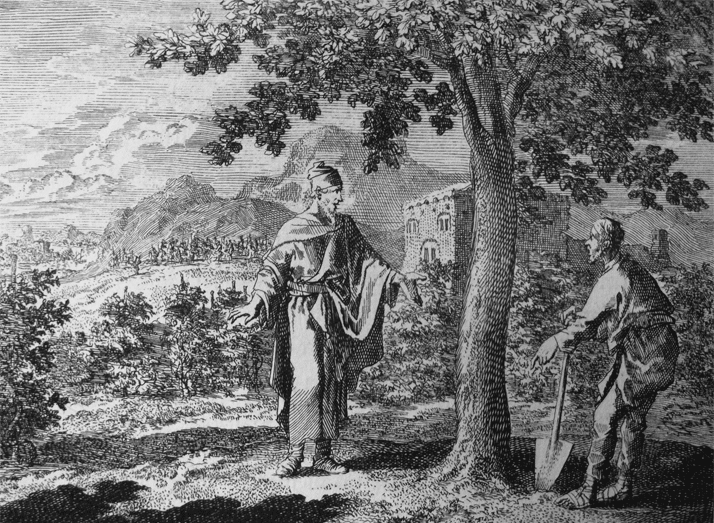
And he told this parable: “A man had a fig tree planted in his vineyard, and he came seeking fruit on it and found none. And he said to the vinedresser, ‘Look, for three years now I have come seeking fruit on this fig tree, and I find none. Cut it down. Why should it use up the ground?’ And he answered him, ‘Sir, let it alone this year also, until I dig around it and put on manure. Then if it should bear fruit next year, well and good; but if not, you can cut it down.’”

Some theologians attempt to divorce this parable from the previous 5 verses because on the surface, the narrative in verses 1-5 seems detached from the theme of the parable.  However,  a careful study will prove their theories incorrect.  The parable begins with a man who owns a vineyard and plants a fig tree in the vineyard.  The owner planted the tree with the purpose of bearing fruit, but each time he checks on the tree, he sees that it fails to bear fruit.  The owner then contacts the vinedresser, explains the situation and tells him to cut the tree down as it is merely wasting profitable space. The vinedresser petitions the owner to wait it out the rest of the year so he can once more give the tree the best opportunity to bear fruit, but that if tree continues to be barren, he will then cut it down.  With this understood, it is now time to reveal the parable cast.

The Man…..God the Father
The Vineyard…..Israel
The Fig Tree…..Jerusalem
The Fruit…..Repentance
The Vinedresser…..Jesus Christ
The 3 Years…..The collective ministry of the preparatory work John the Baptist and the fulfillment in Jesus Christ
The current year…..Extension of grace that carried through from the time of this parable through Jesus’ death and glorification.

God the Father owns a vineyard.  This vineyard was initiated by God’s promise to Abraham in Genesis 12 and 15 and realized through Jacob and his 12 sons in Genesis 32 when God changed his name from Jacob to Israel.  After many generations of nomadic living and temporal instability, God then plants his presence, through the building of his temple in Jerusalem which makes it the spiritual center of the Jewish faith.  Eventually through sin, Israel breaks into two kingdoms and only a remnant is faithful.  The remnant is taken into Babylonian exile with God’s promise of rescue after 70 years.  After 70 years, God keeps his promise and rescues the remnant, however, their spiritual exile continues until the Messiah comes.  This prophecy is consumated in the preparatory work of John the Baptist and completely fulfilled in the redemptive office of Jesus Christ.  John comes preaching repentance, and Christ, at his Baptism, engulfs John’s ministry and propagates it.  Christ continues to preach repentance.  This means that the vinedresser (or the one who cares for, nurtures and inspects both the condition of the tree/vine and its fruit) is Jesus Christ and the fruit that both he and The Father are looking for is repentance.  The collective ministry of John the Baptist and Jesus Christ was 3 years up to the point of this parable and the remaining year carries forth until Christ’s death, resurrection, and ascension.  In Luke 13:1-5, Jesus is most concerned with the unrepentant hearts of these Jewish reporters.  He is seeking the fruit of repentance, but they are yielding none.  Jesus will continue to preach repentance to them until his time comes.  This understanding adds all the more meaning to Matthew 23:37 where Jesus says ““O Jerusalem, Jerusalem, the city that kills the prophets and stones those who are sent to it! How often would I have gathered your children together as a hen gathers her brood under her wings, and you were not willing!” This is the picture of the vinedresser talking to the fig tree at the end of the final year saying that he cared for and nourished it as much as he was given time to do, but that it ultimately refused to produce fruit and thus must be cut down.  Ultimately, this picture is not reserved just for Jerusalem alone, but is a picture of our sinful, hardened, self righteous hearts.  Repentance is the fruit that Jesus looks for in each of us. Repentance is not self righteous, but instead is naked agreement with our righteous God as we turn from sin and admit His ways alone are right and true.  Repentance also is not something that is done once, but is continual in the life of the Christian.  Just as the fig tree continues to bear fruit until death, so too will the Christian.  This fruit is not something that is forced, but comes out of our new nature which was gifted to us.  Therefore repentance is ultimately a gift.

As the first novella in “Hammer of God” comes to a close, the reader is never told what becomes of Anders.  Did he eventually recognize his self righteousness and repent or did he continue down the road that leads to  hardness of heart?  I suppose we will never know and while Anders is merely a fictional character in a book written long ago, the hardened heart he displayed is alive and well in each of us from Adam forward.  Each time the sun breaks the plane of a new day, the battle once again rages.  Self righteousness is our natural, fleshly preset. So although Anders may have never existed, his attitude is all too familiar. The call to repent is not only to the Galilean reporters, Jerusalem or to Anders.  The call to repent is directed to each of us as we go forth in this life. The first of Luther’s 95 Theses says it best. “When our Lord and Master Jesus Christ said “Repent” (Matthew 4:17), he willed the entire life of believers to be one of repentance.” In 1 John 1:8-10 the Apostle writes…

If we say we have no sin, we deceive ourselves, and the truth is not in us. If we confess our sins, he is faithful and just to forgive us our sins and to cleanse us from all unrighteousness. If we say we have not sinned, we make him a liar, and his word is not in us. 

Let us therefore confess our sins daily with great eagerness. This is the perfect picture of a fig tree that is no longer barren.

Christian Baptism Series – Part 7 – Conclusion and Q&A

Oregon
I can understand how things have turned out the way they have. If baptism is something that we do as our first act of obedience in Christ, it certainly cannot save, because the result would be each of us earning salvation, and that is something that all Protestants would collectively deny. So therefore the clear verses are explained away because if they were true and literal, that would make baptism efficacious, and us no different from the Judaizers of Galatia. What believers’ baptism has done to get around this issue is adopt a modern form of Gnosticism. The Gnostics taught, and still teach today, that the spirit is inherently good and the material is inherently bad. Therefore, those that profess believers’ baptism, in effect, are saying that God only chooses to work through the spirit manifestation, not by any real material means. Therefore baptism is taught as symbolic only; like a wedding ring. The problem with this is that it negates the efficacy of Christ coming in the flesh. Christ became “material” at the incarnation. He physically lived and touched people during His 33 years of life. Those who closely watched as he was scourged, played witness to the nails pounded into his hands and feet as well as those who watched the violence play out as they stood under the cross as he bled and breathed his last breathe saying “It is finished” all had access to his physical blood to cover themselves as an atonement. We, today, cannot go back to Calvary and scrape Jesus’ blood from the ground to cover ourselves. It is no longer there.  But Jesus knew this and gives the good news to the disciples in Matthew 28 when they realize what was accomplished and how disciples are made.  This bloody picture of our ravaged savior is the precise picture of what baptism is and what it delivers to us. The real and physical means that Christ chose to dispense atonement to those that could not access it. Christ touches through the waters of baptism because his word says he does. From the Old Testament means of grace and baptismal foreshadowing (Part 1 & 2) to the preparatory work of John the Baptist (Part 3) that resulted in the baptism of Jesus (Part 4) and the subsequent fulfillment of means of grace and prophecy through the gift of salvation and the Holy Spirit (Part 5 & 6) the masterpiece of salvation through baptism is now complete. As this series comes to a close there is one additional point to be made.

What does it mean when God says  “remember?”

It comes up many times in scripture and is synonymous with salvation.  There are many verses that point to this (Genesis 8:1, Genesis 9:14-16, Genesis 19:29, Genesis 30:22, Exodus 2:23-25, Exodus 20:24, 1 Samuel 1:19-20, Psalm 105:8-11, Psalm 111:4-5, Isaiah 65:16-17, Jeremiah 31:33-34, Luke 1:54-55, Luke 1:69-78, etc., Hebrews 8:10-14, etc).  These verses display that when God “remembers” his promise, salvation flows forth. The scarlet thread of the Old Testament text shows the preparatory means by which everything proceeding from the gospel promise given in Genesis 3:15 was to prepare the way for the one who will bruise the head of the serpent. All of the covenants, miracles and opened wombs were means of grace to prepare the entrance of the savior into the world.  God Remembers Noah and rescues him, his family and an ark full of animals from the great flood. God remembers his covenant with Abraham in Exodus and returns Israel from Egyptian exile. God remembers Rachel and her womb is opened to birth Joseph. God remembers Hannah and her womb is opened to birth Samuel.  God remembers the remnant and rescues them from Babylonian exile and points to a future covenant in which he will remember their sins no more.  In Luke, John the Baptists father, Zechariah, prophesies over his son saying that he will prepare the way for the Lord which is an answer to the prophecy in Jeremiah 31.  In Hebrews, the Jeremiah prophecy is shown to be fulfilled in the person and work of Jesus Christ.  All of scripture points to Jesus Christ.  He is the reason for God’s remembrance.  There are three particular verses that will help bridge the gap between God remembering and baptism.  The verses are…

Exodus 20:24
An altar of earth you shall make for me and sacrifice on it your burnt offerings and your peace offerings, your sheep and your oxen. In every place where I cause my name to be remembered I will come to you and bless you.

Matthew 28:19-20
Go therefore and make disciples of all nations, baptizing them in the name of the Father and of the Son and of the Holy Spirit, teaching them to observe all that I have commanded you. And behold, I am with you always, to the end of the age.”

1 Peter 3:18-22
For Christ also suffered once for sins, the righteous for the unrighteous, that he might bring us to God, being put to death in the flesh but made alive in the spirit, in which he went and proclaimed to the spirits in prison, because they formerly did not obey, when God’s patience waited in the days of Noah, while the ark was being prepared, in which a few, that is, eight persons, were brought safely through water. Baptism, which corresponds to this, now saves you, not as a removal of dirt from the body but as an appeal to God for a good conscience, through the resurrection of Jesus Christ, gone into heaven and is at the right hand of God, with angels, authorities, and powers having been subjected to him.

In Exodus, God gives a promise of blessing attached with the remembrance of His name. When God remembers his promises, salvation happens.  In Matthew, Jesus gives the baptismal formula which is by water in the name of the Father and of the Son and of the Holy Spirit.  In each and every baptism, His name is remembered.  Peter then affirms that as God remembered Noah (Genesis 8:1) He also remembers each of us in our baptism stating that as God saved Noah and his family by bringing them through the flood waters, so too will he save us through the waters of baptism.  Peter continues that this is not merely a temporal cleansing, but a true means to clear ones conscience through the atoning work of Jesus Christ. Baptism is more than a mere act of obedience or a hollow ordinance.  Baptism is true salvation.  Baptism is an extension of the cross because just as God “remembered” the thief on the cross, so too will he remember us who were adopted in baptism.  I’ll close with one last picture. When the soldier pierces Jesus’ side with the spear; blood and water flow out. What a perfect picture of the sacraments of baptism and communion. As Eve was created out of Adams side, so to the church was created from the side of Christ through the promises he offers through the proclamation of His word, the Lord’s table and the waters of baptism.

Q&A

1. Can someone be re-baptized?
There is no such thing as re-baptism if baptism is God’s work. If it is God’s work, then the act of re-baptizing would signify that God was either only partially effective or ineffective in the baptismal waters the first time. This would also mean that God doesn’t keep his promises; which makes Him out to be a liar. I am not saying that if you are re-baptized you are condemned, only that you have a misunderstanding of what baptism is and should, when convicted, repent of that misunderstanding. On the other hand, if baptism is our work (a position I disagree with), an infant baptism would become null and void while necessitating cognizant “age of discretion” baptism since the claim of those who affirm believers’ baptism is that it’s the first act of obedience. Since I see neither scripture or history affirming anything resembling “age of accountability” or a “first act of obedience” view of baptism, the infant baptism performed in the triune name of God, would be the fully efficacious baptism the second “baptism” (as first act of obedience), would merely be an empty work. The only time that I believe scripture merits a second baptism is if your first baptism was not done in accordance with Matthew 28:19; that is in the name of the “Father, Son and Holy Spirit.” We see this in Acts 19. This still would not be called a “re-baptism” as the first baptism wasn’t a true baptism, thus scriptural baptism has never occurred in the first place. Any denomination that will baptize an adult more than once has zero scriptural evidence to perform such a multitude of rebaptisms and is completely missing any scriptural foundation for understanding baptism.

2. Does the absence of baptism condemn?
The short answer is no, but it is much deeper than simply that. Our sins are what condemn us. So to escape condemnation we need forgiveness of sins. Forgiveness of sin (grace) is dispensed by the means of faith through hearing the word and the waters of baptism. The command given in Matthew 28:19 is to make disciples of all nations by baptizing and teaching, therefore an un-baptized Christian is a rare bird, however, there is precedence. The thief on the cross heard the Word proclaimed, believed and that gifted faith justified him.  The thief often finds himself in the midst of poorly formed arguments against efficacious baptism. As stated earlier, it’s not the absence of the baptism that condemns, but the  despising of it.  Despising baptism is any attitude that keeps you from it.  Secondly, Jesus’ exhortation to make disciples through baptism was some 43 days after the crucifixion.  Lastly, he was nailed to a cross thus making it relatively impossible for him to be baptized. It wasn’t the thief’s attitude that kept him from baptism, but 3 nails and a cross (and lack of directive since the narrative in Matthew 28 hasn’t happened yet).  This carries forward to paint the big picture.  Baptism is A means of grace, not THE means of grace. As pointed out many times in this series saving faith comes both through hearing of the word and the waters of baptism.  These two means are not to be pitted against one another, but are to harmoniously interact.

3. Why don’t you just go to the hospital and start baptizing all the babies if it is indeed certain salvation?
This is a question that comes up rather frequently because it seems logical at first glance. However, the life of a Christian, from birth to physical death in one of constant nourishment and care.  When a baby is born they must be fed and cared for until they can care for themselves apart from their parents or guardians.  The same goes for babies and their spiritual lives.  Baptism is only given to infants and children of believing parents or guardians because the parents and guardians are responsible for the spiritual nourishment and upbringing.  The have to take them to read and teach them the word, take them to church, and generally bring them up in the ways of the Lord.  It would be frivolous and un-scriptural to baptize infants of unbelievers because their faith will ultimately be starved to death.  It would be akin to welcoming an infant with an incredible feast and then sending them to a barren desert to live out the rest of their days as their spiritual life is quickly staved out.

4. What about those that were baptized as infants that are not bearing fruit in keeping with repentance but claim salvation in their baptism anyway?
I believe that John 15 best answers this. In John 15 we are told that God the Father is the vine-dresser, Jesus is the true vine and we are the branches. We are told that if we abide in him we will bear fruit, but if we do not abide in him, we will be removed from the vine and thrown into the fire. In this picture there are several things to point out. First, if we want to stay in the vine, we have to understand how to abide. In the proceeding verses we learn that “we abide” by loving Jesus and we love Him by keeping his commands. The Greek word there is “tereo” which does mean keep, but not in the same sense as it is typically preached. It means keep-in-tact or guard. Therefore, to abide we must guard or keep-in-tact His commands (also see John 5:38 for further evidence of this understanding). This also insinuates that we have to know what His commands are. Faith needs nourishing just like branches need nourishing. It is important for the parents and the church to collectively work together in bringing our children up in the faith by not only teaching them God’s Word and commands, but also teaching them to guard them. This is a true picture of discipleship. Secondly, it is apparent that those that are not bearing fruit are still in the vine before they are removed and thrown into the fire. They are in the vine by baptism. So God kept His promise that was made in their baptism. However, somewhere along the line, through malnourishment, they reject the promise, stop bearing fruit, and are thus removed from the vine and thrown into the fire. This is a sad picture that should touch us all. This is the picture of one whom claims salvation through baptism, while refusing to receive spiritual nourishment through word and sacraments. Just as there are those who hear the word and come to faith only to eventually fall to apostasy, there will be those who in like manner are baptized and will fall to apostasy.  As long as we find ourselves on this side of the grace, proper spiritual nourishment important no matter the age of the believer.

5. Do infant baptizing brethren ever baptize adults?
Yes. Infants are only baptized when their parents are professing believers. If there is an adult that comes to repentant faith in Christ having never been baptized in the triune name of God, then this calls for adult baptism. This is the same baptism that is seen in scripture concerning Cornelius, the Philippian Jailer, Lydia and the Eunuch (among others). These were all converts that had never been baptized previously. The text clearly says their whole household was baptized. This brings us to the debate centered on what is meant by households.  It is my contention as well as the contention of historical Christianity, that households are inclusive of all who live in the house.  Household is as inclusive as “nation” is.  I purposefully left the debate about “households” out of the previous parts of this series because it is an overused argument from both sides of the fence.  Ultimately, we can fight about assuming whether household equates to infants. The fact is we do not know for certain that these households had infants nor can we, with any certainty, say they didn’t. What we do know is that the whole household was baptized; therefore if there were infants, they too were baptized.  What we can say with absolute certainty is that all nations include infants and the baptismal directive is to baptize all nations.  Households are part of nations.  I see no scripture anywhere that gives a positive case for infants to be excluded.

6. What’s the proper mode of baptism?
This is a hot topic amongst the brethren. The typical infant baptizing congregation will say sprinkling while the believers baptizing congregation will demand immersion. There is some validity on both sides of the argument. I personally think that baptizing by pouring water on the head three times out of a shell is the most historically accurate way, but ultimately I don’t think it matters all that much since it’s God’s work and he has promised to work and gift through water and word.  As long as water and word are present it shouldn’t make much difference. This is one reason I spend any time on this in the series. However, the hang up tends to focus on the Greek word “baptismo.” This word can mean immersion and it can also mean a sprinkling. The believers’ baptism congregations use this to invalidate infants because they say that you must be immersed to truly be baptized and thus immersing an infant could drown them. The infant baptism crowd says that we sprinkle all and thus do not see a problem. I personally believe the Didache is insightful when considering the mode. The Didache is a writing, believed to be written in first century, that has been called “the teaching of the apostles.” It is a short work dealing with many of the rules and regulations for the ecclesia or church. Here is what it says concerning baptism…

Now about baptism: this is how to baptize. Give public instruction on all these points, and then “baptize” in running water, “in the name of the Father and of the Son and of the Holy Spirit.” If you do not have running water, baptize in some other. If you cannot in cold, then in warm. If you have neither, then pour water on the head three times “in the name of the Father, Son, and Holy Spirit.”

The baptismal hierarchy within the Didache is…
1. In running water in the name of the Trinity
2. If you don’t have running, use some other water
3. Use cold water and if you don’t have that, use warm
4. If you have neither, then pour water on the head three times in the name of the Trinity.

Notice there is a hierarchy of water modes, however, what doesn’t change is that water is used in combination with the triune name of God. Also, even though full immersion paints of beautiful picture of being buried and raised with Christ, I have a hard time harmonizing this with scripture.  The text typically used for this is Acts 8:39 when Philip baptizes the Ethiopian eunuch.   The text says “and when they came up out of the water” and this is usually quoted as proof that Phillip immersed the eunuch.  This is not what the text says.  In Acts 8:38 Philip and the eunuch come upon water and go down into it.  In verse 39 Philip baptizes the eunuch and they come out of the water.  If this was talking about full immersion the text could not say “they came up out of the water” because when someone s baptized by immersion only the baptized comes up out of the water.  The baptizer is always above the water.  Therefore this verse is simply stating that they went down to the water, the baptism happened, then they returned to the dry land.  I do not see support for full immersion from this passage.  Once again, it is my position that the means doesn’t particularly matter, but we must be faithful to what the text actually says and not jump through hoops just to attempt to prove our presupposition.

Thank you for reading the “Christian Baptism Series” and please feel free to comment of email e with any questions.

Introducing the Church Fathers – Prosper of Aquitaine

Prosper of Acquitaine

Prosper of Aquitaine was a lay theologian born in 390AD.   Although the year of his death is uncertain, many scholars believe it was sometime between 455AD and 465AD.  Prosper was born in Aquitaine which is the southwestern metropolitan region of France.  Following in the footsteps of Hippo of Augustine’s debate with Pelagius and his followers, Prosper primarily wrote against the semi-pelagian heresy that was gaining popularity in the fifth century.  In addition to his contributions on soteriology, he was also a continuator of Jerome’s historical work called “The Universal Chronicle.”  His contributions are viewed as important due to a general lack of historical documentation from his time period.  The selection of today’s post is Chapter 8 from his book “The Call to All Nations.”  This is a fantastic book and one of his later writings. This book was recognized by Caesarius of Arles at the Council of Orange as a positive case in denouncing the semi-pelagian heresy.  Martin Luther found this work very helpful in formulating his reformation view of predestination, grace and the will.  If you haven’t read this work, I highly encourage you to get your hands on a copy and make your acquaintance.

Prosper of Aquitaine – The Call to All Nations – Chapter 8

Grace repairs God’s work in such a manner as not to take away free will but rather to heal it by itself.

In Adam our nature existed without blemish, but he by his wilful disobedience incurred many evils and transmitted them to his posterity in whom they were to multiply more and more.  The victory over these evils and their utter destruction only springs from the grace of the saviour who restores His own work with His own labour. For, as the Apostle John says For this purpose the Son of God appeared, that He might destroy the works of the devil. He it is who breaks the chains of the prisoner. He clothes the nakedness of the robbed man, He heals the injuries of the wounded, but all this in such a manner that what He works in him is also effected by man himself.  He indeed cannot risk to fight against his enemy without a protector. He has to wage war against one who once defeated him. He should, therefore, not trust in his own strength which, even when it was unimpaired, did not hold out; but let him seek victory through the One who alone is unconquerable and who brought victory to all. And if he does seek victory, he should not doubt that he has received this very desire of seeking it from Him whom he is seeking. And he should not think that, because he is led by the Spirit of God, he no longer has free will. This he did not lose even when he wilfully surrendered himself to the devil. The devil perverted his judgment that goes with the will, but did not take it from him. What was not taken away by the one who inflicted a wound is still less destroyed by the One who comes to heal. He heals the wound. He does not set aside nature. But what was lost in nature cannot be restored except by its Author; in whose sight what was lost in nature did not perish. He is eternal wisdom, eternal truth, eternal goodness, eternal justice, He is, in short, the eternal light of all virtues, and all that is virtue is God. Unless He works in us, we cannot be partakers of any virtue. For indeed without this Good nothing is good, without this Light nothing is bright, without this Wisdom nothing is wise, without this Justice nothing is right. For the Lord says through the mouth of Isaias, I am, I am the Lord, and there is no one besides me who saves; and Jeremias says, I know, O Lord, that the way of a man is not in him; neither is it in a man to direct his way. Mortal man, born according to the flesh from a source that was cursed in Adam, cannot come to the spiritual dignity of the new birth except through the guidance of the Holy Spirit. Indeed, he cannot even foster any desire for it as long as he has not received from God the ardour of this desire, about which the Lord says, I am come to cast fire on the earth, and what will I, but that it be burning? That fire is the love of God which a lover of the world cannot conceive in his enslaved heart. He is filled with the love of vain things, and even if he could escape these to some extent, and, rising above temporal and visible goods, attain through his own understanding the eternal and invisible ones; even if he could renounce the worship of idols and give up the adoration of heaven and earth and all the created things of this world; even so he would not conceive the faith and the love of Christ, because he would be upset by His lowliness. He would not with his own insight overcome the scandal of our Lord’s nativity and death. For, as the wisdom of the world resists the wisdom of God, thus blinding the pride of the self-conceited, so it pleased God by the foolishness of our preaching to save them that believe. Hence, those who are made arrogant by their worldly learning, think that the Cross of Christ is something to be laughed at rather than adored; and the higher a man rises in the attainments of the human sciences, the more he scorns the humility and feebleness of our preaching. No wonder either, that pagan philosophy opposes the Gospel of the Cross of Christ, when Jewish learning also resists it. We conclude that neither the learned nor the illiterate of whatever race or rank come to God led by human reason; but every man who is converted to God is first stirred by God’s grace. For man is no light unto himself, nor can he inflame his own heart with a ray of his own light. If Saint John than whom no son of men was greater, was not the light because he did not shine with his own brightness, but had received the power to enlighten others from the true Light which enlighteneth every man that cometh into this world: what man is there who would give up so many conflicting opinions, so many constraining habits, so many inveterate prejudices, relying only on his own judgment and helped solely by the spoken word of a teacher? Grace would then consist only in the exterior hearing of the doctrine and the whole of a man’s faith would spring from his own will If such were the case, there would be no difference between grace and the Law; and the spirit of forgiveness would enliven no one if the letter that kills remained. For indeed the Law commands things to be done or avoided, but it does not help one to do or to avoid them. Its rigour is complied with not out of free choice but out of fear. But the Lord with a view not to destroy but to fulfill the Law, through the help of His grace, made the command of the Law effective, and through the abundance of His clemency lifted its penal sanction so that He might not avenge sin with punishments, but destroy it through forgiveness. That is why the adulterous woman whom the Law prescribed to be stoned, was set free by Him with truth and grace, when the avengers of the Law frightened with the state of their own conscience had left the trembling guilty woman to the judgment of Him who had come to seek and save what was lost. And for that reason He, bowing down that is, stooping down to our human level and intent on the work of our reformation-wrote with His finger on the ground in order to repeal the Law of the commandments with the decrees of His grace and to reveal Himself as the One who had said, I will give my laws in their understanding and I will write them in their heart. This indeed He does every day when He infuses His will into the hearts of those who are called, and when with the pen of the Holy Spirit the Truth mercifully rewrites on the pages of their souls all that the devil enviously falsified. Whenever, then, the word of God enters into the ears of the body through the ministry of the preachers, the action of the divine power fuses with the sound of a human voice, and He who is the inspirer of the preacher’s office is also the strength of the hearer’s heart. Then the food of the word becomes sweet to the soul; the darkness of old is expelled by the new light; the interior eye is freed from the cataracts of the ancient error; the soul passes from one will to another, and although the will that is driven out lingers on for a while, yet the newborn one claims for itself all that is better in man, so that the law of sin and the law of God do not dwell in the same way and together in the same man. And then, whilst the flesh lusteth against the spirit and the spirit also resists the desires of the flesh, the tempter ventures to ambush man through exterior objects; but the mind strong with God’s help prevails. For, obviously, there are occasions for struggle and these serve the great profit of the faithful: their weakness is buffeted that their holiness may not yield to pride. Hence, too, the Apostle says: Lest in the greatness of the revelations I should be exalted, there was given me . . . an angel of Satan to buffet me. For which thing thrice I besought the Lord that it might depart from me, but He said to me: My grace is sufficient for thee, for power is made perfect in infirmity. Let, then, the Lord seek His image; let the Good Shepherd find His erring sheep and not disdain to bear it, sick and tired for long of the trackless wilds, on His shoulders, and save it not only by calling it back, but also by carrying it along. Let the Lord seek His image, wash away from it all accumulated uncleanness that has stained it and so brighten up the mirror of the human heart. For it is written: Who can make clean that is conceived of unclean seed? Is it not Thou who only art? Let the Lord seek His image that in its renovation and justification the grace of its Reformer may appear, as the Apostle Paul testifies to have happened to himself when he says: And I was unknown by face to the churches of Judea, which were in Christ. . . . They had heard only that he who persecuted us in times past doth now preach the faith which . . .he impugned. And they glorified God in me. Such was the conviction of the Christian people at that time, such the belief of the first members of the Church who had but one heart and one soul: when they saw a man converted from his error to the acceptance of the truth, they gave glory to God and confessed that the convert’s faith came from a divine gift. The Lord Himself when instructing His disciples, the teachers of all nations, said: So let your light shine before men, that, seeing your good works, they may magnify your Father who is in heaven.

The Bride of Christ Needs Counseling…

I’m thankful that I’m married.

Watching my single friends run through the gambit of 21st century dating etiquette allows me to feel all the more blessed.

The onslaught of what is considered culturally acceptable on social media platforms boggles the mind as many freely expose the dark taboo-ish corners of their lives in an effort to gain attention through individualism and avant garde living.  I’m amazed at what is considered “commonplace” in the arena of social media.  Passive aggressive girlfriends who, with their forked tongues, speak slander and praise as an attempt to manipulate their way through relationships.  Misogynist man-boys who’s goal is to mark their territory and expand their imaginary empires by the means of lies, deception and emotional thievery.  This formerly sealed off corner now has the spotlight through the likes of  reality TV and no-holds-barred social media.  The landscape is hostile, lawless and ultimately narcissistic.

This paradigm shift makes me all the more satisfied that I not only have a wife, but that I love her and find security and assurance in our relationship.  Sure neither of us are close to being perfect and our relationship has its ups and downs, but as I watch while others openly live their lives in the public forum, I began to entertain a thought.  What would the bride of Christ, which is the church, look like within the confines of  modern day social media?  Do we look passive aggressive?  Do we jump into the relationship just to strip-mine the benefits for ourselves and then bail?  Are we emotionally unbalanced?  What is our current mental state?  I recently read an article on “Ask Men” titled “10 signs she’s crazy.”  In the article the author lays out 10 signs that you might be dating someone who is crazy and when I compared the list to the current state of the Church, the results were scary.

10. Controls Narrative

We like to be the one that controls the narrative.  So often, God’s word is conformed to our worldview instead of our worldview being conformed to God’s word.  We control this narrative through many ways such as the purpose and direction of the church service, how worship is viewed and a strange view of what prayer actually is.  I could spend much time delving into how the modern church is embracing culture instead of maintaining its position as counter-cultural, but for the sake of time I’m going to focus on prayer.  Prayer is often viewed as a literal conversation between us and God.  In the personal setting many are instructed to find a quiet room, talk to God and wait in silence until he answers.  This is the perceived “conversation” that many Christians expect.  However, this is not the biblical definition of prayer.  Prayer is simply talking to God, through Jesus.  The perfect picture of this is found in the Old Testament where the high priest would offer prayers for the people and would burn incense to represent the prayers ascending to God. Interestingly enough, the smoke never descended back to the people. Nor did it change back to incense and audibly reply. This is because prayer is not like our earthly conversations.  We should not expect an answer directly from God, but instead should seek answers in his word.  That is how God speaks to us.  Prayer is not a conversation.  Look at the Psalms.  David was a prophet and how many of his prayers were conversational?  Jesus is God and taught us how to pray in Matthew 6 and Mark 11.  Jesus’ prayer doesn’t end “…and deliver us from evil and answer me back to let me know if I should date Cindy.” The Lord’s Prayer was given because it shows God’s precise will for each of our lives.  It’s not that Cindy doesn’t matter, but that if you are honestly praying the contents of the Lord’s prayer, then you will trust that his will be done.  I am not saying that God could not talk directly to us, only that direct revelation is not normative. The modern church correctly takes its every need and desire to God, as directed through scripture, but controls dialogue when answers are sought outside the appropriate method of response, given by God, which is through his word.   The answers to our prayers will ultimately be answered as God perfectly reveals his will in his perfect time.

9. Self Aggrandizing

There is so much self importance placed upon the individual that Christ is left as a supporting cast member instead the lead actor.  This happens often as many sermons are set up to make us feel important.  These days, it’s more important to make people feel like they have purpose than to show them they are a sinner in desperate need of salvation.  I mean, who wants to feel bad about themselves? Many pastors subtly engage in this behavior by reading themselves into the biblical texts.  When the narrative of David and Goliath is the Sunday text, the pastor compares the congregations life to that of David and accordingly asks them to identify the “Goliath” in their lives.  This belittling of the biblical narrative not only takes our eyes off of Christ and his scarlet thread through the old testament, but feeds our inner narcissist as we suddenly have the power to slay our giants of guilt, debt or anger.  The problem is that Goliath was a real Philistine giant not a projection of our problems.  The bible is not about us.  The bible is about Jesus and what he has done FOR us.  All things point to him and we can rest in what he has accomplished in our place.  The bible isn’t a self help book that leads us on a path to self actualization, but instead is a book enables us to die to self as we place our faith in Christ Jesus, Emmanuel, that came, bled, died and rose again for our justification.  The church should be aggrandizing it’s groom, Jesus, not itself.

8. Hates other women

How often do Christians look down on unbelievers living in exposed sin?  How often are our lives lived as if we are sinning less and less while the world around us are way worse sinners than we are?  Have you ever caught yourself feeling pretty good on the inside when a person that annoys you gets caught in sin?  Have you ever had a person tailgate you for 10 miles until you move over and let them pass only to think “I hope there’s a cop up there waiting to give them a ticket” as if you never speed?  How about realizing that you are sinning by not speeding because your motive for driving under the limit is fueled by greed instead of a desire to serve Christ through obedience? How often do we look like Pharisees on both the inside and out. This attitude against unbelievers is true hatred.  Love would come along side them.  Love is not haughty.  Love would not discount the damage and and ugliness of their sin, but would point to Christ as the one who died and rose again for those sins.  Love would point to repentance, not as a process to perfection, but as a realization of complete inability to please God apart from the work of Jesus Christ.  True love doesn’t hate others through haughty eyes that see the spec in their neighbor’s eye while missing the plank in their own.  We often harbor hatred for others because of our own insecurities.  We may have been deeply, personally hurt by a particular sin of others and now paint those with even a hint of that sin with the broad brush of reprobation. We often hate because we see what we don’t like about ourselves or our experiences in others.  That sin is just as damning as the sin committed against us because both sins are in opposition to God.  This is precisely what 1 John 4:20 is talking about.

7. Isolates herself

How many times do we like to hang out in our comfortable groups, speaking Christianese as a way to protect ourselves against the trials and tribulations of this world.  This is not only unhealthy for us, it is also hypocritical.  Hanging out with “only” Christians as we isolate ourselves not only implies superiority, but also projects an unloving attitude.  This attitude will reveal itself in the places in which we are in contact with the largest population of unbelievers…which is usually our work environments.  Our unbelieving co-workers are curious as to why we claim to be Christians, but fail to show them any love or always turn them down when they extend an invitation.  The mission field is wherever our vocation is.  Every time we head into the office, job site or the onto the production floor we carry the torch of Christianity through our thought, word and deed.  The same goes for when we visit others work places as we dine in restaurants, pick up our children at daycare and interact with others at the grocery store. The world doesn’t need to see us in our collective groups of dissociation.  The world needs to hear the comfort of the full proclamation of the gospel message.  The world needs to know that we struggle just as they struggle, but that our faith and hope lay in the one who came and died for the sins of the world instead of faith in our works.  Isolation is not an adjective that defines the Christian life.

6. Weird about Exes

We are pretty weird about our exes.  Our exes in this case are the idols that we used to (and continue) to exalt in place of God.  These idols could be food, comfort, luxury, pietism, other people…really anything.  As Calvin famously said, our hearts are idol factories.  This being the case, we are weird about them.  We struggle to call them what they are. We often run back to them in an attempt to satisfy the longings of our sinful flesh.  It’s a weird coping mechanism. On one hand we hate and renounce them while on the other, we secretly love and cling to them.  Our God is a jealous God who doesn’t desire to interact with our former crushes.  He wishes to exterminate them and call them out for what they really are…false securities of our sinful flesh.

5. False Accusations

Many times in an effort to comfort ourselves, we project our shortcomings onto our loved ones.  When we see the things that we hate so much about ourselves in other people we tend to harp on it.  This is an interesting paradigm when compared to our relationship with Christ.  How many times, in our sin, have we said “Well you made me this way.”  How often to we project our shortcomings onto Christ as if he is responsible for our condition. The interesting twist is that even though he is not responsible for our condition, he did willingly and actively take our place on the cross.  He bore each and everyone of our sins that we falsely blame him for to earn our pardon.  He defeated death and the false accusations which to him were very real, true and painful as he suffered and died only to rise again for our justification.

4. Shaves her head

We are attention seekers.  We really love attention even if it’s negative.  We do weird things in order to steal the spotlight.  Many times these weird things are a blemish to the name of Christ. We do many of these attention seeking acts in the name of relevance with the tag line “If it could only save one person…” as our qualifier.  We shave our heads by attempting to make the worship service “entertaining.”  This could be as ridiculous as an arena rock service with smoke machines and laser lights or as head scratching as a Mixed Martial Arts Fight Church (I am not lying.  This is a real thing).  This is akin to the girlfriend that always acts outrageous as a means to gain acceptance, while her boyfriend stands at the side shaking his head in disgust.  Once again the church is and always will be counter-cultural.  It’s not counter-cultural to draw attention to itself because it’s an attention seeker, but because we have been given a true picture of what the church should look like in scripture and it’s never been bright lights and parties to draw in unbelievers.  For 120 years Noah preached the word to all who would hear.  Scripture doesn’t tell us that Noah offered free drinks, a rock concert and a MMA fight to get people into the Ark.  He simply preached the word.  Sure the Ark was a spectacle. A spectacle of ridicule instead of relevance.  The same Ark that he was ridiculed for building, is the same Ark that God used to save him and the only 7 others in the world that believed God’s word, which were Noah’s family.  We shouldn’t figuratively shave our heads to focus the attention on us, but instead should stay with the outline that Scripture gives us and focus the spotlight on Jesus Christ.  Anything we do to steal the spotlight, will take our eyes off of him.

3. Hits below the belt

This can either be a literal kick or an verbal spar.  Either are equally painful.  Angry and hateful comments about our family or lack of success should be off limits to our spouses, but sometimes find themselves fair game in the heat of battle. The church utilizes these cheap shots against our Lord and Savior when we deny the efficacy of the sacraments.  Jesus, through his word, promises to be present and offer gifts through baptism, the Lord’s Supper, and absolution of sin.  When the church, through many denominations, deny what Jesus proclaims using arguments of fallen reason, it is a hit below the belt.  Jesus offers to meet us and give himself to us through these particular means and many reject them because it doesn’t fit within their comfort zone or desired understanding.  I am sure that some will take exception with this, but think about it for a moment.  If the sacraments are truly efficacious, as I believe the word clearly proclaims, then rejecting them on any basis would be a supreme low blow to the one offering his presence and gifts.

2. Contradicts herself

This deals with the sad fact that many Christians that I run into, couldn’t explain their faith if their life depended on it.  Jay Leno used to have a segment called “man on the street” where random tourists outside his studio would be asked insanely simple questions and fail to give the correct answer.  If we did a similar experiment in many of our churches, I hypothesize that the results would be similar.  This is a major issue because those participating in Jay Leno’s segment aren’t making a knowledge or affiliated claim before being subjected to the simple questions whereas those in the church are claiming fellowship and thus should know something substantive about what they believe.  This does not mean that each and every Christian should be able to succinctly wax eloquent on the hypostatic union, but should at minimal, be able to defend the faith they claim to lay hold of.  When we don’t know what we believe, we become walking and talking contradictions.  These contradictions are easy to spot and make us easy picking for false teachings and teachers who will gladly guide us to apostasy.  Could you imagine a marriage where the wife has only superficial knowledge of her husband?  Could you imagine the confusion and utter amazement of the husband for how clueless his wife really is?  It doesn’t take Sherlock Holmes to figure out that the relationship is based off of what the bride can “get” instead of actual genuine, sacrificial love.

1. Other crazy people think she’s crazy

Atheists and agnostics are quick to point out all the craziness that was pointed out in the previous 9 signs.  While I am fine with a self-proclaimed atheist or agnostic calling me crazy if I am proclaiming the truth of the gospel, (1 Corinthians 1:18 tells us that the message of the cross is foolishness to those who are perishing) it’s a whole other story to behave in the fashion of the “signs” listed above and be justly labeled crazy.  There is a difference.  Accept the label of foolishness for the message of the cross, not because you exhibit behavior found in the above “signs” of craziness.

Is this what the true bride of Christ looks like or is this some doppelganger infiltrating the ranks of Christendom?  As much as I would like to lay the blame on an evil twin, scripture gives us picture of what we look like and it’s messy.  Throughout scripture the church is compared to a prostitute.  Our story is more  desperate than we’d like to admit.  This doesn’t mean that we are supposed to give up and give into our sin nature as scripture also gives us a picture of what we should strive to look like.  We will continually fall short of the goal, but his grace gifted to us is what gives life to the striving.  We have been redeemed.  Purchased for a price.  Bought and freed from the bounds of sin, death, and the devil.  Our groom is the text-book example of loving and puts up with our garbage as he continues to strengthen and encourage our faith in him through word and sacrament.  So yes we have many problems and need counseling. Yet, even though we are trapped in these earthen vessels, we can look forward with faith, hope and love to our wedding day when we are finally united with our groom who gave it all for us so that we can have freedom in him.  We are the treasure in the field.

Christian Baptism Series – Part 6 – Should Infants Be Baptized?

Dylan Baptism

Should Infants Be Baptized?

It has been established by the previous posts in this series that baptism actually does something.  It gifts forgiveness of sins and the Holy Spirit.  If the scriptural promise attached to baptism is true, then the question of  nessecity arises concerning whether infants need the gifts offered.  Do infants need forgiveness of sins?  Are they born perfect or are they born sinful?

Romans 5:12
“Therefore, just as sin came into the world through one man, and death through sin, and so death spread to all men because all sinned”

Job 15:14
What is man, that he can be pure? Or he who is born of a woman, that he can be righteous?

Psalm 51:5
Behold, I was brought forth in iniquity, and in sin did my mother conceive me

John 3:6
That which is born of the flesh is flesh and that which is born of the Spirit is spirit.

Ephesians 2:3
among whom we all once lived in the passions of our flesh, carrying out the desires of the body and the mind, and were by nature children of wrath, like the rest of mankind.

These verses paint a rather dire situation for anyone born of flesh (with Christ Jesus being the lone exception).  Infants may not be able to rob a bank, tell a lie or covet their neighbors Ferrari, but the seed of Adam is ever present within us all from the point of conception forward.  The fall has infected us to the core.  Sin has no prejudice. Like a pit viper, it inflicts it’s poisoness effect without regard for gender, race, status or age in hopes of certain death for it’s victim.  The anti-venom is only found in the blood of Jesus Christ.  So yes, it is quite evident that infants need what baptism offers.  They need forgiveness of sin.  This may be shocking or a hard teaching for many, but within historical Christianity, there wasn’t even a debate about this. The earliest teaching resembling the doctrine of believers’ baptism didn’t arise until the 1520’s when the Zwickau Prophets organized to protest Martin Luther. These “prophets” came out of the early stages of the radical reformation.  They taught that the Holy Spirit reveals all that is needed, directly, to the individual apart from the word.  Therefore they taught that the bible was not authoritative. This claim was in opposition to Luther’s teaching of sola scriptura.  Their defense of denying sola scriptura stated that if the Bible was indeed authoritative, then God would have dropped it directly out of the sky. Since the bible was written by mere men, it couldn’t attain the status of divine authorship or authority.  On the other hand, they taught that God dropped the Holy Spirit out of the sky and implanted him into all believers and therefore, authoritative truth proceeds solely from believers.  Because of this view, they divorced what the scriptures said concerning many things, including baptism, and created their own views based on their supposed direct revelations. They severely opposed infant baptism and affirmed believers’ baptism based on these direct revelations.  Following in the baptismal steps of the Zwickau Prophets the radical reformation moved forward through the likes of Anabaptist groups like the Hutterites and Mennonites.  Unlike the Zwickau Prophets, these groups affirmed Sola Scriptura, however since the Bible didn’t explicitly say “baptize infants” they rejected infant baptism through the claim of Sola Scriptura. Many controversies and separations continued as this new teaching of symbolic adult baptism continued to spread.  Other groups were also influenced by the radical reformation which resulted in the English separatist movement in the 17th century which birthed denominations like the Baptists.  The position of the Radical Reformation came out of a stark desire to distance themselves as far away from Rome as possible as they believed Luther’s error was that he did not go far enough.

Therefore the baptismal continuum looks something like this. From 30AD to 1525AD, baptism was taught to be regenerative and for all regardless of age, then a split started with the birth of the radical reformation around 1525 that produced 3 alternative views resulting in 4 major branches; Regenerative baptism for all ages, non-regenerative baptism for all ages, regenerative believers baptism and believers baptism as a symbol. There is a major problem with this as it would mean that for approximately 1500 years Jesus would leave His church completely misinformed and lost in the woods concerning one of only two things that He instituted in Matthew 28:19-20. For there to be a misuse, there has to be an initial correct use. If I am misusing a wrench, there had to first be a correct use for which the wrench was intended before misuse can be entertained. Concerning baptism, history reveals unity in appropriate use and function for 1500 years, followed by 500 years of proper use alongside misuse. The church fathers are rather clear in their position as they repeatedly affirm regenerative baptism for all ages. If the church fathers that carried the torch of Christianity through the first 5 centuries alone are studied, it is clear that infant baptism is the standard, accepted, unquestioned, professed and proclaimed view amongst the church. There was no discussion concerning age requirements for baptism apart from whether baptism should occur on or before the eighth day. That debate was quickly extinguished by Cyprian of Carthage in 253AD when he suggested that the day doesn’t matter, just do it as soon as possible. Here is a list of solid, sound church fathers who affirm regenerative baptism as a means of grace for people of all ages…

1st Century – Barnabus and Hermas
2nd Century – Irenaeus, Theophilus of Antioch, Clement of Alexandria & Justin Martyr
3rd Century – Tertullian, Cyprian of Carthage and Hippoytus
4th Century – Gregory of Nazianz, John Chrysostom, Basil the Great, Ambrose of Milan, Aphraahat the Persian, Cyril of Jerusalem, Athanasius, Eusibius of Caesarea and Jerome
5th Century – Augustine, Theodore of Mopsuestia and Severian of Gabala,

Now that the historical ground work has been laid for regenerative baptism for all ages, what does scripture say?

Matthew 28:19-20
Go therefore and make disciples of all nations, baptizing them in the name of the Father and of the Son and of the Holy Spirit, teaching them to observe all that I have commanded you. And behold, I am with you always, to the end of the age

This verse issues a directive to make disciples of all nations. This is to be done by baptizing and teaching the word.  The qualifier in the statement hinges on what is meant by “nations.” Webster defines it as “a territorial division containing a body of people of one or more nationalities and usually characterized by relatively large size and independent status.” This is a pretty standard definition. The primary subject that defines a nation is “people.” “People” is nondescript. The word “people”, in its generic use (which is how it is used in this context), has no age description. People, I contend, are people from conception to death. The verse does not say make disciples of all men, or women or all people except infants and small children. It says make disciples of all nations. Infants are included when the census is taken. Citizenship is granted as a birthright. This is as inclusive as it gets.

Galatians 3:28-29
There is neither Jew nor Greek, there is neither slave nor free, there is no male and female, for you are all one in Christ Jesus. And if you are Christ’s, then you are Abraham’s offspring, heirs according to promise.

This verse is also purposefully written to be inclusive. Paul is stating that salvation is for all as there is no hierarchy or limits to who can be saved. Once again, if the Holy Spirit though Paul wished to exclude small children and infants, said exclusion would have been part of the text. The fact that this verse goes to great lengths to be inclusive is proof positive. Each of the categories that Paul mentions could refer to an infant or the elderly, therefore the necessity for such language is unnecessary.  Once again the full inclusivity of Christ is presented.

Acts 2:38-39
And Peter said to them, “Repent and be baptized every one of you in the name of Jesus Christ for the forgiveness of your sins, and you will receive the gift of the Holy Spirit. For the promise is for you and for your children and for all who are far off, everyone whom the Lord our God calls to himself.”

This response by Peter is to those at the Day of Pentecost sermon when they realize Jesus’ blood was on their hands.  The text says they were cut to the core and asked Peter what they needed to do to be saved. Once again, an enormously inclusive verse is given. One particular argument that I have heard is that Peter is really saying that “you and your children”  is descriptive of “the Jews” and that “all who are far off” describes the “gentiles” therefore the “you and your children” section should not be taken literally. This is shortsighted eisegesis. It is true that both Jews and gentiles are included in the statement as there is a great crowd at Pentecost full of both Jews and various gentile nations (thus the necessity for tongue speaking and translators). Peter is simply preaching what he was told in Matthew 28:19-20. Peter is making disciples through the method in which Jesus commanded him. This crowd was precisely “you and your children and for all who are far off…” All nations were present in the crowd. There were adults, parents, children, infants, brothers, sisters, aunts, uncles, nephews, nieces, fathers, mothers and cousins. These were people of all ages. Peter once again does not exclude anyone from baptism. He says it is for you and for your children and for all who are far off, for as many as the Lord will call unto himself. The verse when taken literally includes everyone present.  If the verse is present only figuratively (as the argument claims) then this verse, by nature, becomes exclusive.  There are no liguistic, historical or theological reasons that necessitate reading this verse other than literally.  This verse clearly states that baptism is “for” the forgiveness of sins and the gift of the Holy Spirit, therefore the promise is made to all who need it which includes “you and your children” as were present at Pentecost and are still present today. This leads us to the next verses…

Matthew 19:13-15
Then children were brought to him that he might lay his hands on them and pray. The disciples rebuked the people, but Jesus said, “Let the little children come to me and do not hinder them, for to such belongs the kingdom of heaven.” And he laid his hands on them and went away.

Luke 18:15-17
Now they were bringing even infants to him that he might touch them. And when the disciples saw it, they rebuked them. But Jesus called them to him, saying, “Let the children come to me, and do not hinder them, for to such belongs the kingdom of God. Truly, I say to you, whoever does not receive the kingdom of God like a child shall not enter it.”

There are a couple things that need to be pointed out here. To properly understand what is going one must look to the koine Greek word for children used in these passages. Matthew uses παιδία (paidia) which means small child.  Paida is somewhat broad as it can be either an infant or a young toddler.  Luke uses the word βρέφη (brephē) which is more precise and means “suckling infant.’  This word is used 8 times in scripture and always identifies the child as being as young as possible.  For instance Luke uses this same word to describe John the Baptist in utero when he lept with joy inside of Elizabeth when Mary shared the news of her immaculate conception.  It is crystal clear that this verse is speaking about infants and very small children.  When these parents were bringing their small children to Jesus, the disciples rebuked them.  Jesus, however, overturned their rebuke and let the children come to Him without hindrance.  These children cannot come to Jesus apart from their parents carrying them because they are so small.  Jesus desires these small children to be brought to him, therefore the question today becomes how do our small infant children come to Jesus? They can’t be brought to a physical Jesus as in the gospel narratives because Jesus has ascended and we are waiting on His return. The answer is found in where Jesus promises to be for his church (word and sacrament), therefore, they are brought to Jesus in the waters of baptism. One of the claims of those who affirm believers’ baptism is that infants cannot repent or have faith because they cannot comprehend such things. The issue is that apart from Christ neither can we. Age is not something that lessens sins stranglehold and according to these verses, age actually does the opposite by increasing sins grip. I didn’t come to Christ because of anything I did and more specifically not because I turned a particular age or ascended to a certain mental capacity.  It was 100% Christ finding me and carrying me home. Because of Jesus, I was gifted with repentance, salvation and the Holy Spirit. I did zero to earn it. Apart from Christ I could not even desire repentance, let alone salvation, I could only despise it. Once again  Romans 10:17 states that faith comes by hearing the Word. Infants can hear from within the womb. There is Psalm 22:9 where David confesses faith while nursing.  Also in Luke 1:15, John the Baptist was filled with the Holy Spirit from the womb. To be filled with the Holy Spirit is to have faith. Lastly, baptism gifts the Holy Spirit (Acts 2:28-39).  If the Holy Spirit is within someone, faith must also be present in order to receive the gift.  Therefore if faith isn’t present before baptism, the word and water will create the faith necessary to receive the gift promised by the word through the waters of holy baptism. Considering all of this, I am most perplexed that many who fight the abortion culture war in this country, that ascribe so much to life at conception (and rightly so) by exalting so high the temporal gift of life, yet completely wash away the spiritual blessings and promises that God has made to and for our infant children by the word through the waters of baptism.

So now the question is raised concerning what this means. Is it certain salvation? The answer to this is actually rather simple.  The answer is to believe God and His promises. To clarify that statement, baptism is a means of grace just like the audible teaching of the Word is a means of grace. Just as there are those who reject the teaching of of the word, there too will be those who will reject the promises gifted in baptism.  The word is always efficacious (capable of producing an effect), but not always effective (producing an effect). Baptism is the same. The mysteries of God must be acknowledged in that that God sometimes allows his will to be thwarted (e.g. the anguished words of Jesus regarding Jerusalem: “How often would I have gathered your children together as a hen gathers her brood under her wings, and you would not!”). What gets us turned around so easily is that we constantly confuse God’s certainty of promise keeping with our proclivity for promise breaking. God is offering a promise in baptism just like he is offering a promise in teaching the Word, we can accept (passively) or reject (actively) the gift of that promise, but keep in mind that our rejection doesn’t nullify the fact that the promise has been made. Age doesn’t figure anywhere into this equation. Our infant children have been tainted by the sin of Adam. Even though our little ones cannot lie or cheat or murder at so young an age, they still have inherited the curse (Romans 5:12). Baptism cleanses not only the sin of Adam, but also the sins of their future because baptism is what God does, not something that we do.  However, this doesn’t negate the necessity of proper nourishment.  Infants must be reared in the shadow of word and sacrament.  After baptism, the second part of process for making disciples must take place as they are taught and instructed all the things the Jesus taught through the disciples found in the written word.   In baptism, God works by gifting forgiveness of sins and the Holy Spirit to the recipient.  The promise of this gift should eagerly send parents running their children to the baptismal font. This is the attitude present when the early church fathers answered questions concerning age of baptism. Good parenting entails proper nourishment, love and care.  If infants are bathed to cleanse the temporal dirt from their body, then scripture gives all the more reason too cleanse them in the waters of baptism as a means of proper spiritual nourishment, love and care.  Failing to do this is the essence of hindering the young ones from coming to Christ.  Therefore infant baptism doesn’t abdicate parental responsibility, it increases it.

(Click here for a link to quotes on regenerative baptism for all ages  by early church fathers as compiled by Chris Rosebrough)

Stay tuned for the final post of the “Christian Baptism Series – Part 7 – Summary and FAQ”

Click here to link to “Christian Baptism Series – Part 5 – What does Baptism do?”

Christian Baptism Series – Part 5 – What Does Baptism Do?

IMG_1876

What does baptism do?
There are many verses that define what baptism is and does.  These verses are where this post will begin.

Acts 2:38-39
And Peter said to them, “Repent and be baptized every one of you in the name of Jesus Christ for the forgiveness of your sins, and you will receive the gift of the Holy Spirit. For the promise is for you and for your children and for all who are far off, everyone whom the Lord our God calls to himself.”6:3-5

Collosians 2:11-12
In him also you were circumcised with a circumcision made without hands, by putting off the body of the flesh, by the circumcision of Christ, having been buried with him in baptism, in which you were also raised with him through faith in the powerful working of God, who raised him from the dead.

Acts 22:16
And now why do you wait? Rise and be baptized and wash away your sins, calling on his name.’

Titus 3:4-7
But when the goodness and loving kindness of God our Savior appeared, he saved us, not because of works done by us in righteousness, but according to his own mercy, by the washing of regeneration and renewal of the Holy Spirit, whom he poured out on us richly through Jesus Christ our Savior, so that being justified by his grace we might become heirs according to the hope of eternal life.

1 Peter 3:18-22
For Christ also suffered once for sins, the righteous for the unrighteous, that he might bring us to God, being put to death in the flesh but made alive in the spirit, in which he went and proclaimed to the spirits in prison, because they formerly did not obey, when God’s patience waited in the days of Noah, while the ark was being prepared, in which a few, that is, eight persons, were brought safely through water. Baptism, which corresponds to this, now saves you, not as a removal of dirt from the body but as an appeal to God for a good conscience, through the resurrection of Jesus Christ, who has gone into heaven and is at the right hand of God, with angels, authorities, and powers having been subjected to him.

John 3:5
Jesus answered, “Truly, truly, I say to you, unless one is born of water and the Spirit, he cannot enter the kingdom of God.

Each of these verses clearly proclaim that baptism actually does something. These verses state that in baptism there is not only the gift of salvation through forgiveness of sins, but also the gift of the Holy Spirit.  Baptism is pure gospel plain and simple. It is not something that I do. It is something done to me. I cannot baptize myself, as I must to be baptized. I cannot remove my sins, only Jesus’ death and resurrection can. I also cannot circumcise my heart (without hands) as the Colossians passage says.  No one can circumcise my heart (without hands) apart from God Himself. So where do I go to have my heart circumcised? The waters of baptism.

It’s just water though right?

Yes. It is just water, but the water isn’t the active ingredient; the word is. The 1 Peter passage says that baptism is not for removal of dirt from the body but for true salvation. What makes the water efficacious is the word of God. Scripture. When the water is combined with the word, baptism is efficacious. Promises are made by God through the means of baptism and we receive the gifts of that promise upon coming in contact with the water because the word is tied to it and the word never lies.  Interestingly enough, American Evangelicals who discount efficacious baptism as salvivic, have no problem when salvation comes by the professed word.  Romans gives a clear look at how the process of hearing the word is a means of grace as it gifts faith. Romans 10:17 says…

“So faith comes from hearing, and hearing through the word of Christ.”

Now combine what was read in Romans 10:17 with what is said in Matthew 28:19-20…

“Go therefore and make disciples of all nations, baptizing them in the name of the Father and of the Son and of the Holy Spirit, teaching them to observe all that I have commanded you. And behold, I am with you always, to the end of the age.”

So one disciples are made by teaching and faith comes by hearing. That is extremely clear and is generally agreed upon across denominational lines. The question is how is this different from baptism? The words I teach are just words right? I speak words everyday and they do not contain life. My words are no different than water. What gives my words life and efficacy to instill faith is the promise found in these two verses. God’s promise that faith comes by hearing the word professed is a means of dispensing grace just like God’s promise that baptism is for the forgiveness of sins and the installation of the Holy Spirit is a means of dispensing grace. The promise is faith and the means is teaching as confirmed by the Word. Likewise, the promise is forgiveness of sins and the Holy Spirit and the means is water in the name of our triune God as confirmed in his word (Matthew 28:19-20). As this thought is carried forward throughout scripture, it becomes rather clear that God has always worked this way.

In Genesis 6:14-22, God attached His word to a coffin shaped boat known as the Ark…

In Exodus 30:17-21, God attached His Word to a bronze basin and water…

In Exodus 12:1-20, God attached His Word to the blood of a lamb wiped on a door post…

In Exodus 14:15-16, God attached His Word to the staff of Moses…

In Levitcus 13:6, God attached His Word to water applied on the 7th day…

In Levitcus 16:20-28, God attached His Word to water…

In Numbers 19:11-13, God attached His Word to water applied on the 3rd & 7th day…

In Numbers 21 God attached His Word to a bronze serpent…

In 2 Kings 5 God attaches His Word to the Jordan River where Naaman bathed 7 times to be healed.

God attaching His Word to a material object as a means of grace isn’t a novel idea. It doesn’t mean the object holds any power, only that it has power because of what God’s word says. When these Old Testament verses are studied, it is discovered that each of them either deal with purification or salvation (It could be argued that the Ark and high priest purification could be representative of both purification and salvation).  For the purification verses, did the water cleanse or did God’s word combined with the water cleanse?  For the salvation verses, did the Ark, lamb’s blood, staff or bronze serpent save or did God’s word combined with them save? The promises were always transferred to the recipient because God’s word described how his promises were to be received.  Therefore, if Moses held up a wooden serpent instead of a bronze, the healing effects wouldn’t have been available because God’s instruction for receiving the promise was not provided. We are not in the position to override God’s methods for delivering his promises (for more on this click here).

There is another place where God attaches his promise to a material object.  That place is the Garden of Eden.  In Genesis 3:17, God attached His Word to the fruit of the tree “in the midst of the garden.” The promise attached to eating this fruit is death and thus when Adam ate, sin entered the world and condemned all mankind.  This one act is a means of destruction that ushered in the reign of sin, death and the devil.  But as our God is a loving God, from which his mercy and justice flow, a gospel promise is made several verses later in Genesis 3:15.  Therefore, all of the means of grace that follow are types of the final means of grace that comes through the promised seed of the woman, which is Jesus Christ.  Thus the salvation texts point to Christ saving us through his death and resurrection by the gifting of forgiveness of sins by faith through grace and the purification texts speak to Christ purifying us through gifting us the Holy Spirit. The prophecy in Ezekiel 36:24-27 brings this all together showing that through the means of Holy Baptism, God will gift His promises of forgiveness of sins and the Holy Spirit.  This will be fulfilled through the person, work and office of Jesus Christ.  When this is understood in light of the New Testament passages at the top of this post, there is no room for the position that baptism is a mere act of obedience (law) that is symbolic (not efficacious).  The history of the means of grace, as laid out above, point to the true work that is done in baptism by the hands of God.

Baptism is gospel, not law.

The above New Testament verses clearly display this good news of promises gifted in and through baptism. The word gospel literally means “good news.”  One cannot “do” good news,  one can only “receive” good news.  Baptism is where one receives these gospel promises which truly are the best news anyone could ever receive; the forgiveness of sins and the Holy Spirit.  Baptism also points to a objective event.  When the devil or our conscience question our faith, all that must be done is to point to our baptism to know the gifts were received. This is a blessed gift of assurance when darts from the enemy pierce the sub conscience with questions like “How do you know you are really saved?”, “You don’t really believe!” or “Are you sure of your faith?”  The objective act of baptism is a gift in and of itself to us to thwart Satan and our sinful nature against these attacks.  When these questions come (and they will for every believer) the answer is found in your baptism which is the very place the gifts were received.

To further support these assertions about baptism, I began to research what the church fathers believed and taught. They all believed the literal passages. This line of thinking is not new.  I am not the originator.  It has been the standard position of orthodoxy throughout church history. All of the historic church fathers from the time of the Apostles into the 16th century collectively believed and confessed this through their writings.  In addition, all of them baptized infants.

That leads us to Part 6 – Should Infants be Baptized?

Click here to go to “Christian Baptism Series – Part 4 – Why Was Jesus Baptized?”

When did you get saved?

This is a common question these days.

Interestingly enough, it usually comes with presuppositions.

Much can be said about ones theology by not only how the question is answered, but more importantly, how the question is phrased.  This question/answer paradigm, in general, is a personal pet peeve and the primary reason I’m penning this post.

The common American Evangelical answer spans a variety of possibilities, but most involve a personal experience had by an individual that enlightened them to the reality of their sinfulness and newly realized need for a savior.  These experiences materialize through a variety of ways including altar calls, youth retreats, and conferences.  These are only a few examples as the list goes on.  The problem with this answer is that it responds to the wrong question.  The response above actually answers the question “When did you come to faith in Christ for the forgiveness of your sins?”  The English language is eroding due to a toxic mixture of laziness and post-modern language deconstruction. This devaluation of language carries forth into our speech, thoughts and theology.  Therefore, the primary issue with the question “When did you get saved” is that it asks the wrong question for the desired answer. This misunderstanding of the proper “question/answer” paradigm as it pertains to salvation has allowed theological language to erode to the point of accepted inconsistencies.  The second issue comes by way of allowing the initial “When did you get saved” question to stand, instead of correcting the inquirer.  As a result truth is subjected to experience.  When the question of salvation hinges upon our experience with God instead of absolute truth as revealed by God, errors will abound.  While I agree that God can work through experience, I am concerned about where the assurance of salvation for those asking and answering the question “as posed” rests. In reality, no one is, was or ever will be  “saved” at any of these events in particular.  The word spoken at these events may allow one to realize their sin and subsequent need for salvation by grace through faith in Christ, but nonetheless, their salvation was bought, purchased and paid for at Calvary’s cross nearly 2,000 years ago and rightly proven on the 3rd day when Christ rose again for our justification (Romans 4:25).  This is when and where salvation happened for all people.

The problem with looking to my conversion story as the defining point for salvation rests in who did the work.  When pressed, many will readily confess that Christ actually did the work, however, that is not what the question or the answer implies. The implication is that the experience is the foundation for their personal salvation even if the individual fails to realize it.  The essence of what is being said is that “I got saved at this particular event and therefore I know I am saved because of that experience.”  Thus Christ’s atoning work on the cross plays second fiddle in assurance .  Assurance is first identified with experience and secondly identified with Christ.

This may seem nit-picky to some, but I find it a grave misunderstanding that can lead to an incorrect understanding of God for both the believer and unbeliever alike. All hope and assurance that we have rests in the person and work of Jesus Christ.  He is our salvation.  Rest in him instead of experiences. It may seem like I am opposed to “experience”, but in all truthfulness I’m not in the least.  Experiences are great.  I still get the “tinglies” when my wife smiles at me. I cherish hugs and playtime with my 3 year old son. I enjoy the way music makes me feel and  there’s nothing quite like the sun coming up on the horizon as winter gives way to spring.  These experiences are all fantastic; but they aren’t truth. Truth may be found in bits and pieces of these experiences, but these experiences in an of themselves are not truth.  Simply put, don’t let  experience trump truth, but instead let truth define experience.

Therefore, going forth…

…if someone asks, “Hey, when did you get saved?” 

Either correct the question or truthfully answer “Nearly 2000 years ago when Christ died for the sins of the world.”

…if someone asks “Where were you when you got saved?” 

Either correct the question or truthfully answer “Hidden in the wounds of Christ.”


Christian Baptism Series – Part 4 – Why was Jesus Baptized?

baptism-of-Jesus

Why was Jesus Baptized?
This is indeed a good question.  Anyone whom claims orthodoxy would agree that Jesus lived a completely sinless life. That perfection was absolutely necessary for Christ to be the spotless Lamb of God. John the Baptist even says as much when he states “behold the lamb who takes away the sins of the world.” So why would the fully righteous, sinless God-man need baptism from John whose baptism was specifically the “baptism of repentance.” In Matthew 3:14 there is a clear view of this event. We also have a completely perplexed John the Baptist. He knows that his is a baptism of repentance. He also knows that Jesus has nothing to repent of. John also knows that he is a lowly sinner being asked to baptize God incarnate. John is perplexed. R.C.H. Lenski, in his Matthew commentary, says it much better than I…

“By associating himself with John in this matter of baptism Jesus is thinking of their respective offices. It was proper that they should carry out whatever respective positions required. It is thus that Jesus views his baptism. The view that it is an act of “righteousness “ only in so far as it marks the willing obedience of Jesus, God having ordered John to baptize Jesus and Jesus (though not needing the baptism) submitting to it, makes the baptism a formality and misunderstands what John’s baptism was. It was not law but gospel, not a demand to obey but a gift of grace to be received and accepted as such. By accepting John’s baptism Jesus is in no sense obeying the law, a useless law in his case; and in no sense accepting grace and pardon since he is indeed sinless. Jesus is choosing baptism by John as the right way by which to enter upon his great office and he is doing it with a fine sense of propriety including John as well as himself. He, the sinless one, the very Son of God, chooses to put himself alongside of all the sinful ones for whom John’s sacrament was ordained. He thus connects himself with all instances of John’s baptism; for it is his mediation that makes these truly efficacious for sinners. By thus joining himself to all these instances of John’s baptism he signifies that he is now ready to take upon himself the load of all sinners, i.e. assume his redemptive office. It was thus proper and right that Jesus should come and, as it were, offer himself voluntarily for this great office and not wait until he would be called or until it would be laid upon him. For this office, especially in so far as it involved the sacrifice upon the cross, had to be assumed voluntarily. Shortly after this baptism John calls Jesus the Lamb of God, referring directly to the sacrifice. Jesus himself calls his suffering a baptism, Luke 12:50 and elsewhere. These are rays which illuminate the character of this act when John baptized Jesus.

To summarize Lenski, Jesus embarks upon this baptism for the sole purpose of assuming His redemptive office. There is much involved in this, and taking it too far either direction has serious implications. On one hand, there are those that will say that this is merely an act of obedience. That simply turns this act into law; a law that would be a formality in this case. Jesus’ baptism is gospel, plain and simple. Jesus, in his baptism, is choosing to enter into his redemptive office by stepping into the waters, alongside those who so very badly need redemption. Ultimately it is Christ’s mediation between God and man, won upon the cross that gives the baptismal waters their efficacy. John knows this as he calls Jesus the Lamb of God a short time later. John knew Jesus was to be our atonement. On the other hand, it cannot be assumed that Jesus acted as our substitute in baptism. Christ secured our salvation by the work on the cross alone; not twice by his baptism and crucifixion. If this were true, then this would mean that each sin must be removed twice. That does not make sense, nor does the Bible teach it. Going too far in either direction here will have serious consequences to ones understanding of this event.

Click here for Part 5 of the series titled “What does baptism do?”

Click here for “Christian Baptism Series – Part 3 – John & his baptism of repentance”

Updates & Blog Direction

First of all, thank you for continued interest in this blog!

Thank you for the support through views, likes, comments and follows. Going forward, I thought it best to come up with a plan to aid continuity of content so that readers can understand the direction.

The following list will hopefully shed some light on what to expect…

Christian Baptism Series
The first 3 posts are up in this series and there will be 4 more which will make this a 7 week series. I plan to continue posts from this series on Mondays.

Introducing the Church Fathers
The first 2 posts in this series are live (Gregory of Elvira & Melito of Sardis). I plan to continue this series for the life of this blog. There are many church fathers that all Christians should be acquainted with. I find it troubling that culturally, more is known about national history (be it ever so slight) than our Church history. I plan new posts in this series on Thursdays. The focus of this series is not to provide an exhaustive biography, but to give a short introduction to the person and then let them speak for themselves through their surviving writings. It is also very possible that some church fathers will be revisited as many have insights on a variety of Theological topics rarely seen in the modern era.

Topical
I will continue to season the blog with topical content on occasion. I hope to do this more often than not. Some examples of my topical posts are “Baptism & the Fountain of Youth”, “Can I Lose My Salvation”, and “Sacraments for those who don’t believe in Sacraments.”

Mining the Parables
This is a new series that I am currently working on. This series will take the place of the Christian Baptism series once it completes. The plan is to exegete the parables of Christ. I find much misinformation regarding the parables and hopefully this series will be a helpful resource for those seeking to understand them in an exegetical, historical and contextual fashion. This series will begin on Monday June 16th.

Once again, I’m very grateful for your interest in this blog. Please don’t be a stranger. If there are any topics that are of interest to you, I’m certainly open to suggestions. Feel free to contact me on twitter @JonRodebaugh or by email at inwithandunder@gmail.com.

Thank you all and have a blessed weekend!

Introducing the Church Fathers – Melito of Sardis

Image

Melito of Sardis was the mid to late second century bishop of Sardis (currently located in modern day Turkey). He was a contemporary of Tertulian and served under the Roman rule of Marcus Aurelius. Unfortunately, apart from his homily on the Passover, only fragments of his writings survived antiquity. Thankfully, these works were preserved through the writings of Jerome and Eusebius. In addition to preserving these works, Jerome also credits Melito with establishing the Old Testament canon. As we are in the midst of Easter season, I found it fitting to post a couple excerpts from Melito’s Passover homily. While the entire homily is excellent (found here) these excerpts loudly and unabashedly proclaim the dual nature of Christ Jesus, His death and resurrection. I hope you enjoy them as much as I.

“Pay attention, all families of the nations, and observe! An extraordinary murder has taken place in the center of Jerusalem, in the city devoted to God’s law, in the city of the Hebrews, in the city of the prophets, in the city thought of as just. And who has been murdered? And who is the murderer? I am ashamed to give the answer, but give it I must. For if this murder had taken place at night, or if he had been slain in a desert place, it would be well to keep silent; but it was in the middle of the main street, even in the center of the city, while all were looking on, that the unjust murder of this just person took place. And thus he was lifted up upon the tree, and an inscription was affixed identifying the one who had been murdered. Who was he? It is painful to tell, but it is more dreadful not to tell. Therefore, hear and tremble because of him for whom the earth trembled. The one who hung the earth in space, is himself hanged; the one who fixed the heavens in place, is himself impaled; the one who firmly fixed all things, is himself firmly fixed to the tree. The Lord is insulted, God has been murdered, the King of Israel has been destroyed by the right hand of Israel. O frightful murder! O unheard of injustice! The Lord is disfigured and he is not deemed worthy of a cloak for his naked body, so that he might not be seen exposed. For this reason the stars turned and fled, and the day grew quite dark, in order to hide the naked person hanging on the tree, darkening not the body of the Lord, but the eyes of men. Yes, even though the people did not tremble, the earth trembled instead; although the people were not afraid, the heavens grew frightened; although the people did not tear their garments, the angels tore theirs; although the people did not lament, the Lord thundered from heaven, and the most high uttered his voice.”

“But he arose from the dead and mounted up to the heights of heaven. When the Lord had clothed himself with humanity, and had suffered for the sake of the sufferer, and had been bound for the sake of the imprisoned, and had been judged for the sake of the condemned, and buried for the sake of the one who was buried,he rose up from the dead, and cried aloud with this voice: Who is he who contends with me? Let him stand in opposition to me. I set the condemned man free; I gave the dead man life; I raised up the one who had been entombed. Who is my opponent? I, he says, am the Christ. I am the one who destroyed death, and triumphed over the enemy, and trampled Hades under foot, and bound the strong one, and carried off man to the heights of heaven, I, he says, am the Christ. Therefore, come, all families of men, you who have been befouled with sins, and receive forgiveness for your sins. I am your forgiveness, I am the passover of your salvation, I am the lamb which was sacrificed for you, I am your ransom, I am your light, I am your saviour, I am your resurrection, I am your king, I am leading you up to the heights of heaven, I will show you the eternal Father, I will raise you up by my right hand. This is the one who made the heavens and the earth, and who in the beginning created man, who was proclaimed through the law and prophets, who became human via the virgin, who was hanged upon a tree, who was buried in the earth, who was resurrected from the dead, and who ascended to the heights of heaven, who sits at the right hand of the Father, who has authority to judge and to save everything, through whom the Father created everything from the beginning of the world to the end of the age. This is the alpha and the omega. This is the beginning and the end–an indescribable beginning and an incomprehensible end. This is the Christ. This is the king. This is Jesus. This is the general. This is the Lord. This is the one who rose up from the dead. This is the one who sits at the right hand of the Father. He bears the Father and is borne by the Father, to whom be the glory and the power forever. Amen.”