Theology

Christian Baptism Series – Part 3 – John & His Baptism of Repentance

Image

Who is John the Baptist and what was the purpose of his baptism?
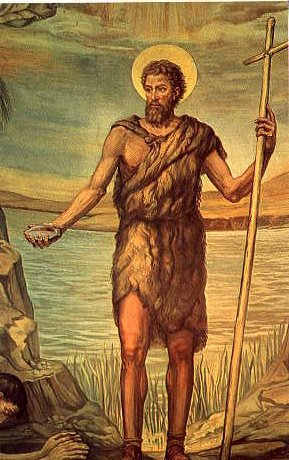
When introduced to John the Baptist in the beginning of the gospels, the role he plays is essential to defining both what baptism is and who Jesus is. In the beginning of the Matthew (Chapter 3) and John’s (Chapter 2) gospel accounts it is revealed that the Pharisees send messengers to inquire about John the Baptist to discern who he claims to be and why he is baptizing. They are curious as to whether he is the Christ, Elijah or the (faithful) Prophet (John 1:19-22). He denies each of these titles and answers by simply quoting Isaiah 40:3 saying that he is a “voice crying out in the wilderness…” and points them to the one that will come after him whose “sandals he is unworthy to untie.” The Jews were used to their many forms of purification as we studied earlier, so while the act of purification was not foreign to them, the language used along with the massive number of recipients was. This was the basis for the Pharisees questioning. So what’s the difference between the baptism of John the Baptist and the baptism commissioned by Jesus in Matthew 28:19? Several times in scripture, John’s baptism is called a “baptism of repentance” (Luke 3:3, Mark 1:4, Acts 19:4) and this title is specific to John.

What does this mean?

Is it different than Jesus’ baptismal commission in Matthew 28:19?

To understand this, the person of John the Baptist, his purpose and work, must be understood. Scripture lays this out in detail.  Isaiah 40:3 is where this study begins.

“A voice cries: Prepare ye the way of the LORD; make straight in the desert a highway for our God.”

Traditionally, before the New Testament period, Isaiah 40:3 was viewed as fulfilled when the remnant of Judah returned from Babylonian captivity. The desert highway was the route of grace for those who remained faithful.  Barry G. Webb, in his commentary on Isaiah, has a more astute observation when he says…

“Although there was a partial return from exile in the years following 539 B.C., spiritually the exile continued until the Messiah came. Only he could solve the deep, underlying problem.”

This is actually at the heart of the often misquoted Jeremiah chapter 29.  Jeremiah has prophesied that Babylon will conquer Jerusalem but God will save for himself a remnant that will be exiled to Babylon. Chapter 29 is a letter of comfort to these exiles outlining the promises, hope and blessings they have and will be given for staying faithful.  The promises include both spiritual and temporal blessings. The temporal blessings were fulfilled when the remnant returned from exile, but the spiritual blessings of hope and a future were still yet to be fulfilled.  These blessings would be met in the person and work of the coming Messiah.

Malachi 3:1 says…

“Behold, I send my messenger, and he will prepare the way before me. And the Lord whom you seek will suddenly come to his temple; and the messenger of the covenant in whom you delight, behold, he is coming, says the Lord of hosts.

This is the same verse that is quoted in Matthew 11:10, Mark 1:2 and Luke 7:27. Notice there is a distinction between the “messenger” who prepares the way (John) and the “messenger of the covenant” (Jesus). Therefore, looking through these lenses, John’s ministry is fully preparatory for the entrance of Christ. This means that in all things John is preparing, which includes baptism. John’s baptism of repentance, in light of Isaiah 40:3, is a call for Israel to return from their spiritual exile. Thus John’s baptism of repentance is for Israel alone and fully efficacious for the remission of their sins. Therefore, the Pharisees were looking for Elijah to return in the flesh as a fulfillment of the prophecy in Malachi 4:5 and thus sent messengers to ask if this was who John claimed to be.  Malachi 4:5 says…

“Behold, I will send you Elijah the Prophet before the great and awesome day of the Lord.”

John denies this claim which was true.  He was not Elijah in the flesh but John who was naturally born of Zechariah and Elizabeth.  That being said, how does this work in light of Matthew 17:10-13 where Jesus refers to John the Baptist as Elijah?  Jesus was simply stating that John was a type of Elijah as he was the last prophet before Jesus Christ.  All previous prophets pointed forward to Christ and the same is true for John, only in addition to pointing to his coming, he was also Jesus’ contemporary and thus prepares the way for him. The idea of preparing the way for Jesus’ ministry begins with Johns baptism of repentance.  John’s preparatory baptism merges into Jesus’ ministry in John 3:26 and 4:1-2 when Jesus’ disciples begin to baptize alongside John. John’s view of this accompaniment is that he must decrease and Jesus must increase. R.C.H. Lenski puts it this way in his commentary on Matthew…

“In essence and efficacy both were the same. The Baptist’s was on the level of the revelation given at that time; that of Jesus on the level of his completed work. That of the Baptist made followers of the Christ about to come; That of Jesus followers of the Christ who had come. Both bestowed forgiveness; the one the forgiveness about to be wrought; the other the forgiveness that had been wrought. Thus the baptism of John was preparatory for Israel alone, Christ’s permanent for all nations. And only in this way that one made ready for and then gave way to the other.”

Therefore the only real difference between John’s preparatory baptism and Jesus’ is whom it is directed toward. John’s is for Israel and Jesus’ is for everyone. I would also like to address some confusion concerning John’s baptism as seen in Acts 19. When Paul arrives in Ephesus, he discovers some disciples who knew nothing of the Holy Spirit. Paul subsequently asks in whom they were baptized? They reply into John’s baptism. This appears to contradictory. The apostles and Apollos were also baptized into John’s baptism and it was fully efficacious not warranting a “re-baptism.” Paul makes sure to point out why their baptism wasn’t real; lack of knowledge of the work of Jesus or the Holy Spirit. These disciples were not familiar with Jesus nor had they heard of, let alone received the Holy Spirit in their baptism. This means that no baptism really took place. Paul lays hands on them and baptizes them in the triune name of God (in the name of the Father, Son and Holy Spirit); which is how the Lord Jesus commanded in Matthew 28:19. The New Bible Commentary has a solid explanation…

“These people had received a baptism of repentance, which was in itself a good thing, but unlike Apollos (Acts 18:25), they did not seem to know anything about Jesus. We are not told that Apollos needed to be rebaptized (Priscilla and Aquila certainly would have been able to baptize them, if Ananias could baptize Paul, Acts 9:17-19). The probable difference was that Apollos knew about and trusted in the Messiah (having accurate, if incomplete knowledge about him, Acts 18:25-26) and saw his baptism in connection with that faith, whereas for these disciples, the baptism was merely a pledge of good behavior. They still needed to be baptized into the name of the Lord Jesus.”

What is Repentance?

Now that the similarities and differences between John’s and Jesus’ disciples baptism have been established, it is important to look at and understand repentance as defined by scripture. These days, it seems common thought amongst Christians that repentance is something that the individual does in and of themselves. In this modern definition, I do the initial work and God takes care of the rest (by forgiving my sin). This is 180 degrees backwards from what scripture presents. Repentance is a gift that we cannot come to apart from God’s work. In Luke 15:3-7, Jesus tells the parable of the lost sheep.

So he told them this parable: “What man of you, having a hundred sheep, if he has lost one of them, does not leave the ninety-nine in the open country, and go after the one that is lost, until he finds it? And when he has found it, he lays it on his shoulders, rejoicing. And when he comes home, he calls together his friends and his neighbors, saying to them, ‘Rejoice with me, for I have found my sheep that was lost.’ Just so, I tell you, there will be more joy in heaven over one sinner who repents than over ninety-nine righteous persons who need no repentance.

This is where we go to truly understand repentance. The shepherd in the parable is Jesus and we are the sheep. A sheep is lost, representing us, and the shepherd does all the work to find the sheep, then puts the sheep on his shoulders, rejoices and carries him back home. Notice that Jesus doesn’t make the sheep walk back on his own. This is purposeful. This shows that we do absolutely none of the work as we are only receptive of the life saving gift. In verse 7, Jesus concludes by saying that this parable is a picture of repentance. Repentance is Jesus finding us and carrying us home, therefore, it is not something we do. The only role we play in the story is that of getting ourselves lost, and when found, agreeing with Christ that we are indeed lost thus we cooperate by returning with him.  Repentance is gifted agreeance with Christ.  Repentance acknowledges that our sin is indeed sin and is in opposition to the will of God and thus receives forgiveness of sins as a gift given from Christ’s atoning work on the cross.

Summary thus far

In effect, John’s baptism is one of repentance, specifically for Israel and Christ’s baptism is one of repentance for all nations. John’s baptism calls the Jews from their spiritual exile while Jesus’ baptism expands the call to all nations. Both baptisms are fully efficacious and do precisely what scripture says they do; forgive sin.  Neither baptism requires any work of our own because they both are 100% Christ’s work. In Mark 2, when the paralytic is lowered through the roof, Jesus first forgives the mans sin.  The Pharisees respond in verse 7 by saying…

“Why does this man speak like that? He is blaspheming! Who can forgive sins but God alone?”

The Pharisees were right in saying that only God can forgive sin.  By doing this Jesus claims His divinity and then proves it by healing the man’s temporal ailment allowing him to walk.  Baptism, as described in scripture is no different.  There are many passages that connect baptism to the forgiveness of sins.  These verses will be investigated in the upcoming installments of this study on baptism.  Before moving on, let’s look back to what was learned in week 1 of this study to begin to connect the Old Testament with the New Testament.  In week 1 of this study, several examples of “means and promise” were studied.  For the priest, washing feet and hands in the bronze basin before entering the tent of meeting was efficacious as it saved him from certain death.  For the person in contact with the deceased, washing on the 3rd and 7th day was efficacious in allowing him to return to the community.  This same “means and promise” purifies the leper as well as the scapegoat handler.  In like manner, the New/Old Testament allegories (The flood narrative and the crossing of the Red Sea) point to baptism as accomplishing salvation.  The Ezekiel prophecy in Chapter 36:24-27  says…

“I will take you from the nations and gather you from all the countries and bring you into your own land. I will sprinkle clean water on you, and you shall be clean from all your uncleanliness, and from all your idols I will cleanse you. And I will give you a new heart, and a new spirit I will put within you. And I will remove the heart of stone from your flesh and give you a heart of flesh. And I will put my Spirit within you, and cause you to walk in my statutes and be careful to obey my rules.”

This prophecy also speaks of “means and promise.”  The means is sprinkling with water and the promise is cleanliness, a new heart of flesh and gifting of the Holy Spirit.  This prophecy points forward to both John’s baptism of repentance and Jesus’ baptism for the forgiveness of sins (and gifting of the Holy Spirit) as Jesus’ baptism engulfs John’s and expands it to all.  There is no racial restriction. There is no cultural restriction. There is no gender restriction. There is no positional restriction.

There is no age restriction.

This statement of inclusion has been a topic of much debate in “modern” times.  I am well aware of there being no verse that clearly states “baptism is for infants.” However, using this same poor hermeneutical principle, a case could be made that communion isn’t for women as there is no place in the Bible that records a woman taking communion, or where it says that women can take communion. We know this to be hogwash, but it goes a long way in making the point as I am equally aware of zero verses that restrict baptism from infants. Simply, the arguments used to validate women taking the Lord’s Supper are the same arguments historically used for affirming infant baptism. We cannot say this argument can be used for women and communion but not for baptism and infants. Matthew 28:19 says that we are to baptize all nations; children and infants are included in all nations. They are part of the census. They are counted. Galatians 3:28-29 states…

There is neither Jew nor Greek, there is neither slave nor free, there is no male and female, for you are all one in Christ Jesus. And if you are Christ’s, then you are Abraham’s offspring, heirs according to promise.

These verses are solely salvivic. They clearly state there is no division or distinction in Christ’s salvation plan. I understand that it does not specifically say “elderly or infant”, nor does it have to. Any of the distinctions made in the verse could be infant or elderly. The purpose of the list is the complete inclusiveness of Christ. If Paul had added a disclaimer excluding “infants” it would not be inclusive, but exclusive. Remember in Ephesians 1:4, Paul says that…

“even as he chose us in him before the foundation of the world, that we should be holy and blameless before him.”

This statement is as inclusive as Galatians 3:28-29. If God chooses us, what does age have to do with anything? It is as irrelevant as our color, gender or social status. In addition, infants are in need of what baptism offers.  Job 15:14, Psalm 51:5, John 3:6, Ephesians 2:3 and Romans 5:12 show that all are born under the curse of sin.  No one is born good or innocent.  In addition to believing what scripture says about this, there is also temporal proof.  The proof is that infants die.  Romans 6:23 says that the wages of sin is death.  Therefore, with ample proof that all are born under the verdict of guilty, including infants, the reality of the necessity for baptism of all ages is presented.  This will be revisited and expanded upon in Parts 5 and 6 of this study. In the meantime, stay tuned for next weeks installment “Part 4 – Why was Jesus baptized?”

Click here for “Christian Baptism Series – Part 4 – Why was Jesus Baptized”

Click here for “Christian Baptism Series – Part 2 – Jewish Rites of Purification & Pharisaical Law”


Introducing the Church Fathers – Gregory of Elvira

ImageGregory of Elvira was the Bishop of Elvira, Spain during the mid to late 4th century (died 392).  Unfortunately many of his writings were lost to antiquity and there remains confusion concerning correct authorship for many of those that survived.   Thankfully his writing titled “The Prostitute viewed from Salvation” persevered.  If you are not familiar with this work, I encourage you to take a few minutes and make your acquaintance. 

The Prostitute viewed from salvation by Gregory of Elvira

“And Joshua the son of Nun, “It says, “sent two spies from Shittim, saying to them ‘Go up and survey the land and Jericho.’ When they arrived in Jericho, the two young men entered the house of a prostitute by the name Rahab and stayed as guests.” Pay attention to the structure of this mystery, most beloved brothers, and ask yourselves why men as great as these, for whom the Lord had performed such great marvels and miracles, entered the house of a woman of ill repute, as if they were unable to lodge elsewhere. They did this not by chance, I believe, but intentionally by prophetic design. For I find this prostitute in many places, not only as a hostess of saints but also as their bride. The most holy prophet Hosea, for instance, was commanded by the Lord to accept a harlot as his wife: “For the Lord said to me, ‘Take for your wife a prostitute and generate children of prostitution.’” Even our Lord and Savior himself, when he had sat down by the well in Samaria, conversed with an immoral woman to whom no one had previously spoken there. After he said to her, “You have had five husbands and the one you have now is not your husband,” she believed that he was the Messiah, that is, she confessed him to be the Christ. Then there was the harlot who washed the Savior’s feet with her tears and wiped them with her hair and anointed them while kissing them. Let us see, therefore, what our hostess represents. This Rahab, although she is called a prostitute, nevertheless is a sign of the virgin church, considered as a foreshadow of the coming realities at the end of the age, where she alone is preserved to life among all who are perishing. For even when it was said to the prophet Hosea, “Take for your wife a prostitute,” surely then the image of the church as coming from Gentiles was being prefigured, given that the people were to be gathered from the harlotry of the nations and from the prostitution of idols, for, it says, “they prostituted themselves to strange gods.” Indeed, she is called “the church” because the Greek word ecclesia means “gathering of the people.” And just as the apostle says, “An unfaithful wife is sanctified through her faithful husband,” so also is the church, coming from the infidelity of the Gentiles and prostitution with idols, sanctified through the body of Christ, of which we are members, as we learn from the same apostolic author. Because the church, as I have often said, gathered from the multitude of Gentiles, was then called a prostitute, therefore the church is found in the figure of Rahab, the hostess of saints.”

Christian Baptism Series – Part 2 – Jewish Rites of Purification & Pharisaical Law

Jewish Rites of Purification
As discussed in Part 1 of the Christian Baptism Series, there are many Old Testament verses concerning purification rituals for various purposes. However, the Jews, through the Pharisees, innovated and expanded these laws extraordinarily thus creating two distinct categories for specific cleansings; Netilat Yadayim and tevilah. Pharisaical law determines which purification right is to be performed for which cleansing.

Netilat Yadayim is the washing of the hands with a cup and is to be performed at meals, before worship, before priestly blessing, after sleeping, after visiting the bathroom, after cutting hair, after cutting nails, after participating in a funeral procession, being at a funeral, coming in contact with a corpse, after touching body parts that are typically covered (arm pits, private parts, etc), touching inside of nose or ear, after touching scalp, or prior to scribal work.

Tevilah is the full body immersion in a mikveh.  A mikveh is a collection of water as found  in a natural spring, river or drawn bath. This purification is also performed for a variety of reasons.
– Those who came in contact with a corpse
– Those with skin conditions
– Those emitting bodily fluids
– Women experience their monthly flow
– Men experiencing seminal discharge
– The one who led the scapegoat on Yom Kippur
– Those suffering from any issue resulting from blood discharging from the body
– Conversion to Judaism (2nd century)

When the list is studied, a blending of Biblical cleansing mixed with manufactured cleansing rituals are revealed. The “tevilah” appears to have a Biblical root in the Old Testament purification rituals that were listed in Part 1 of this study, while the “netilat yadayim” appears to be an innovation or hybrid (man’s law and God’s law) at best. There are two particular New Testament passages that reference these innovations; John 2:6 and Mark 7. In John 2:6, there is only a mention of 6 ceremonial washing jars (netilat yadayim) at the wedding in Cana. Mark 7 tells us not only what these jars are for, but gives a clear scope of the meaning behind them. In the passage, the Pharisees become agitated that Jesus and the disciples didn’t ceremonially wash their hands (netilat yadayim) before eating. This appears to be a small debate to our 21st century minds, however, when one understands what is actually at stake, the fight that Jesus and his disciples are initiating by not washing their hands is cataclysmic. To fully understand what is going on, two things must be explained;

(1) How Pharisaical laws came to be
(2) What not washing their hands really meant.

How Pharisaical Law came to be
The common perception of Pharisaical law tends to visualize itself as well intentioned law guarding. Their extra, innovative laws are thought of as caution tape (Pharisaical Law) around an open manhole (God’s Law).  The seemingly well intentioned Pharisees are just helping by devising extra precaution to keep from danger.  While it may appear that way on the surface, there is much more going on than meets the eye. The Pharisees actually believe(d) in 2 Torahs; the written and the verbal. They also believe(d) that Rabbi’s had absolute authority to interpret scripture and this absolute authority was governable by the majority. Therefore, the “second” verbal Torah was the Pharisaical rabbi’s living interpretation of scripture. It was verbal because they wanted to keep it to themselves in order to exclude the gentiles. The written Torah was for everyone, while the verbal Torah was exclusive. This conveniently resulted in the Pharisees having absolute power to determine law without having to explain themselves to anyone, let alone God. They used an irrational interpretation of Deuteronomy 30:12 and Exodus 30:12 to support their position.

Deuteronomy 30:12 says ” It is not in heaven, that you should say, ‘Who will ascend to heaven for us and bring it to us, that we may hear it and do it?”

Exodus 30:12 says “When you take the census of the people of Israel, then each shall give a ransom for his life to the LORD when you number them, that there be no plague among them when you number them.”

By taking these two verse completely out of context and combining them together they establish that since the Torah is no longer in Heaven, but on earth, interpretation is now solely their responsibility according to the consensus of the Pharisaical council. With this understanding, the Rabbinical Pharisees are the only ones who can now interpret God’s law; even excluding God (since the Torah is no longer in Heaven). Therefore they take these interpretations, create traditions of the elders or (takanote) and bestow upon them the authority of God’s commands (written Torah). This is how God’s commands such as “keep the Sabbath holy” can devolve into equating spitting on the ground with gardening. This understanding goes a long way in explaining Jesus’ incessant anger at the Pharisees. It is also important to note that the verbal Torah was eventually written down and is now the Talmud (Jerusalem and Babylonian).  This position is evident in reading the Talmud.  There is an account of Rabbi Eliezer in the Babylonian Talmud found in Baba Mezi’a 59 a & b.  Here is the selected account…

We learnt elsewhere: If he cut it into separate tiles, placing sand between each tile: R. Eliezer declared it clean, and the Sages declared it unclean; and this was the oven of ‘Aknai. Why [the oven of] ‘Aknai? — Said Rab Judah in Samuel’s name: [It means] that they encompassed it with arguments as a snake, and proved it unclean. It has been taught: On that day R. Eliezer brought forward every imaginable argument, but they did not accept them. Said he to them: ‘If the halachah agrees with me, let this carob-tree prove it!’ Thereupon the carob-tree was torn a hundred cubits out of its place — others affirm, four hundred cubits. ‘No proof can be brought from a carob-tree,’ they retorted. Again he said to them: ‘If the halachah agrees with me, let the stream of water prove it!’ Whereupon the stream of water flowed backwards — ‘No proof can be brought from a stream of water,’ they rejoined. Again he urged: ‘If the halachah agrees with me, let the walls of the schoolhouse prove it,’ whereupon the walls inclined to fall. But R. Joshua rebuked them, saying: ‘When scholars are engaged in a halachic dispute, what have ye to interfere?’ Hence they did not fall, in honour of R. Joshua, nor did they resume the upright, in honour of R. Eliezer; and they are still standing thus inclined. Again he said to them: ‘If the halachah agrees with me, let it be proved from Heaven!’ Whereupon a Heavenly Voice cried out: ‘Why do ye dispute with R. Eliezer, seeing that in all matters the halachah agrees with him!’ But R. Joshua arose and exclaimed: ‘It is not in heaven.’ What did he mean by this? — Said R. Jeremiah: That the Torah had already been given at Mount Sinai; we pay no attention to a Heavenly Voice, because Thou hast long since written in the Torah at Mount Sinai, After the majority must one incline. R. Nathan met Elijah and asked him: What did the Holy One, Blessed be He, do in that hour? — He laughed [with joy], he replied, saying, ‘My sons have defeated Me, My sons have defeated Me.’ It was said: On that day all objects which R. Eliezer had declared clean were brought and burnt in fire. Then they took a vote and excommunicated him. Said they, ‘Who shall go and inform him?’ ‘I will go,’ answered R. Akiba, ‘lest an unsuitable person go and inform him, and thus destroy the whole world.’ What did R. Akiba do? He donned black garments and wrapped himself in black, and sat at a distance of four cubits from him. ‘Akiba,’ said R. Eliezer to him, ‘what has particularly happened to-day?’ ‘Master,’ he replied, ‘it appears to me that thy companions hold aloof from thee.’ Thereupon he too rent his garments, put off his shoes, removed [his seat] and sat on the earth, whilst tears streamed from his eyes. The world was then smitten: a third of the olive crop, a third of the wheat, and a third of the barley crop. Some say, the dough in women’s hands swelled up.

This account begins with an argument between Rabbi Eleazer and the other Rabbis concerning whether the oven tile arrangements  were clean or unclean.  Rabbi Eleazer says the arrangement is clean while all other Rabbi’s issue dissent.  Rabbi Eleazar continues to argue his point against the other Rabbis to no avail.  Once he sees that his words and reason cannot sway the other Rabbis, he calls on God for supernatural proof that he is correct.   There are a series of supernatural events including a tree uprooting, a river reversing flow and a library collapsing.  The other Rabbis scoffed and refused to accept these events as proof that Eleazar was right in his assessment of the oven tiles.  As a final sign to prove his assertion, he says ‘If the halachah agrees with me, let it be proved from Heaven!’ Whereupon a Heavenly Voice cried out: ‘Why do ye dispute with R. Eliezer, seeing that in all matters the halachah agrees with him!’ The other Rabbi’s were unimpressed saying that it doesn’t matter what a voice from heaven says because the Torah was given at Mt. Sinai and thus is no longer in heaven.  They believed that God himself didn’t have the power to overthrow the Pharisaical Consensus. Thus Rabbi Eleazer was excommunicated.  This is the perfect picture of how Deuteronomy 30:12 and Exodus 30:12 was twisted and ripped from context to grant the Pharisaical counsil absolute executive power.

What not washing their hands really meant
Now it should be much clearer why the refusal of Jesus and His disciples to wash their hands would spark outrage. The argument is not about whether it is good to wash hands before dinner (it is); the argument was about whether God commanded it or not. The Pharisees believe that He did because they believe that Deuteronomy 30:12  and Exodus 30:12 gives them interpretive authority that supersedes even God. Jesus, rightly so, says that it is not one of God’s commands, but instead, a “tradition of the elders.” His mere saying this completely strips their self-appointed authority away and exposes it for what it is; twisting of God’s word in the form of man’s law. By refusing to wash their hands, Jesus and the disciples are rebuking these Rabbis and exposing their false teachings and deception. This was no minor dispute as it calls the very office of Pharisaical Rabbi into question. This completely attacks and strips their perceived self appointed authority.

What does this have to do with Baptism?
I bring this up primarily to discount any arguments for Jewish rites of purification stemming from Pharisaical law as a case for understanding Christian baptism. I am a staunch advocate for looking at history to get a full, clear picture; however, in this case, any Jewish purification rite that stems from Pharisaical law must be discounted as it was birthed from a tradition of the elders. However, purification laws that stem from Old Testament passages can and should be studied as a prefigurement of Christian baptism; especially when New Testament apostles reference them.

Summary from Part 1 & 2
When looking at Old Testament law, it is apparent that purification laws served many purposes. Old Testament purification laws were efficacious for all that participated. This is known because scripture tells us that Priests who followed the “tent of meeting” purification laws lived and those who didn’t died. There are also the allegorical verses that shed light on the Flood and the parting of the red sea. These are both equated with baptism. In addition, there is also the prophecy in Ezekiel that points toward efficacious baptism. So while baptism practiced salvivicly for all people isn’t part of the Old Testament, there is imagery present that is pushing toward John and his baptism of repentance; this imagery would lead to the Pharisees sending messengers to inquire who he is and what he is doing. The groundwork has been laid in the OT rites of purification, allegories and specific prophesies concerning both baptism and the one who would prepare the way for the Messiah.  This was apparent enough to the Pharisees to cause them to believe that John and his baptismal work could be the fulfillment. Notice in Matthew 3 that they are not curious as to what John is doing; only who he is and why he is doing it.  Keep the Pharisaical beliefs studied above in the Eleazer account close at hand as it will shed light on John the Baptists response to the Pharisaical messengers discussed in Matthew 3.  Stay tuned for Part 3 – John and his baptism of Repentance.

Click here for “Christian Baptism Series – Part 3 – John & his Baptism of Repentance”

Can I Lose My Salvation?

Navel Gazer Question Mark

I hate hearing it.

Not because it’s altogether wrong, but because it’s damaging.  It insinuates a contradiction.  A true life oxymoron.

I hate hearing the question “Can I lose my salvation?”

It’s like nails on a chalkboard.  It’s a contradiction because it insinuates that it can be done apart from our will.  When I lose something, I’m always upset about it because I never wanted to lose it in the first place.

I currently find myself in the midst of several home improvement projects.  My house is a disaster area.  In the mix of attempting to work from home, advise contractors and field questions from my wife; I lost my car keys.  Did I want to lose them? Not at all.  Did I reject that the car keys were effective in starting my car or unlocking my front door?  No.  I simply lost them.  The next reasonable question is why did I lose them? On the most simplistic level, I lost them because I am a sinful fallen creature that is encapsulated in this body of flesh until death or Christ’s return. I lost them because I’m forgetful. I lost them because my mind wanders.

I lost them because they were mine to lose.

This begs a rather large question.  Do we own Christ or does Christ own us?  Let’s go to scripture for answers.

1 Corinthians 6:19-20 – Or do you not know that your body is a temple of the Holy Spirit within you, whom you have from God? You are not your own, for you were bought with a price. So glorify God in your body.

1 Peter 2:9 – But you are a chosen race, a royal priesthood, a holy nation, a people for his own possession, that you may proclaim the excellencies of him who called you out of darkness into his marvelous light.

1 Corinthians 12:27 – Now you are the body of Christ and individually members of it

John 15:5 – I am the vine; you are the branches. Whoever abides in me and I in him, he it is that bears much fruit, for apart from me you can do nothing. If anyone does not abide in me he is thrown away like a branch and withers; and the branches are gathered, thrown into the fire, and burned.

These passages makes it very clear that we are the possession of Jesus Christ; not the other way around.  In addition to these verses, there are many more that speak of our new position in Christ as children of God.  Simply put, that is more evidence that we are His possession.  Therefore, in my case, I lost my keys not because I wanted to, but because I am a sinful fallen creature AND because they were mine to lose.  Christ Jesus on the other hand is not sinful nor is he a creature.  He is the one and only God-Man who is the Second Person of the Trinity and is of the same substance as the God the Father.  Therefore Jesus can never lose me.  His perfection won’t allow it.  We are secure in Christ.

This opens a whole new can of worms.

I can hear the premature victory chants from the Calvinists alongside feigning shouts from the synergists.

My encouragement is to bear with me because we’ve only just begun.

If you look back to the beginning of this post, you will see that my issue was with wording.  This is why proper phrasing is key. The phrase “lose your salvation” completely irks me primarily because it is not possible for anyone to lose their salvation.  However, I do think it is possible to forfeit your salvation.   There is an important difference between lose and forfeit.

Webster defines lose as “to be unable to find, to fail to win or to fail to keep or hold (something wanted or valued).”

Webster defines forfeit as “something that is lost or given up as punishment or because of a rule or law.”

In order to lose something, one must be in possession of it.  I have already established evidence that Jesus Christ is the one in possession of our salvation and thus cannot lose it because of His perfection.  On the contrary, one who receives a possession from the possessor has the right to forfeit the rights and privileges that are being given from the possessor. You don’t have to be in possession to forfeit or give up your rights to the possession.  Therefore, speaking directly of salvation, Christ is the possessor of salvation and whether you initially forfeit those rights in unbelief or you lay hold of salvivic rights through faith in Jesus and then forfeit them at some point later (Ephesians 2:8 states that faith is also a gift, and thus can be forfeited) the right to forfeit is freely given to all as is defined by the term forfeit. The second part of the definition states that forfeit occurs by punishment of a rule of law.  This also works perfectly within the constraints of biblical reason.  If the gift of salvation is passively received through faith in Jesus, then active rejection of the gift through unbelief obtains the wage we earned which is punishable by separation from God in hell since the law demands perfection (James 2:10).  So when salvation in Jesus is forfeited through unbelief, punishment in eternal hell is earned.  This presents two distinct categories of people who actively forfeit the gift by grace through faith won by Jesus upon the cross; those who always will reject the gift of faith and those who passively receive the gift of grace through faith and eventually actively reject through unbelief. Both categories forfeit the free gift that is offered.  The first category containing those who always reject faith and live in unbelief thus forfeiting their salvation is generally accepted as a normative doctrine amongst most denominations within the church catholic.  The second category is someone who comes to faith in Jesus and eventually forfeits said faith and becomes apostate. Whether this category is possible is often debated between brethren.  The bible is clear that though it is uncommon, the possibility does exist. The following verses provide clear evidence for this position.

Hebrews 10:19-39Therefore, brothers, since we have confidence to enter the holy places by the blood of Jesus, by the new and living way that he opened for us through the curtain, that is, through his flesh, and since we have a great priest over the house of God, let us draw near with a true heart in full assurance of faith, with our hearts sprinkled clean from an evil conscience and our bodies washed with pure water. Let us hold fast the confession of our hope without wavering, for he who promised is faithful. And let us consider how to stir up one another to love and good works, not neglecting to meet together, as is the habit of some, but encouraging one another, and all the more as you see the Day drawing near. For if we go on sinning deliberately after receiving the knowledge of the truth, there no longer remains a sacrifice for sins, but a fearful expectation of judgment, and a fury of fire that will consume the adversaries. Anyone who has set aside the law of Moses dies without mercy on the evidence of two or three witnesses. How much worse punishment, do you think, will be deserved by the one who has trampled underfoot the Son of God, and has profaned the blood of the covenant by which he was sanctified, and has outraged the Spirit of grace? For we know him who said, “Vengeance is mine; I will repay.” And again, “The Lord will judge his people.” It is a fearful thing to fall into the hands of the living God. But recall the former days when, after you were enlightened, you endured a hard struggle with sufferings, sometimes being publicly exposed to reproach and affliction, and sometimes being partners with those so treated. For you had compassion on those in prison, and you joyfully accepted the plundering of your property, since you knew that you yourselves had a better possession and an abiding one. Therefore do not throw away your confidence, which has a great reward. For you have need of endurance, so that when you have done the will of God you may receive what is promised. For, “Yet a little while, and the coming one will come and will not delay; but my righteous one shall live by faith, and if he shrinks back, my soul has no pleasure in him.” But we are not of those who shrink back and are destroyed, but of those who have faith and preserve their souls.”

This Hebrews passage is crystal clear in its warning to the church.  The person described in this passage has “received knowledge of the truth.”  The phrase itself forces the idea that the knowledge received was true to the person who received it.  If the person did not agree with the knowledge they received they would not label it as truth therefore the person receiving the knowledge must have agreed at one point that what is being received is true or the verse completely falls apart.  A few verses later in this passage the same person is labeled as being “sanctified” (meaning made holy) and then trampling Jesus underfoot.  It was already made abundantly clear in verse 26 that there no longer remains a sacrifice for sins for the this person.  Several verses later the writer of Hebrews warns the reader to not “throw away their confidence” in like fashion.  Why would the writer of Hebrews give an example of a sanctified believer that received knowledge of the truth and turned from that through rejection of Jesus by trampling Him underfoot through deliberate sin thus nullifying the forgiveness of sins that was gifted through the original reception of the knowledge of truth AND THEN warn of us not to do the same?  If falling away isn’t a possibility, this passage would simply be a lesson in futility. The Hebrews passage is abundantly clear and thus doesn’t need further explanation. The only reason one would attempt to twist these verses to mean anything other than what they clearly state would be to form them into a doctrine of human creation.

John 15:1-11 – “I am the true vine, and my Father is the vinedresser. Every branch in me that does not bear fruit he takes away, and every branch that does bear fruit he prunes, that it may bear more fruit. Already you are clean because of the word that I have spoken to you. Abide in me, and I in you. As the branch cannot bear fruit by itself, unless it abides in the vine, neither can you, unless you abide in me. I am the vine; you are the branches. Whoever abides in me and I in him, he it is that bears much fruit, for apart from me you can do nothing. If anyone does not abide in me he is thrown away like a branch and withers; and the branches are gathered, thrown into the fire, and burned. If you abide in me, and my words abide in you, ask whatever you wish, and it will be done for you. By this my Father is glorified, that you bear much fruit and so prove to be my disciples. As the Father has loved me, so have I loved you. Abide in my love. If you keep my commandments, you will abide in my love, just as I have kept my Father’s commandments and abide in his love. These things I have spoken to you, that my joy may be in you, and that your joy may be full.

John 15 provides further evidence concerning real possibility of forfeiting salvation.  This is the famous passage about Jesus being the vine and Christians playing the part of the branches.  Verse 5 tells us that if anyone doesn’t abide in Jesus, the true vine, they will be cut off and thrown into the fire.  To be in the vine is to be in Christ.  Jesus gives the answer on how to stay in the vine.  A person stays in the vine by abiding in Christ. A couple verses later, Jesus says that we abide by loving Him and we love him if we keep his commandments.  The Greek word for “keep” is “tereo” which does in fact mean keep, however, not in the sense that it is most often understood.  “Tereo” means keep-in-tact or guard. We keep Jesus’ commandments in tact when we believe that they are right and true.  We guard them against false teaching because they are right and true.  Therefore we keep His commandments by trusting in Him, i.e. faith.  Once again, faith in Jesus for the forgiveness of sins receives the promise of forgiveness of sins while unbelief forfeits the gift that is offered.  One cannot be cut from the vine if they were not or were never in the vine to begin with.  The argument that those who are apostate were never really saved doesn’t hold water because if they never had faith, they would have never been in the vine in the first place.

These two passages are clear texts that show that we must be on guard against apostasy (forfeiting our salvation).  Apostasy is always the result of unbelief expressed through continual, unrepentant sin.  One doesn’t accidentally fall into apostasy as it is a premeditated active exchange of forgiveness of sins in Jesus Christ for the pleasures of this world through temporal desire for instantaneous satisfaction. This doesn’t mean that when someone sins they are apostate or if someone fails to repent of each and every sin they have forfeited their salvation.  It simply means that if someone comes to a place where they find themselves consistently choosing /living in sin and when confronted with that sin, has no contrition, remorse or desire to repent, then forfeiture of salvation has occurred.  There is still hope for these people (as long as they have breath in them) that through the hearing of the word, God could bring them back to repentant faith in Him.

(Side Note:  I am aware that Hebrews 6:4-8 states that is impossible for anyone who has ” been enlightened, who have tasted the heavenly gift, and have shared in the Holy Spirit, and have tasted the goodness of the word of God and the powers of the age to come” to be restored again after falling away.  I wholeheartedly agree with this passage as it is scripture and I readily confess that all scripture is God breathed.  I’d like to take a moment to harmonize this passage with my thoughts pertaining to hope for those who have fallen away.  What is exposed in this passage is “blasphemy of the Spirit” also known as the unpardonable sin.  This sin is also discussed in Matthew 12:31-32, Mark 3:28-29 and Luke 12:10. The writer of Hebrews paints a vivid picture of one who truly believes and experiences the complete fullness of the Christian life with great understanding and then falls away, rejecting all that they factually know to be true (we are not dealing with standard unbelief, but true belief that results in them rejecting all they know be true).  Since we do not know the heart of those we minister too, we cannot go forward with the attitude that all who have fallen away fit this description of having blasphemed the Spirit, therefore we must treat all as if there is hope.  I have actually met some people who thought they had blasphemed the Holy Spirit and were wrecked thinking that they were hopeless.  Their contrition proves their heart has not completely hardened (Acts 28:27).  I initially considered removing the statement concerning hope for those who have fallen away out of the post as to avoid confusing people or starting a debate, but I decided to leave it as a way to give hope to those who may have thought they unintentionally committed blasphemy of the Spirit.  After thinking about it i decided it would be better to add this side note for clarification.)

The argument put forth in this post is why I get worked up when I hear of someone terrified of losing their salvation and equally upset when they believe they are eternally preserved by the Calvinist doctrine of Perseverance of the Saints.  You see, either end of this spectrum will bring you doubt instead of comfort. Either end of this spectrum forces you to look within yourself to determine if you have either lost your salvation or to answer internal doubts about whether you are indeed elect (or not).  Whenever we look to ourselves for proof of salvation, we take our eyes off of Jesus Christ, the possessor of our salvation who will never lose or forfeit our salvation because of his perfection.  In the gospels of Matthew and Mark when Peter walks upon the water to meet Jesus, he only begins to sink when he takes his eyes off of Jesus.  Likewise, looking to ourselves takes our eyes off of Jesus which causes us to sink into the miry depths of depression and soul searching while leaving us in constant limbo as we continually question our salvation.  Both the Calvinist position of perseverance of the saints and the synergist position of losing your salvation are two sides of the same coin and the effects are equally damning to any confidence that we have in Jesus Christ.  They both draw you away from Jesus by turning your eyes from His promises to introspective mind games of self doubt and insecurity. It’s my encouragement for you to stop looking in the mirror.  Stop focusing on yourself so much because ultimately it’s not about you; it’s about what Jesus Christ has done for you.  That should be the focus of your attention.  Rest in his perfection.

Christian Baptism Series – Part 1 – The Old Testament

The Old Testament and Baptism

To begin to understand what baptism is and does, let’s start in the Old Testament. In the Old Testament, purification laws are given. There are three primary verses that give an origin for such purification. These verses are Genesis 32:5 (purification from idol worship), Exodus 19:10 (Israel at Mount Sinai) and Numbers 19:7 (purification for priests). All other purification rituals seem to flow from these verses. When broken down, there are seven primary categories for purification. These categories (in no particular order) are…
– Purification for priests (Exodus 29:1-9, 30:17-21, 40:3-32 – Psalm 26:6, 73:13)
– Leprosy (Leviticus 13:6, 13:34)
– Day of Atonement (Leviticus 16:20-28)
– Bodily discharges (Leviticus 15:1-29, Deuteronomy 23:10-11)
– Cleansing of the Levites (Numbers 8:5-7, 19:7-22)
– Contact with the deceased (Leviticus 5:2, 16:4, 16:24, 11:24-28, 11:39-40, 22:4-6 & Numbers 19:11-13)
– Unsolved murders (Deuteronomy 21:1-9)
Old Testament purification texts are only one area that should be examined when studying Christian baptism. In all, there are three categories; purification, allegory and prophecy. To further investigate, it is important to view the verses listed above which correspond to Old Testament purification practices, True Old Testament events that are allegorized by New Testament apostles (Genesis 6:9-18/1 Peter 3:20-21, Exodus 14:1/1Corinthians 10:1-2) and Old Testament prophesies concerning baptism (Ezekiel 36:24-27). Let’s examine a few of these passages in context.

Old Testament Purification Rituals

1. Purification for Priests – Exodus 30:17-21

“The Lord said to Moses, “You shall also make a basin of bronze, with its stand of bronze, for washing. You shall put it between the tent of meeting and the altar, and you shall put water in it, with which Aaron and his sons shall wash their hands and their feet. When they go into the tent of meeting, or when they come near the altar to minister, to burn a food offering to the Lord, they shall wash with water, so that they may not die. They shall wash their hands and their feet, so that they may not die. It shall be a statute forever to them, even to him and to his offspring throughout their generations.”

Here the instruction is given by God, to Moses, for Aaron and descendant priests to purify themselves before embarking on their priestly duties. This passage specifically commands them to purify themselves in the ceremonial basin…“When they go into the tent of meeting, or when they come near the altar to minister, to burn a food offering to the Lord, they shall wash with water, so that they may not die.”  This is an interesting picture. If the priest comes into the presence of God without cleansing with water in the basin of bronze he will surely die. There is nothing concerning any specific miraculous property of the water; only that God said for the priest to “wash” their feet and hands in the water of the bronze basin before performing priestly duties or else face death.   Also there is a means (wash hands/feet with water in bronze basin) and a promise (death will not occur).  Once again, their is nothing “special” about the water or the bronze basin.  The action here is in God’s word. We will see the importance of this thought carried through the rest of this study.

2. Leprosy – Leviticus 13:6

And the priest shall examine him again on the seventh day, and if the diseased area has faded and the disease has not spread in the skin, then the priest shall pronounce him clean; it is only an eruption. And he shall wash his clothes and be clean.

The disease of leprosy comes up many times throughout the Old and New Testament. There are many similarities between leprosy and sin. Leprosy is an extremely painful and incurable skin disease that once contracted leads to affected body parts falling off, eventually resulting in death. Likewise, sin is a completely devastating disease that reeks havoc throughout the body eventually earning us death (Romans 6:23). Several theologians have written comparing sin and leprosy. C.H. Spurgeon wrote an entire sermon on the subject (The Cleansing of the Leper sermon #353). The verse above speaks of a purification process after a former leper has been pronounced clean. After this pronouncement, the text says, “he shall wash his clothes and be clean.”

3. Contact with the deceased – Numbers 19:11-13

Whoever touches the dead body of any person shall be unclean seven days. He shall cleanse himself with the water on the third day and on the seventh day, and so be clean. But if he does not cleanse himself on the third day and on the seventh day, he will not become clean. Whoever touches a dead person, the body of anyone who has died, and does not cleanse himself, defiles the tabernacle of the Lord, and that person shall be cut off from Israel; because the water for impurity was not thrown on him, he shall be unclean. His uncleanness is still on him.

These are the purification rights associated with coming into contact with a corpse. There are some echoes of baptism in this verse, especially in the statement “…because the water for impurity was not thrown on him, he shall be unclean.” Here there is a correlation of water with cleansing impurity.  One could argue that this is a sanitary precaution as to not contaminate the community with the infirmary from the deceased, but if that was the case, shouldn’t the command have been to “wash immediately and scrub well?”  Instead we have a means (water for impurity on the 3rd and 7th day) and a promise (cleanliness that rejoins the person with fellowship).  I also cannot help but see the correlation between cleansing on the 3rd day as a symbolic reference to the resurrection of Jesus Christ and the 7th day cleansing as a symbolic reference to “completion” as we see in the creation account.

4. Day of Atonement – Leviticus 16:20-28

“And when he has made an end of atoning for the Holy Place and the tent of meeting and the altar, he shall present the live goat. And Aaron shall lay both his hands on the head of the live goat, and confess over it all the iniquities of the people of Israel, and all their transgressions, all their sins. And he shall put them on the head of the goat and send it away into the wilderness by the hand of a man who is in readiness. The goat shall bear all their iniquities on itself to a remote area, and he shall let the goat go free in the wilderness. Then Aaron shall come into the tent of meeting and shall take off the linen garments that he put on when he went into the Holy Place and shall leave them there. And he shall bathe his body in water in a holy place and put on his garments and come out and offer his burnt offering and the burnt offering of the people and make atonement for himself and for the people. And the fat of the sin offering he shall burn on the altar. And he who lets the goat go to Azazel shall wash his clothes and bathe his body in water, and afterward he may come into the camp. And the bull for the sin offering and the goat for the sin offering, whose blood was brought in to make atonement in the Holy Place, shall be carried outside the camp. Their skin and their flesh and their dung shall be burned up with fire. And he who burns them shall wash his clothes and bathe his body in water, and afterward he may come into the camp.”

Leviticus 16 outlines the Day of Atonement which was the day 3 animals atoned for the sins of Israel.  First a bull was selected to cover for the High Priest and his family.  Second, two goats were selected to atone for the sins of Israel.  Lots were cast to see which goat would be sacrificed (The Lord) and which goat would live as the scapegoat (Azazal which means outcast or scapegoat).  For the goat whose lot fell as scapegoat, the High Priest would confess all of the iniquities of Israel over the goats head, thus transferring onus from Israel to the goat.  The goat was then guided outside of the camp, into the wilderness, to never return again. We ultimately see the true fulfillment of all of this (the sacrifice of the bull, goat and the scapegoat) in Christ and His atoning work on the Cross as Hebrews 10:4 says “it is impossible for the blood of bulls and goats to take away sin.”   There is so much good news in these verses now as we see Jesus Christ as the one true atonement that takes away the sin of the world.  Once again, there is purification ceremonies for the High Priest, the handler of the scapegoat and the one who burns the remnants of the sacrificed bull and goat.  The High Priest is to bathe, put on garments of a specific fabric before sacrificing the bull and goat and then remove the garments and bathe again.  We are told numerous time that this is so he will not die.  Likewise the one who takes the scapegoat to the wilderness and the one who burns the sacrificed remains must wash his clothes and bathe his body in water or he will face excommunication.  Once again, there is a means and a promise.  The means for the High priest are: wash in water, wear particular garments, remove particular garments, wash in water.  The promise is that the High Priest will live.   Likewise there is a means and a promise for the men who handled the goats and sacrificed remains.  Upon coming in contact with the creatures that atoned for their sin, they were to wash their clothes and their bodies in order to return to fellowship with Israel.    There is no evidence that neither the fabric or the water has any special properties, only the word of the Lord.  Yet again, the action lies within the word of the Lord.

Baptismal Allegory in the Old Testament

Genesis 7:7-24
And Noah and his sons and his wife and his sons’ wives with him went into the ark to escape the waters of the flood. Of clean animals, and of animals that are not clean, and of birds, and of everything that creeps on the ground, two and two, male and female, went into the ark with Noah, as God had commanded Noah. And after seven days the waters of the flood came upon the earth. In the six hundredth year of Noah’s life, in the second month, on the seventeenth day of the month, on that day all the fountains of the great deep burst forth, and the windows of the heavens were opened. And rain fell upon the earth forty days and forty nights. On the very same day Noah and his sons, Shem and Ham and Japheth, and Noah’s wife and the three wives of his sons with them entered the ark, they and every beast, according to its kind, and all the livestock according to their kinds, and every creeping thing that creeps on the earth, according to its kind, and every bird, according to its kind, every winged creature. They went into the ark with Noah, two and two of all flesh in which there was the breath of life. And those that entered, male and female of all flesh, went in as God had commanded him. And the LORD shut him in. The flood continued forty days on the earth. The waters increased and bore up the ark, and it rose high above the earth. The waters prevailed and increased greatly on the earth, and the ark floated on the face of the waters. And the waters prevailed so mightily on the earth that all the high mountains under the whole heaven were covered. The waters prevailed above the mountains, covering them fifteen cubits deep. And all flesh died that moved on the earth, birds, livestock, beasts, all swarming creatures that swarm on the earth, and all mankind. Everything on the dry land in whose nostrils was the breath of life died. He blotted out every living thing that was on the face of the ground, man and animals and creeping things and birds of the heavens. They were blotted out from the earth. Only Noah was left, and those who were with him in the ark. And the waters prevailed on the earth 150 days.

1 Peter 3:18-22
For Christ also suffered once for sins, the righteous for the unrighteous, that he might bring us to God, being put to death in the flesh but made alive in the spirit, in which he went and proclaimed to the spirits in prison, because they formerly did not obey, when God’s patience waited in the days of Noah, while the ark was being prepared, in which a few, that is, eight persons, were brought safely through water. Baptism, which corresponds to this, now saves you, not as a removal of dirt from the body but as an appeal to God for a good conscience, through the resurrection of Jesus Christ, who has gone into heaven and is at the right hand of God, with angels, authorities, and powers having been subjected to him.

Here the flood narrative is our Old Testament passage. When striking parallels come to the forefront, such as this, I am reminded of Augustine’s brief statement concerning the Old and New Testament, “The old is the new concealed; the new is the old revealed.” These passages in Genesis show what happened and why in a way that seems readily visible, while the passage in 1 Peter sheds light and depth onto it in a way that is majestically revealing. Peter is saying that through the flood waters Noah and his family were saved, now too, the waters of baptism now save. The direct quote from 1 Peter states “…when God’s patience waited in the days of Noah, while the ark was being prepared, in which a few, that is, eight persons, were brought safely through water. Baptism, which corresponds to this, now saves you…” Just as real and true as Noah and his family were saved is equally true and real as how baptism now saves you.  The God who sealed the door of the Ark is the same God that seals the door of salvation through baptism.  This is the allegory revealed in 1 Peter.  Once again there is a means and a promise.  The means is baptism and the promise is salvation.

Exodus 14:21-25
Then Moses stretched out his hand over the sea, and the Lord drove the sea back by a strong east wind all night and made the sea dry land, and the waters were divided. And the people of Israel went into the midst of the sea on dry ground, the waters being a wall to them on their right hand and on their left. The Egyptians pursued and went in after them into the midst of the sea, all Pharaoh’s horses, his chariots, and his horsemen. And in the morning watch the Lord in the pillar of fire and of cloud looked down on the Egyptian forces and threw the Egyptian forces into a panic, clogging their chariot wheels so that they drove heavily. And the Egyptians said, “Let us flee from before Israel, for the Lord fights for them against the Egyptians.”

1 Corinthians 10:1-5
“For I do not want you to be unaware, brothers, that our fathers were all under the cloud, and all passed through the sea, and all were baptized into Moses in the cloud and in the sea, and all ate the same spiritual food, and all drank the same spiritual drink. For they drank from the spiritual Rock that followed them, and the Rock was Christ. Nevertheless, with most of them God was not pleased, for they were overthrown in the wilderness.”

Here is the familiar account of the great exodus of Israel from the bonds of Egyptian slavery.  Paul uses this text as a picture of both who the Corinthian church is and what could befall them.  The Popular Commentary by Paul Kretzmann handles this well. Kretzmann writes…

“In this passage the apostle offers a few pages from the history of ancient Israel as a warning example for those that are in danger of yielding to carnal security. Out of the entire number of adult Israelites that left the land of Egypt only two, Joshua and Caleb, entered the Promised Land. Therefore the lesson should be heeded: For I do not want you to remain in ignorance, brethren, that our fathers all were under the cloud, and all passed through the sea. Paul openly speaks of “our fathers,” thus identifying the New Testament Church with the true Israel (Romans 4:1-11, 11:17-18). When the children of Israel left Egypt, the land of their bondage, the Lord went before them by day in a pillar of cloud to show them the way (Exodus 13:21).  And the entire congregation also passed through the Red Sea as on dry ground, the Lord Himself causing the water to stand like a wall on either side (Exodus 14:22). The merciful presence of God surrounded and accompanied them at every step of their journey. Note that all the Israelites, without exception, escaped from the house of bondage, that they all were included in the miraculous deliverance in the Red Sea; and yet most of them afterward perished! Paul states; furthermore, that they all received their baptism unto Moses in the cloud and in the sea. The cloud and the sea together became the elements by which the children of Israel were cleansed to the Lord, separated as the people of the covenant. Thus the cloud and the sea were types of the New Testament sacrament of Baptism; they were God’s seals and pledges of His merciful promises, just as the Sacraments are in truth to-day. Through the cloud and through the sea God saved His people from the tyranny of Pharaoh and led them forth to freedom. And thus God, through Baptism, delivers us from the power of Satan and transfers us into His kingdom, to be His free, blessed children forever. In saying that the children of Israel were baptized unto Moses, the apostle means that they entered into intimate relationship or fellowship with Moses, as the mediator of the divine manifestations ; they took upon themselves the obligation to follow him faithfully as the leader given them by God (Exodus 14:21) even as a believer baptized unto Christ makes Him the great Leader of his life (Galatians 3:27).”

Here there is a cleansing for the people of the Lord as they were cleansed through the cloud and the sea.   This is what it meant to be baptized into Moses.  Moses was the mouthpiece for God to Israel and the cloud and the sea were the “means” by which God “promised” to save Israel from Egyptian bondage.  Once again we have a means (cloud and sea) and a promise (salvation).  Therefore Paul is warning the Corinthian church that even though God chose and saved Israel through the cloud and the sea (which is a picture of New Testament baptism), Israels hearts became hardened as they lived carnally in unbelief.  The picture of what happened with Israel is grim as they wandered for 40 years with the only two original men entering the promised land being Joshua and Caleb (those who remained faithful).  The writer of Hebrews also speaks of this in Hebrwes 3:12-19 when he says…

“Take care, brothers, lest there be in any of you an evil, unbelieving heart, leading you to fall away from the living God. But exhort one another every day, as long as it is called “today,” that none of you may be hardened by the deceitfulness of sin. For we have come to share in Christ, if indeed we hold our original confidence firm to the end. As it is said, “Today, if you hear his voice, do not harden your hearts as in the rebellion.” For who were those who heard and yet rebelled? Was it not all those who left Egypt led by Moses? And with whom was he provoked for forty years? Was it not with those who sinned, whose bodies fell in the wilderness? And to whom did he swear that they would not enter his rest, but to those who were disobedient? So we see that they were unable to enter because of unbelief.”

Therefore 1 Corinthians 10 confirms what we have already discovered in 1 Peter; that baptism does in fact save.  We also have more evidence of God acting through means and promise based upon His word given here through Moses.  Paul goes on in 1 Corinthians 10 (as does the writer of Hebrews) to use the Exodus judgment of Israel as an example to the Corinthians (and to us) to warn of the consequences against hardened hearts and unbelief.  This warning will be looked at in more detail later in this study.

Baptismal Prophecies in the Old Testament
Ezekiel 36:24-27
I will take you from the nations and gather you from all the countries and bring you into your own land. I will sprinkle clean water on you, and you shall be clean from all your uncleanliness, and from all your idols I will cleanse you. And I will give you a new heart, and a new spirit I will put within you. And I will remove the heart of stone from your flesh and give you a heart of flesh. And I will put my Spirit within you, and cause you to walk in my statutes and be careful to obey my rules.

In Ezekiel 36:24-27 we are given a prophecy for the future restoration of Israel. The imagery here is that of baptism. God says that through the sprinkling of clean water He will cleanse from all uncleanliness, give a new heart made of flesh, and instill the Holy Spirit to allow for holy living. Once again there is a means and promise.  The means is “the sprinkling of water” and the promise is “cleansing from all uncleanliness, a heart made of flesh and the gift of the Holy Spirit.”  The future restoration of Israel is in Christ Jesus. This prophecy is for the entire church, not just for the nation of Israel.  We share in the promise of this prophecy through the means of baptism by the work of Jesus Christ.

Thanks be to God.

Click here for “Christian Baptism Series – Part 2 – Jewish Purification Rites & Pharisaical Law”


Comfort by Proxy: Heaven is for Real

You may have read it.

You may have gone to the theater over the weekend to see it moving picture style.

You may have seen it mentioned on social media.

Any way you slice it is hard to get away from the promotional propaganda that is “Heaven is for Real.”  If you are unaware, the film is derived from a book written by a Pastor named Todd Burpo about his sons near death experience (while on an operating table).  His sons name is Colton.  Colton claims to have gone to heaven where he meets a long deceased relative, hangs out with Jesus, looks around  and then comes back to life as Jesus says it’s not his time.  It’s a fascinating story.  Really it is.  How fantastic would it be to see heaven and return?

This is what has so many people intrigued.  A peer into the afterlife.  A direct revelation of peace, happiness and joy in an eternal state.  What a fantastic boost to ones faith…

This statement is where it all begins to fall apart. Hebrews 11:1 defines faith as “… the assurance of things hoped for, the conviction of things not seen.” Do you see the fallacy that exists between the reasons people want to believe the Burpo story and what scripture says in Hebrews 11?  Do you see the rejection of Biblical faith in acceptance of faith through the eyes of Colton?  The argument that I have heard most often is that the Burpo story serves to strengthen confidence in what was already believed.  That line of reasoning flies directly in the face of Hebrews 11:1.  Either we have faith or we do not.  If what was already believed, was truly believed, then the Burpo story wouldn’t be such a financial success.  Either we believe the scriptures as the inspired Word of God or we do not.  Either we believe Hebrews 11:1 or we believe that the “Heaven is for Real” experience proves Hebrews 11:1 which would mean that Colton’s experience is the purest source of truth.  Is your comfort and hope in Jesus because of what is revealed in scripture or because of a child’s fanciful experience.  What is the object of your faith?  Whom do you trust more: a child or the inspired word?

The second point of major concern that i have with this book/film has to do with Colton going to heaven and then returning.  John 3:13 clearly says “No one has ascended into heaven except he who descended from heaven, the Son of Man.” This verse is specifically talking about Jesus being the only one to descend from heaven, to take on human flesh and to ascend bodily to heaven after the resurrection.  I know that Colton isn’t proclaiming a bodily ascent to heaven, but there still is trouble with the theology behind his experience.  When we die bodily in this present post-ascension time continuum in which we find ourselves, the spirit only splits from the body of the Christian upon true bodily death in which Paul famously says in 2 Corinthians 5:8 “to be absent from the body is to be at once with The Lord.”  The only way our spirit will travel to be with The Lord is for our body to die.  Just because an earthly doctor pronounces someone dead with solid accuracy doesn’t mean that they are always perfect.  There are anomolies. We know much about the human body in our 21 century world, but we are only students of this earth and its many facets, not its creator. Therefore the only way to ascend to heaven is either by true bodily death or to be alive during the second coming.  We know neither of these happened to Colton, therefore I am more than skeptical.  At this point I am sure that some of you are screaming…

“What about Lazarus?”

“What about all the People Jesus brought back from the dead in the Gospels?”

“What about those that all of the apostles brought back from the dead in Acts, huh?”

Context, context, context.  Concerning Lazarus and the gospel resurrections, we are specifically told that they were done for “God’s glory so that God’s Son would be glorified through it.”  They were done to point to the person and work of Jesus Christ.  They were done to produce repentance and faith in Jesus Christ.  In Acts, it is a very similar situation. Christ had just ascended and the Apostles were going into Jerusalem, Samaria and the ends of the earth proclaiming the good news.  There was no written word (bible) at this point in time, however, God still worked through means of grace then, just as he does today.  These miraculous signs were done as a means of grace to soften hearts and call people to repentant faith in Jesus Christ and point them to baptism and the Lord’s supper for the forgiveness of sins.  In essence it was the same as with Lazarus and the Gospel resurrections.  The purpose was for “God’s glory so that God’s Son would be glorified through it.”  God is glorified when people come to repentant faith in Jesus Christ.  That is always the sign of a true work. In addition, all of the NT resurrections had another thing in common. A person performing the miracle.  Lazarus and the Gospel ressurections were performed by Jesus and the Acts ressurections were performed by the Apostles. We have no biblical evidence of anyone, apart from Jesus Christ, physically dying and returning in and of themselves. Prophets would dream or have visions, but there is no precidence for them to  bodily die and be resurrected supernaturally.

This leads to issue number three.  Revelation 19:10 says that the “…testimony of Jesus is the spirit of prophecy.”  This is important because Colton is claiming to have seen heaven and is revealing what God showed him to all people.  This is the definition of a Prophet.  This is problematic because the testimony of Jesus is the gospel message of faith and repentance not that “Heaven is for real.”  Of all the interviews that Todd and Colton have done, they have yet to point people to faith and repentance in Jesus Christ for the forgiveness of their sins.  It’s all about what heaven looked like.  Meeting his long deceased relative that he had never before seen.  What Jesus looked like and how he acted.  It was all of the temporal desires that our sinful flesh craves and none of the Gospel message that our sinful flesh truly needs.  Simply put, the fruit of the interviews were never in line with the fruit of the cross.

It’s sad really.  The platform that this family has been given to proclaim the good news to a world that desperately needs it has all been forfeited for the glitz and glimmer of fame and fortune.  This is where you and I come in.  We are no different.  I cannot say for sure that if it were me and my son going through a similar experience, that i wouldn’t be tempted and possibly cave to worldly desires in order to cash in and make a killing.  It’s a scary picture of how truly ugly and sinful we really are. How our wants and desires for temporal blessing and comfort outweigh our need for salvation and eternal security.

We can find ourselves in this story.

This is what repentance and forgiveness is all about.  Christ came to earth, was conceived by the Holy Spirit, born of the the virgin Mary.  Was crucified, died and was buried.  He descended into hell and was raised on the third day.  He ascended and is seated at the right hand of God the Father almighty.  He did all of that because we are desperately fallen sinners who have no hope in salvation apart from Christ’s perfection in our place.  He paid it all so that we don’t have to.  This is the gospel message.

If you want to experience true resurrection, find yourselves in the wounds of Christ not in the experience of Colton Burpo.

Thoughts on Sanctification

ImageSanctification is a tough subject to define in the culture of 21st century thought. Thankfully God’s truth is transcendent and absolute, so therefore we need go no further than scripture to define it. On one hand, there are those who claim that sanctification is positional; that it was a finite declaration that happened in union with or shortly after justification and thus all Christians have liberty and freedom from the harsh damnation of the law through Jesus Christ our Lord and Savior. This is the antinomian leaning perspective. On the other hand, there are those that claim justification and sanctification should be distinctly separate, and thus sanctification is evidenced in the work that we do. This is the legalist leaning perspective and can be taken to the extreme where complete holiness can be obtained on earth (Wesleyan thought) or that works are actually a necessary element for salvation; not just an evidence of (Roman Catholic). My position and claim is that sanctification is both positional and progressive.

I will begin by defining what “sanctify” objectively means. Sanctify is defined as “to set apart or declare holy; to consecrate.” Therefore sanctification is the act of setting apart, declaring holy or consecrating. Within the broad spectrum of Christianity each definition applies, however, holiness is most often used. In the first place I will put forth the position that sanctification is a positional declaration. Whenever sanctification comes up in scripture, it is typically positional. It is positional because it is typically found in the past tense; i.e. “sanctified.” Let’s look at a few examples.

1 Corinthians 1:2
To the church of God that is in Corinth, to those sanctified in Christ Jesus, called to be saints together with all those who in every place call upon the name of our Lord Jesus Christ, both their Lord and ours: Grace to you and peace from God our Father and the Lord Jesus Christ.

1 Corinthians 6:11
And such were some of you. But you were washed, you were sanctified, you were justified in the name of the Lord Jesus Christ and by the Spirit of our God.

Romans 15:16
But on some points I have written to you very boldly by way of reminder, because of the grace given me by God to be a minister of Christ Jesus to the Gentiles in the priestly service of the gospel of God, so that the offering of the Gentiles may be acceptable, sanctified by the Holy Spirit.

Hebrews 2:11
For he who sanctifies and those who are sanctified all have one source. That is why he is not ashamed to call them brothers,

Acts 20:32
And now I commend you to God and to the word of his grace, which is able to build you up and to give you the inheritance among all those who are sanctified.

Here we have some clear passages that point to the act of sanctification as a declared position the Father has made by the work of Christ through faith. These verses do not speak of an ongoing, progressive perfecting, but a declaration that the Christian is now declared holy (set apart) by the work earned by Jesus’ death and resurrection. This culminates in 1 Corinthians 1:30 where Paul writes,

And because of him you are in Christ Jesus, who became to us wisdom from God, righteousness and sanctification and redemption, so that, as it is written, “Let the one who boasts, boast in the Lord.”

So it looks pretty clear that our sanctification is in Christ. It is done, finished and completed upon the cross…right?

Yes and it is ongoing.

Sanctification is progressive in each Christian’s life because we bear fruits by walking in good works. These good works are evidence of our walk with Christ (James 2:14). These works are not performed to earn position with Christ, but to show forth the work of Christ in and through the Christian life. Good works are as simple as changing dirty diapers and providing for our families. Whatever vocation God has given us, we bear fruit by being good stewards of those gifts and blessings. Luther was once quoted as saying that even our best works would earn us damnation, and he is right. We are saved solely on account of Christ and his atoning work. Works contribute zero to our salvation. If you spend any time with a Lutheran you will hear the phrase “God doesn’t need your good works, but your neighbor does” and this is a true and right saying. The works we perform are God given. God uses them to minister to others. Does this mean that we are completely oblivious to our good works or that we are not cognizant of them?

Many times yes…

Sometimes we know that we are doing a good work and other times we will be oblivious until the final judgment (Matthew 25:33-40). As we go forth in the Christian life, we must be nurtured and fed. This comes to us through word and sacrament (hearing the the word (both Law & Gospel), partaking in the Lord’s Supper,  repentance/absolution, and our personal study of the word). As we are nurtured and fed, we will begin to see how wretched and filthy we are, and realize our desperate need for Christ and his work. The best way to explain this is to use a dimmer switch as an example. At regeneration, the light switch is turned on, but the dimmer is at its lowest setting. We see a faint image of how filthy we are. In response we cling to Christ through his word and sacrament. As we are fed and nurtured through his word and sacrament, the dimmer switch goes up, ever so slightly, revealing how dirty, sinful and corrupt we really are. Our response is to once again, cling to Christ through his word and sacrament. Therefore our sanctification, or progression in holiness, is not centered on our works, but a clarifying agent that shows us what we really look like apart from Christ. If God were to show us all of our sin at once at the time of regeneration, it would truly be harsh act that would cast us into the throngs of a great depression and probably cause instantaneous death. God, in his grace and mercy, reveals our sinful state to us slowly throughout our lives as we continue to abide in Christ through his word and sacrament. The result of this action is that we begin to walk in good works. As I stated earlier, good works are as simple as taking care of your family. Good works are also choosing not to sin. Paul gives us many lists of sins that we as Christians must refrain from. These lists are found in 1 Corinthians 9:24-27, Galatians 5:19-21 and Colossians 3:5. As God reveals our sin to us, and we cling to him, we not only perform good works through our actions, but also through a lack of action as we choose not to sin. There is a cooperation that takes place here. We choose to submit ourselves to God’s law, not because it has any power to save us, but because through Christ and his work on the cross we are now able to cooperate in holiness. This doesn’t mean that we will perfectly keep the law; far from it. It does however mean that we have the power in Christ to say no to sin and yes to good works for the sake of Christ, not selfish ambition. We as Christians will continue to struggle with sin until Christ’s return because we are all simultaneously saint and sinner. This is the battle of the flesh. At regeneration we share in the paradoxical nature of Christ. Christ became 100% man while maintaining 100% of his divinity. He is not two partial sums that add up to 100%, but rather the full expression of both natures. Likewise at regeneration, we are “simul justus et peccator” which means simultaneously saint and sinner. We are not saints that still sin or sinners that are improving towards perfection; we are the fullest expression of both natures as a reflection of Christ. To simplify, I once heard it put this way by a listener of the Just & Sinner podcast by Pastor Jordan Cooper. “At regeneration we are a new creation in Christ and the result is that our sin nature (the old Adam) is both put to death, and continually being put to death. It both happened and is happening. Our new nature that God created in us is perfect and thus cannot improve. The old Adam that is dead and dying has been definitively killed, but is going down fighting as it continues to wage war against our new nature. This is the source of conflict within every Christian. Therefore, sanctification is not a self improvement continuum but a cognizance of the war within that yields an increasing desire to daily drown and kill the old Adam and embrace the perfect new life that we already posses in Christ.” This daily killing of our sin nature will haunt us until death or Christ’s return. When we receive our glorified bodies, the same type of perfected fleshly body that the resurrected Christ has, our old Adam is finally conquered and eternally destroyed.

To summarize, sanctification is both positional and progressive. Our work in sanctification is not efficacious in salvation as that is solely the work of Christ. Our work in sanctification is to grow in holiness by abiding in Christ through his word and sacrament, thus we are sanctified and Christ is continuing to sanctify us cooperatively (even though our cooperation is minimal). In addition, sanctification is only a work that we do inasmuch as we are capable to do good works by the work of Christ on the cross and his drawing us to himself. We only cooperate in sanctification because Christ made it available through his death and resurrection by consuming his word and sacrament. Thus Christ does good works through us that are unbeknownst to ourselves as well as us choosing to do good works because of our love from and for Christ. This is all understood within the parameters and framework of our dual nature of simul justus et peccator.

Christian Baptism & The Fountain of Youth

ImageEver since my move from American Evangelicalism to the Confessional Lutheran Church, baptism has been a topic of much discussion and debate. I’ve played the spectator in many social media feuds between Lutherans and most other denominations on this topic over the last year or so. I sincerely believe that both sides are well intentioned, but are talking past each other in an effort to play their supposed trump cards to “win” the debate once and for all. Coming from American Evangelicalism, I can certainly understand where they (American Evangelicals) are coming from. I no longer agree with them, but I can understand them. The American Evangelicals (here on referred to as AE’s) believe that baptism is a decision rooted in spiritual acumen. It’s the first step of new obedience to begin ones sanctified journey. Lutherans, on the contrary, believe that baptism is much, much more. Lutherans believe that baptism actually saves and gifts faith. The argument here is typically based in how we define “work” as it applies to our salvation. The AE’s say that Lutherans are adding baptism to the gospel message in a similar way the Judaizers in Galatia did with circumcision. This is a complete misunderstanding of what Lutheran’s believe about baptism. Lutheran’s do not believe that baptism works “ex opere operato” (that the act in and of itself grants salvation), but that the God is working in, with and under baptism as a means to fulfill His promise of forgiveness of sins. The Judiazers in Galatia stated that in order to become a Christian, one must first become a Jew (through circumcision) and only then could salvation be obtained. This is the essence of “ex opere operato.”

So the question often bandied about centers on how is the NT work of circumcision (as found in Galatia) different from Lutheran view of baptismal regeneration?

The answer lies in who is doing the work. There is no NT promise attached to circumcision as circumcision was the sign of the Abrahamic covenant. The Abrahamic covenant was fulfilled in Christ (as Christ is the Seed of Abraham as found in Genesis 22:17 & Galatians 3). So now circumcision is just that; circumcision. There is, however, a NT promise attached to baptism. The promise is “the forgiveness of sins” and the “gifting of the Holy Spirit.” We see this promise in many places in the NT (Acts 2:37-39, Titus 3:4-7, John 3:5-6, Colossians 2:11-15, 1 Peter 3:18-21, Acts 22:12-16, Romans 6:1-5, Matthew 28:19-20).  When a promise is made (by God), it is He (God) who fulfills the promise. This is where the rubber meets the road. In the Lutheran view, the act of baptism is not a human work, because the recipient is not doing any of the work. The promises are being fulfilled by God through the means of baptism (water and the triune name of God). In addition, the recipient is just that…a recipient. In speaking with a dear friend concerning this, a rather helpful analogy came to mind.

(Please keep in mind that all analogies break down when taken too far…)

As I was considering the debate on Christian baptism, the idea of the fountain of youth crossed my mind and I realized that it could be used as a tool to help explain the Lutheran view of baptism. For those unfamiliar with the fountain of youth, I’ll give you a brief overview. The fountain of youth is a mystical tale that crosses cultural, national and historic boundaries. It claims there exists a hidden fountain that has the magical property to stop aging and overcome death; eternal life. All that one must do is find the fountain and dip in it and the promises of the fountain will attach themselves to the person dipping. Similarly, in the NT, (Acts 2:37-39, Titus 3:4-7, John 3:5-6, Colossians 2:11-15, 1 Peter 3:18-21, Acts 22:12-16, Romans 6:1-5, Matthew 28:19-20) we are told that Baptism “…is for the remission of sins”, “baptism now saves”, and “…is the washing of regeneration” (as well as gifting The Holy Spirit). In these verses we see that baptism actually does something. Here is also where I surrender that baptism is a work; the question is who’s doing the work? If the result of the work is forgiveness of sins, and Mark 2:7 tells us that only God can forgive sins, then it stands to reason that God is doing the work. This is where the “fountain of youth” comes in handy. When someone finds the fountain of youth and dips in it, is youthful complexion and eternal life a gift or a wage? Where did the eternal life come from? The answer is the fountain. The only thing the person dipping in the fountain did was receive the promise of never aging and eternal life. This also helps in explaining how faith is created in infant baptism. If the fountain of youth grants eternal life by merely dipping in it, then what does age matter? If I dipped my infant in the fountain of youth, would the promise of youth be rejected because of failure to comprehend the promise? No, that’s not how it works. Baptism is the delivery method for the gifts of God’s promise to forgive our sins in Christ. Baptism is an extension of what was wrought and accomplished on the cross. Infants can and should be baptized because they are sinners through the seed of Adam (Romans 5:12) and thus need what baptism has to offer. Just as an infant will eventually age and die, the fountain of youth will counteract this result through dipping in the fountain. Similarly, since we all are sinners and face the wage of death, we all need forgiveness of sins obtained through a dip in the waters of baptism in the name of the Father, Son and Holy Spirit.